TIlE
STEERING
•
SllbS
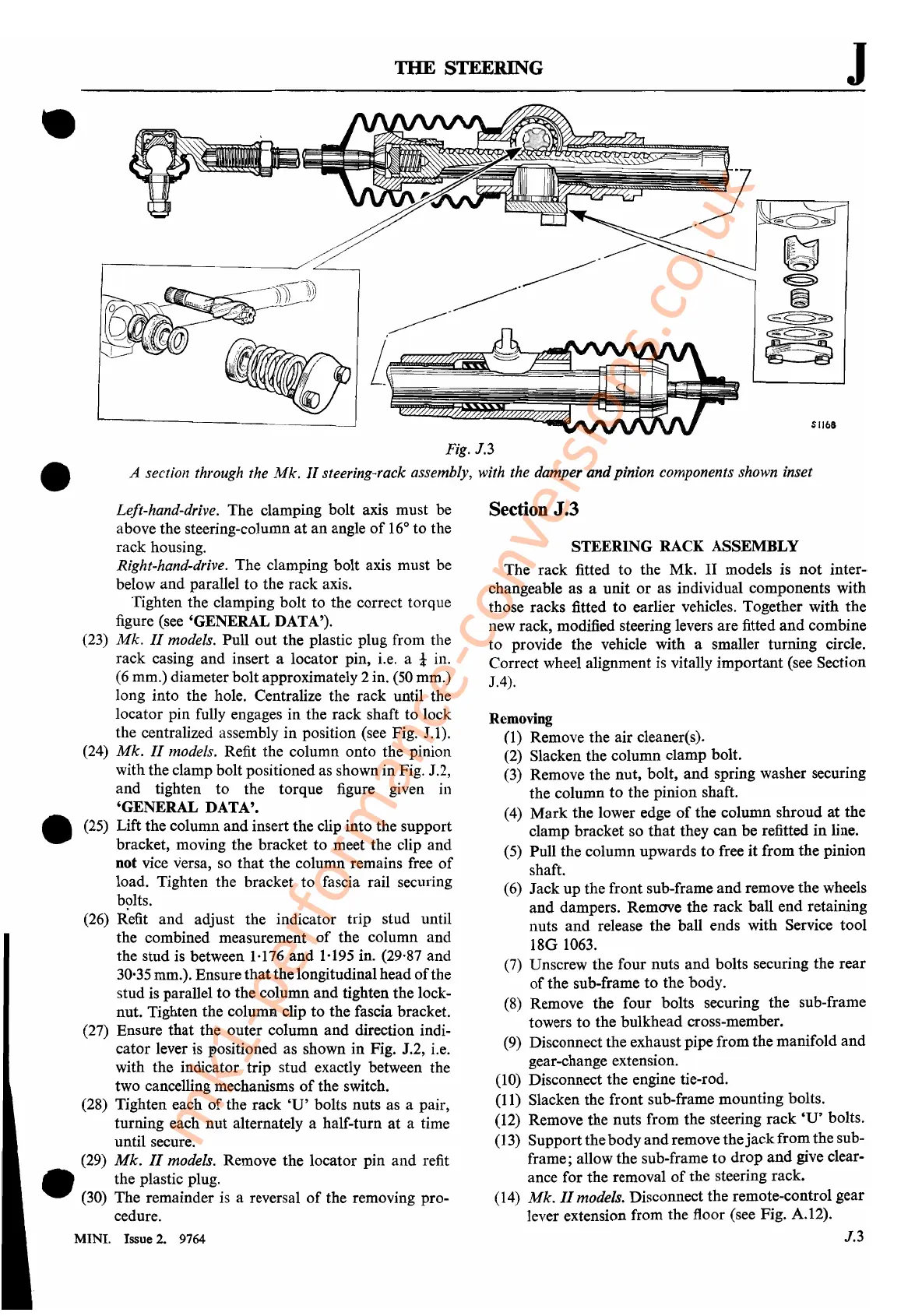
Fig. J.3
• A section through the
Mk.
11
steering-rack assembly, with the damper
and
pinion components shown inset
J
Left-hand-drive. The clamping bolt axis must be
above the steering-column
at
an angle
of
16°
to the
rack housing.
Right-hand-drive. The clamping bolt axis must be
below and parallel to the rack axis.
Tighten the clamping bolt to the correct torque
figure (see 'GENERAL DATA').
(23)
Mk.
11
models. Pull out the plastic plug from the
rack casing and insert a locator pin, i.e. a
-!
in.
(6
mm.) diameter bolt approximately 2 in.
(50
mm.)
long into the hole. Centralize the rack until the
locator pin fully engages in the rack shaft to lock
the centralized assembly in position (see Fig. J.l).
(24)
Mk.
11
models. Refit the column onto the pinion
with the clamp bolt positioned as shown in Fig. J.2,
and tighten to the torque figure given
in
'GENERAL DATA'.
•
(25)
Lift the column and insert the clip into the support
bracket, moving the bracket to meet the clip and
not vice versa, so that the column remains free
of
load. Tighten the bracket to fascia rail securing
bolts.
(26)
Refit and adjust the indicator trip stud until
the combined measurement
of
the column and
the stud is between 1·176 and 1·195 in. (29·87 and
30·35
mm.). Ensure thatthelongitudinal head
ofthe
stud is parallel to the column and tighten the lock-
nut. Tighten the column clip to the fascia bracket.
(27)
Ensure that the outer column and direction indi-
cator lever
is
19ositioned as shown in Fig. J.2, i.e.
with the indicator trip stud exactly between the
two cancelling mechanisms
of
the switch.
(28) Tighten each
of
the rack
'U'
bolts nuts as a pair,
turning each nut alternately a half-turn
at
a time
until secure.
(29)
Mk.
11
models. Remove the locator pin and refit
•
the plastic plug.
(30)
The remainder
is
a reversal
of
the removing pro-
cedure.
MINI. Issue 2. 9764
Section
J.3
STEERING RACK ASSEMBLY
The rack fitted to the Mk. II models is
not
inter-
changeable as a unit
or
as individual components with
those racks fitted
to
earlier vehicles. Together with the
new rack, modified steering levers are fitted
and
combine
to provide the vehicle with a smaller turning circle.
Correct wheel alignment
is
vitally important (see Section
J.4).
Removing
(1) Remove the air cleaner(s).
(2)
Slacken the column clamp bolt.
(3)
Remove the nut, bolt, and spring washer securing
the column
to
the pinion shaft.
(4)
Mark
the lower edge
of
the column shroud
at
the
clamp bracket so
that
they can be refitted
in
line.
(5)
Pull the column upwards to free it from the pinion
shaft.
(6)
Jack up the front sub-frame and remove the wheels
and dampers. Remove the rack ball end retaining
nuts and release the ball ends with Service tool
18G
1063.
(7)
Unscrew the four nuts and bolts securing the rear
of
the sub-frame to the body.
(8)
Remove the four bolts securing the sub-frame
towers to the bulkhead cross-member.
(9)
Disconnect the exhaust pipe from the manifold and
gear-change extension.
(10)
Disconnect the engine tie-rod.
(11)
Slacken the front sub-frame mounting bolts.
(12)
Remove the nuts from the steering rack
'U'
bolts.
(13) Supportthe bodyand remove the
jack
from the sub-
frame; allow the sub-frame to drop
and
give clear-
ance for the removal
of
the steering rack.
(14)
Mk.
11
models. Disconnect the remote-control gear
lever extension from the floor (see Fig. A.12).
J.3
mk1-performance-conversions.co.uk



 To Next Page