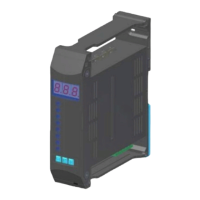
IS3W/MTC Sensor Features
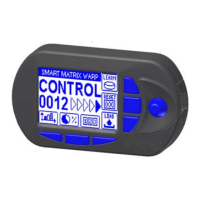
SMART MATRIX MTC 3 - 8
Preliminary Instructions for the Correct Use of IS3W/MTC Sensors
After having completed the installation of the whole system, it is necessary to proceed with the initial setup of
the system itself. To do this, operate as follows.
1) Check all the electrical connections (see chapter 1).
2) Supply the system and check that all the IS3W/MTC sensors haw the red led on.
3) Number theSM-DIN/MTC Boards, the IS3W/MTC sensors and the DAC devices.
4) Configure the parameters related to the machine characteristics, sensor detection characteristics and
sensors operating modes (SETUP).
5) Create an article with the desired measurement/control parameters (STYLE EDIT)
6) Load the created article (STYLE LOAD) and check, using the GRAPHICS function, that the system
properly performs the meter count feature and signals the error condition in case of yarn
breakage/missing (if the BROKE DETECTION function is enabled)
LDRUM Setup Procedure
The following is a suggested procedure to setup the LDRUM parameter for an individual machine position;
However it is convenient to carry out the same procedure simultaneously on more positions in order to obtain
an average value.
1) Program the desired sensor with a LDRUM value equal to 1000; in this way the sensor will increment the
counter by 1 unit upon each stroke.
2) Program the TARGET value of the sensor with a very large number, in order to prevent the sensor from
stopping the machine because of TARGET reached.
3) Reset the sensor’s stroke counter using the “Touch Light” and confirm that the counter is actually set to
zero, by reading the value on SMART MATRIX MTC terminal (GRAPHICS function).
4) Weigh each cone and take note of the values; we will call these measurements: T
1
, T
2
,… T
N
.
5) Produce one or more bobbins with the desired diameter.
6) For each bobbin produced, read the sensor’s counter value; we will call these measurement CNT
1
,
CNT
2
, … CNT
N
7) Weigh the bobbins produced using a precision scale; we will call these measurement M
1
, M
2
, … M
N
8) Obtain the weight of yarn using the following formula; we will call the obtained values P
1
, P
2
, … P
N
Pi = Mi - Ti
9) Through the values P
1
, P
2
, … P
N
and knowing the type and title of the yarn, it is possible to calculate the
number of meters collected on the bobbin. We will call these values Meters_Weight
1
, Meters_Weight
2
,
Meters_Weight
N
10) Using the following formula we will obtain the value to be set as LDRUM:
LDRUM
i
=
1000* Meters-Weight
i
CNT
i



 To Next Page