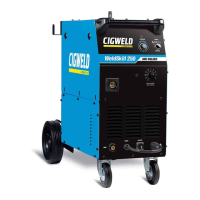
TROUBLESHOOTING WELDSKILL 250, 350
Manual 0-5186 6-11
Troubleshooting
5. Motor drive
To determine wirespeed, a voltage is derived from the +15V rail through R65 to be supplied into the wirespeed
potentiometer. Established by the front panel mounted wirespeed potentiometer, R63, R64, a voltage set point
is fed to U5 pin 12.
Motor voltage is fed also into U5 pin 12, but as a negative voltage. U5D is set up as an error amplifier with its
gain determined by R61 & R62, so the output of U5 pin 14 will be the difference between the demand signal
from the front panel potentiometer & the motor voltage.
The motor power comes from the auxiliary transformer 30VAC winding into connector CN5. Diodes D22 &
D23 rectify this and feed it to Q9 through R47. Q9 turns off whenever the 30VAC is above 14V. Q9 is the zero
crossing detector for the phase angle control amplifier U5C. When Q9 is on, C33 is shorted and U5 pin 9 is
high. When Q9 turns off, C33 charges down through R56. When the voltage on U5 pin 9 equals the voltage on
pin 10, pin 8 changes state, providing gate current to the scr’s U3 & U4.
Scr’s U3 & U4, along with diodes D15 & D16 form a full wave bridge, with 30VAC from the auxiliary transformer
as its input. The motor is connected to the output of this bridge, so the phase angle control of U3 & U4 will
cause variation in the motor voltage, and hence the motor speed.
6. Spot timer
When SPOT MODE is selected on the front panel, CN6 terminals 3 & 4 are connected. Upon trigger, capacitor
C24 charges through R31, D18, R52, R30 and the spot time potentiometer on the internal panel. When C24
charges to above the voltage on U5 pin 5, the output of U5B changes state turning off Q7 and disabling the
motor drive and the contactor & solenoid.
R46 and D21 cause U5 pin 5 to be pulled high, effectively disabling the spot timer, until the trigger is released
and the op amp U5B is reset.
The SPOT potentiometer determines the charging rate for C24, thus establishing the SPOT TIME.
7. Burnback
When the torch trigger is closed, transistor Q3 which charges C6. When the torch trigger is opened, U1 pin 3
remains on as C6 discharges through the internal panel BURNBACK potentiometer. The rate of discharge of C6
through the burnback potentiometer will determine the duration U1A will remain on, and therefore how long
the contactor & solenoid will remain on after the trigger is released.
8. Brake
When the torch trigger is pressed op amp U5 pin 1 output will be high. The base of Q10 will be high & Q10
will be off.
When the torch trigger is opened, opamp U5 pin 1 output goes low, charging C30, and as the voltage across
C30 goes above 15V, Q10 will start to turn on. As Q10 turns on, it will trigger scr U6 through R69.
The scr U6 is connected across the motor, so the motor will be shorted when U6 is turned on, causing the
motor to brake rapidly. R70 provides a path for stray leakage gate current of U6 to prevent false turn on of the
brake scr U6.
Diode D26 provides a rapid discharge of C30 to ensure the motor scr’s & brake scr’s are never both on at the
same time.
9. Thermostats
Thermostats are connected in series to CN2 the over temperature LED is connected to CN4, terminals 3 & 4.
The thermostats are normally closed types.
When both thermostats connected to CN2 are closed, Q4 is turned on by R1, D1 and R9. R10 provides a path
for base leakage current of Q4. With Q4 turned on, U1 pin 2 will be low, ready for normal operation.
If either thermostat is opened, Q4 will turn off, causing the voltage on U1 pin 2 to rise, turning the contactor
& solenoid off. The base of Q6 will go high through R16 & R18, which are no longer held low by D10 & Q4.
Q6 will turn on, causing the over temperature LED to turn on.



 To Next Page