Troubleshooting
6-16 Manual 0-5186
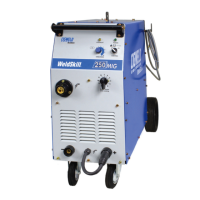
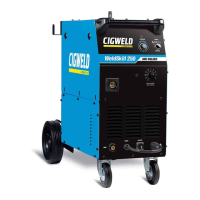
WELDSKILL 250, 350 TROUBLESHOOTING
5 Power Source Faults
The following table is a guide for analysing problems and making repairs to the Power Source.
Fault Possible Cause Remedy
1 The wirefeed motor
and the contactor do
not operate when the
torch trigger switch is
depressed.
A Control fuse or circuit breaker is
open circuit or the wires to the fuse
holder are broken.
A Replace the fuse or repair
the fuse holder wires.
B The primary winding in the auxiliary
transformer is open circuit or the
wires to the primary winding are
broken.
B Replace the auxiliary
transformer or repair the
wires to it.
C The STANDBY SWITCH is in the
STANDBY position.
C Switch to ON.
2 Control fuse or circuit
breaker ruptures on an
intermittent basis.
An extension lead is being used
which decreases the Mains supply
voltage to the Power Source. Thus
the control fuse or circuit breaker
has to carry a higher current.
Remove the extension lead
& plug the welder’s Mains
supply lead directly into the
Mains outlet.
3 The contactor operates
when the torch trigger
switch is depressed but
a welding arc can not be
estab lished.
A The contactor contacts are burnt
and are not making a good
electrical contact.
A Measure the voltage drop
across all contactor contacts
while the Power source is
supplying welding current to
a load bank. If the measured
voltage is greater than 100mV
then replace the contactor.
B The Coarse or Fine switch contacts
are burnt and are not making a
good electrical contact.
B Measure the voltage drop
across all closed contacts
while the Power source is
supplying welding current to
a load bank. If the measured
voltage is greater than 100mV
then replace the defective
switch.
C Bad electrical connection(s)
between the Mains supply voltage
wires and the primary side of the
main transformer.
C Repair the broken wire(s) or
termination point(s) after the
fault has been isolated.
D Bad electrical connection(s)
between the primary side of the
main transformer taps and the
Coarse or Fine switches.
D Repair the broken wire(s) or
termination point(s) after the
fault has been isolated.



 To Next Page