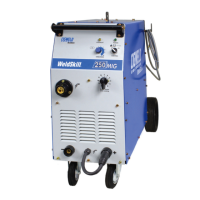
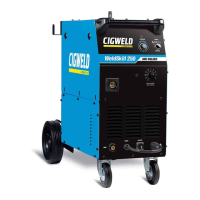
TROUBLESHOOTING WELDSKILL 250, 350
Manual 0-5186 6-17
Troubleshooting
4 A welding arc can be
established but the welding
current diminishes.
Higher Coarse/Fine switch
positions must be set to
obtain the same welding
conditions.
A Bad electrical connection(s)
between the secondary side of the
main transformer and the rectifier.
A Repair the termination
point(s) after the fault has
been isolated.
B Bad electrical connection(s)
between the secondary rectifier
and the positive or negative
welding terminals.
B Repair the termination
point(s) after the fault has
been isolated.
C Poor electrical contact between
the work clamp & the work piece.
C Repair or replace work
clamp. Clean the work piece
around the work clamp area
to ensure a good electrical
connection.
5 A welding arc can be
established but the
excessive welding spatter
is produced for control
setting that normally
produce minimal spatter.
A The inductor windings have
overheated or short circuited due
to:
i) Fan failure,
ii) Blockage of the front air vents,
iii) Duty cycle has been exceeded
for prolonged periods.
A Examine the inductor
winding for burn marks
or discolouration due to
excessive heat.
Replace the inductor if its
windings have short circuited.
B The output capacitors (ie.
22000uF) are not connected to
the DC terminals of the secondary
rectifier.
B Repair the termination
point(s) between the
capacitors and the DC
terminals of the secondary
rectifier.
C The output capacitors are open
circuit.
C Replace all the capacitors if:
i) The rubber safety valve
has ruptured,
ii) The plastic around the
capacitor terminals has
melted.
6 A large arc occurs when
the electrode wire touches
the work piece 20 seconds
after a weld has been
completed.
A Resistor R3 (15 ohm 50W) is
open circuit or it has bad electrical
connections.
A Replace R3 if it is open circuit
or repair the termination
point(s) after the fault has
been isolated
B The normally closed contacts in
the contactor KM are open when
the contactor is de-energised.
B Replace the contactor
KM if its contacts are not
normally closed when it is
de-energised.
Table 6 -17 Power Source Faults



 To Next Page