28 | CMCPRO.COM
| CAPTO USER MANUAL 29
EN
WARNING
Activities involving the use of this
equipment are inherently dangerous. You
are responsible for your own actions and
decisions. Before using this equipment,
you must:
• Read and understand the user
instructions, labels, and warnings.
• Familiarize yourself with its capabilities
and limitations.
• Obtain specic training in its proper use.
• Understand and accept the risks
involved.
FAILURE TO HEED ANY OF THESE
WARNINGS MAY RESULT IN SEVERE
INJURY OR DEATH.
For information on device performance
when using other life safety ropes, please
contact CMC or refer to CAPTO technical
section at cmcpro.com.
1. TRACEABILITY &
MARKINGS
(A) Product Name (B) Rope Path Diagram
(C) Double Action Opening (D) Incorrect
Rope Path (E) Rope Diameter & Anchor/
Load Side (F) Special Notice or Caution
(G) Pulley Loading/Running Direction
(H) USA Made (I) Mark and Information
of NFPA certication body (J) Standard
Markings (K) CE mark and Number
of the Body Controlling Production of
this Personal Protective Equipment (L)
Manufacturer & Contact Information (M)
Model Identication: 336011 (N) Individual
Number (O) Pulley Strength (P) Carefully
Read the Instructions for Use:
2. FIELD OF APPLICATION
Introduction
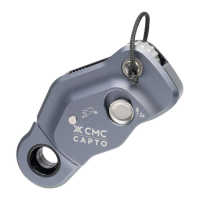
CAPTO is an intuitive device that reduces
the time and equipment required for
hauling, ascending, and related tasks.
Featuring an integrated rope grab, pulley,
and becket, CAPTO allows rapid rigging
of mechanical advantage systems without
the need to use prusiks or attach multiple
components.
CAPTO’s innovative V-groove Cam
is intended to hold a rescue load
without damaging the rope. Unlike toothed
devices, the V-groove Cam is designed to
dissipate energy in overload situations by
slipping on the rope. Visit CMC’s website
for data on CAPTO slip performance
across a range of industry ropes in
multiple hauling congurations.
The V-groove Cam installs quickly and
easily on tensioned and un-tensioned
lines. It smoothly releases, even after
a slip event, running up the rope with
minimal friction and engaging again with
ease. An accessory loop can be installed
in CAPTO’s hollow Cam axle to allow
remote resets of mechanical advantage
systems and ergonomic stowage on a
harness or gear rack.
Built into CAPTO chassis is a high-ef-
ciency needle roller bearing pulley with
an integrated becket. Both the Cam and
pulley are immediately accessible when
the Sideplate is open, making it possible
to rig 3:1 haul systems in a single motion.
Rope can be installed and removed
without detaching from the becket. As
an independent attachment point, the
becket is ideal for connecting mechanical
advantage components or personal ascent
equipment such as lanyards, retention
systems, etriers, and foot loops.
Applications
CAPTO shall not be used outside of its
limitations, or for any purpose other than
that for which it is intended.
This equipment is personal protective
equipment (PPE) used for fall prevention
during work and rescue. This product
meets the requirements of regulation (EU)
2016/425 on personal protective equip
-
ment only when used as a Type B rope
adjustment device (EN12841), as a rope
grab/ascender (EN567 & NFPA 2500), and
as pulley (EN 12278 & NFPA 2500).
When used as rope adjustment device in
rope access systems (EN 12841/B), the
device acts as a working line ascender
and can be used for work positioning
in rope access systems and for travel
restriction (restraint). When used as rope
clamp (EN 567 & NFPA 2500), the device
will grab under load in one direction and
move freely in the opposite direction
when attached to a rope of an appropriate
diameter.
When used as a pulley (EN12278 &
NFPA 2500) the device can be used to
link a rope (in accordance with EN 892
and EN 1891) or an accessory cord (in
accordance with EN 564) to a connector
(in accordance with EN 12275) to reduce
the friction while the rope or accessory
cord is moving under load.
The EU declaration of conformity is
available at cmcpro.com.
Standards & Certications
1
Pulley strength testing performed by
using the CAPTO becket as Pulley
Attachment Point
Responsibility
These instructions explain the correct use
of your equipment. The warning symbols
inform you of some potential dangers
related to the use of your equipment, but
it is impossible to describe them all. You
are responsible heeding each warning
and using your equipment correctly.
Any misuse of this equipment will create
additional dangers. This product shall only
be used by a person that is trained and
competent in its safe use.
Contact CMC if you have any questions or
difculty understanding these instructions.
Check cmcpro.com for updates and
additional information.
User Information shall be provided to
the user of the product. NFPA 1983,
incorporated into the 2022 edition of NFPA
2500 recommends separating the User
Information from the equipment and retain-
ing the information in a permanent record.
The standard also recommends making a
copy of the User Information to keep with
the equipment and that the information
should be referred to before and after each
use. Additional information regarding life
safety equipment can be found in NFPA
1500, and NFPA 1858 and NFPA 1983,
incorporated in the 2022 edition of NFPA
2500. This document must be provided to
the user by the retailer in the respective
country’s language and must be kept with
the equipment while it is in use. Observe
relevant national regulations.
Before using this equipment, you must
have a rescue plan in place to deal with
any emergencies that could arise and be
medically t and capable of controlling
your own security and emergency
situations. Check equipment before and
after use. No alterations or additions to
the equipment shall be made without the
manufacturer’s written consent. The user
must ensure that, in the event of falling
into the PPE system, rescue can take
place immediately, effectively, and safely.
Motionless suspension in a harness may
cause severe injury or death.
While the CAPTO is intended to slip in
overload situations, unforeseen or untest-
ed scenarios, environmental conditions,
or other factors could prevent slippage. In
these cases the total applied loads should
not exceed 2500 lbf (11kN) to prevent
damage to the CAPTO, rope or other
system components. CMC recommends
the use of an Enforcer Load Cell or other
load-sensing device in training scenarios
to better understand these limits.
3. NOMENCLATURE
(A) Moving Sideplate (B) Sideplate
Release Button (C) Sideplate Latch (D)
Cam (E) Cam Grip (F) Rear Rope Guide
(G) Front Rope Guide (H) Pulley (I)
Becket (J) Accessory Loop Attachment (K)
Anchor/Load End
4. INSPECTION, POINTS TO
VERIFY
Inspection
User safety depends on equipment
integrity. Equipment should be thoroughly
inspected prior to being placed into
service and before and after each use. In
addition, a detailed periodic inspection, by
a competent person, is required at least
every 12 months (depending on current
regulations, and conditions of use). Follow
the inspection procedures available
at cmcpro.com. Record and store the
results of the inspection in the Inspection
Checklist. If the equipment fails inspection,
it should be withdrawn from service and
marked accordingly or destroyed to
prevent further use.
Before & After Each Use
Perform the checks listed below to ensure
that the equipment is in serviceable
condition and operates normally before
it is used:
• Conrm the device is functioning
properly.
• Verify the presence and legibility of the
product markings.
• Verify there is no excessive wear or
indications of damage such as deforma-
tion, corrosion, sharp edges, cracks, or
burrs. Minor nicks or sharp spots may
be smoothed with emery cloth.
• Check for the presence of dirt or foreign
objects that can affect or prevent normal
operation such as grit, sand, rocks,
and debris.
• Check the Side Plate for deformation or
excessive play.
• Check the movement of the Cam and
the effectiveness of its spring.
• Check the Cam grooves for excessive
wear.
• Conrm the pulley is functional and
freely rotates around its axis.
During Use
• Conrm all pieces of equipment are
correctly positioned with respect to
each other.
• Monitor the condition of the device and
its connections to other equipment in
the system.
• Do not allow anything to interfere
with the operation of the device or its
components.
• Keep foreign objects out of the device.
• Evaluate environmental conditions.
Damp or icy environments can alter
equipment behavior. Performance can
vary depending on the state of the rope
(age, wear, mud, moisture, ice).
• Reduce the risk of shock load by
minimizing slack between the device
and the load/anchor.
Retirement
CMC does not specify an expiration
date for hardware because the service
life depends greatly on how and where
it is used. The type of use, intensity of
use, and environment of use are all
factors in determining serviceability of the
equipment. A single exceptional event
can be cause for retirement after only one
use, such as exposure to sharp edges,
extreme temperatures, chemicals, or harsh
environments.
A product must be withdrawn from service
immediately when:
• It fails to pass inspection.
• It fails to function properly.
• It has illegible product markings.
• It shows signs of damage or
excessive wear.
• It has been subjected to a major
event such as shock loads, falls, or
abnormal use.
• It has been exposed to harsh chemical
reagents.
• It has an unknown usage history.
• You have any doubt as to its condition
or reliability.
• When it becomes obsolete due to
changes in legislation, standards,
technique or incompatibility with other
equipment.
Withdrawn equipment shall not be used
again until conrmed in writing by a com-
petent person that it is acceptable to do
so. If the product shall be retired, remove
it from service and mark it accordingly or
destroy it to prevent further use.
Carrying, Storage, and Transport


 To Next Page
 Loading...