30 | CMCPRO.COM
| CAPTO USER MANUAL 31
A safety line with a (EN12841 Type A)
backup device should be used for optimum
safety of the user.
To install CAPTO on the working line, refer
to the previous Installation & Removal
section. When using CAPTO as an ascent
device, attach a lanyard into the CAPTO
becket using a compatible connector. At-
tach additional personal ascent equipment
as needed such as a foot loop or etrier.
Function test CAPTO to conrm that the
rope is correctly installed and the device
is working properly. Always use a backup
safety system when performing this test.
To remove CAPTO, refer to the previous
Installation & Removal section. Use of a
lanyard attached to the CAPTO becket
creates a retention system to prevent
dropping the device. The technique
for stowing CAPTO on a harness gear
loop may differ depending on the type
of connector being used. The width of
the CAPTO becket may prevent it from
rotating around the spine of D-shaped
carabiners. In most cases, the becket can
pass over the carabiner gate to hang nat-
urally when clipped to a gear loop. If using
a carabiner with an especially large gate,
such as an ANSI-compliant connector, it
is recommended to use an oval carabiner
to allow becket rotation along the spine. In
this case, it is also best to clip into CAPTO
rst before attaching additional equipment
such as a lanyard and/or foot loop.
To move CAPTO toward the anchor
during personal ascent, push / pull the
device to slide it along the working line.
To make upward progress, use CAPTO in
conjunction with a PCD, such as a chest
ascender or self-braking descender. Take
extra caution when approaching knots,
anchors, or intermediate anchors. Keep
the device at or above the user connection
point to eliminate the potential for falls with
a fall factor greater than 1.
To release the Cam for the purposes of
descending a line, begin by removing any
load acting on the pulley and becket. Push
CAPTO a few centimeters toward the
anchor/load to disengage the Cam. Use a
thumb on the Cam Grip features to rotate
the Cam away from the rope as shown in
the illustrations. Slide CAPTO along the
line while holding the Cam open. Remove
the thumb to allow the Cam to re-engage
where desired on the rope.
WARNING: Do not attempt to release
the Cam while the device is under load.
CAPTO will not grab rope when the Cam
is manually held open.
Use in a RAD System
CAPTO can be used in combination with
a self-braking descender to build a Rapid
Ascent/Descent (RAD) System. A RAD
System adds mechanical advantage and
is recommended for ascents involving
heavier loads, signicant tail weight, or
short climbs requiring efcient transitions
between ascent and descent.
To build a RAD System, begin by
installing and function testing the chosen
self-braking descender. Open CAPTO
Sideplate and place it on the working line
between the descender and anchor. Pass
the rope tail from the descender around
the CAPTO pulley in accordance with
the laser markings. This creates a 3:1
mechanical advantage when operated
by the climber.
Close CAPTO Sideplate and function test
the device. Attach additional equipment to
the CAPTO becket as needed, such as a
lanyard and foot loop. Progress upwards
by pushing CAPTO toward the anchor
then stepping up in the foot loop while
pulling down on the rope tail exiting the
CAPTO pulley.
Descent can be accomplished by
down-climbing with CAPTO as previously
described or by removing CAPTO from the
working line and operating the self-braking
descender.
Always use a set of two ropes, main and
back-up, when ascending and descending
on rope systems. This device is only
intended to be used as a means of
progression on a rope and is not intended
to function in a fall arrest system.
Use as a Pulley
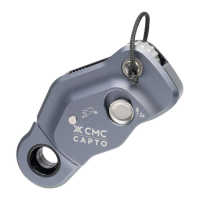
The primary function of the CAPTO pulley
is to aid in building mechanical advantage
systems. It can also be used as a stand-
alone pulley by using the CAPTO becket
as the pulley attachment point. Refer
to the associated illustration for pulley
attachment method and orientation.
The CAPTO pulley is strength rated only
when the becket is used as the pulley
attachment point. If CAPTO rope grab
is used as the attachment point rather
than the becket, then the stated pulley
MBS does not apply. Additionally, this
conguration limits the amount of force
that can be applied to the pulley because
CAPTO rope grab is designed to slip on
rope when overloaded (for example when
more than 4 kN is applied to the pulley or
becket). For safe operation of CAPTO and
its components, do not block the rope grab
with a stopper knot or otherwise prevent
the device from slipping on rope.
Accessory Loop Attachment
CAPTO has a hollow Cam axle (4 mm
diameter) that allows for the attachment
of an accessory cord loop or soft shackle.
The accessory loop can be used to attach
connectors for resetting mechanical
advantage systems or for stowing CAPTO
on a harness, gear loop, or equipment
rack. It should not be considered a
life-supporting or load bearing / rated
attachment point.
It is important to keep the length of the
accessory loop sufciently small so that it
cannot pass behind the Cam and cause
the Cam to be held open. Monitor the
accessory loop when in use to make sure
it does not get pulled into the Cam. An
accessory loop of any size could interfere
with the function of the Cam or Sideplate.
Do not close the Sideplate with the acces-
sory loop inside. Attach an accessory loop
at your own risk.
7. EQUIPMENT RECORDS
Record the results of your detailed peri-
odic inspection using the PPE inspection
procedures and forms available at cmcpro.
com or the sample table provided in this
section. Relevant information includes:
type, model, manufacturer contact info,
serial number or individual number,
problems, comments, inspector’s name
and signature, and key dates including
manufacture, purchase, rst use, and
next periodic inspection. If equipment
fails inspection, it should be withdrawn
from service and marked accordingly or
destroyed to prevent further use.
8. ADDITIONAL INFORMATION
Declaration of Conformity
CMC Rescue, Inc. declares that this
article is in conformity with the essential
requirements and the relevant provisions
of EU regulations. The original Declaration
of Conformity can be downloaded at the
following website: cmcpro.com.
AR
تحذير
الأنشطة التي تنطوي على
استخدام هذه المعدات خطرة
بطبيعتها. أنت مسؤول عن
تصرفاتك وقراراتك. قبل
استخدام هذه المعدات، يجب عليك:
اقرأ تعليمات المستخدم
والملصقات والتحذيرات وافهمها.
تعرّف على إمكانياته وحدوده.
الحصول على تدريب محدد على
الاستخدام السليم لها.
افهم المخاطر التي ينطوي عليها
الأمر وتقبلها.
قد يؤدي عدم الانتباه إلى أي من
هذه التحذيرات إلى إصابة خطيرة
أو الوفاة.
للحصول على معلومات حول
أداء الجهاز عند استخدام حبال
سلامة الحياة الأخرى، يرجى
الاتصال بـ CMC أو الرجوع إلى
القسم التقني لـ CAPTO على
cmcpro.com.
1. التتبع والعلامات
(أ) اسم المنتج (ب) رسم
تخطيطي لمسار الحبل (ج) فتحة
العمل المزدوج (د) مسار الحبل
غير الصحيح (هـ) قطر الحبل
وجانب المرساة/الحمل (و) إشعار
أو تحذير خاص (ز) اتجاه تحميل/
اتجاه البكرة (ح) صنع الولايات
المتحدة الأمريكية (ط) علامة
ومعلومات هيئة اعتماد NFPA
(ي) العلامات القياسية (ك)
علامة CE ورقم الهيئة التي
تتحكم في إنتاج معدات الحماية
الشخصية هذه (ل) الشركة
المصنعة ومعلومات الاتصال (م)
تعريف الطراز: 336011 (N) الرقم
الفردي (O) قوة البكرة (P) قراءة
تعليمات الاستخدام بعناية:
2. مجال التطبيق
مقدمة
CAPTO هو جهاز بديهي يقلل من
الوقت والمعدات اللازمة للسحب
والصعود والمهام ذات الصلة.
يتيح جهاز CAPTO، الذي يتميز
بممسك حبل مدمج وبكرة وبكرة
وبيت دعامة مدمجين، إمكانية
التجهيز السريع لأنظمة المزايا
الميكانيكية دون الحاجة إلى
استخدام البروسيك أو توصيل
مكونات متعددة.
تهدف كاميرا كابو المبتكرة
ذات الأخدود على شكل حرف V إلى
حمل حمولة الإنقاذ دون الإضرار
بالحبل. على عكس الأجهزة
المسننة، صُممت كاميرا الأخدود
على شكل V لتبديد الطاقة
في حالات التحميل الزائد عن
طريق الانزلاق على الحبل. قم
بزيارة موقع CMC على الويب
الخاص بشركة CMC للحصول
على بيانات عن أداء انزلاق
كاميرا CAPTO عبر مجموعة من
حبال الصناعة في تكوينات
سحب متعددة.
يتم تثبيت كاميرا الأخدود
على شكل حرف V بسرعة
وسهولة على الخطوط المشدودة
وغير المشدودة. يتم تحريرها
بسلاسة، حتى بعد حدوث انزلاق،
حيث يتم تشغيل الحبل بأقل
قدر من الاحتكاك والتعشيق
مرة أخرى بسهولة. يمكن
تثبيت حلقة ملحقة في محور
كاميرا CAPTO المجوف للسماح
بإعادة ضبط أنظمة المزايا
الميكانيكية عن بُعد والتخزين
المريح على حزام أو رف تروس.
مدمج في هيكل CAPTO بكرة
ذات بكرة ذات بكرة ذات بكرة
إبرة عالية الكفاءة مع بكرة
مدمجة. يمكن الوصول إلى كل
من الكامة والبكرة على الفور
عندما تكون اللوحة الجانبية
مفتوحة، مما يجعل من الممكن
تجهيز أنظمة السحب 3:1 بحركة
واحدة. يمكن تركيب الحبل
وإزالته دون فصله عن البكرة.
وباعتبارها نقطة ربط مستقلة،
تُعد البيكيت مثالية لتوصيل
مكونات الميزة الميكانيكية
أو معدات الصعود الشخصية
مثل الحبال وأنظمة التثبيت
والإيثرات وحلقات القدم.
التطبيقات
لا يجوز استخدام CAPTO خارج
حدوده، أو لأي غرض آخر غير الغرض
المخصص له.
هذه المعدات عبارة عن معدات
حماية شخصية (PPE) تستخدم
للوقاية من السقوط أثناء
العمل والإنقاذ. يفي هذا المنتج
بمتطلبات لائحة (الاتحاد
الأوروبي) 2016/425 بشأن معدات
الحماية الشخصية فقط عند
استخدامه كجهاز ضبط الحبل
من النوع B (EN12841)، وكجهاز
إمساك/جهاز رفع الحبل (EN567 و
NFPA 2500)، وكبكرة (EN 12278 و
NFPA 2500).
عند استخدامه كجهاز ضبط الحبل
في أنظمة الوصول بالحبال
(EN 12841/B)، يعمل الجهاز
كجهاز صعود خط العمل ويمكن
استخدامه لتحديد موضع العمل
في أنظمة الوصول بالحبال
ولتقييد الحركة (التقييد). عند


 To Next Page
 Loading...