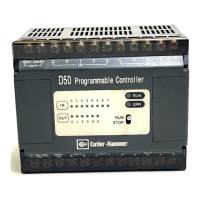
30 D50 PLC User's Manual
Terminology
This section introduces some terminology you should know.
1. Address (register)
Address refers to the location of memory being used. It can refer to the external input/output
module or internal memory. An address is categorized into 1 bit, 16 bit (word), or 32 bit
(double word).
2. Bit
A bit is the minimum unit required for calculation. It can be either On (1) or Off (0).
3. Byte
A byte is made up of 8 bits. It can hold data values from 0 to 255. In base 16, or hexadecimal,
a byte can be expressed as 0 to FF. You cannot have a value greater than 255 when using one
byte.
4. Word
A word is made of 16 bits. It can hold data values from 0 to 65,535. In base 16 a word can be
expressed as 0 to FFFF.
5. Double Word
A double word is made of 32 bits. It can hold data values from 0 to 4,294,976,295. In base 16
a double word can be expressed as 0 to FFFFFFFF. In the D50, a double word is made up of
two consecutive word addresses.
6. Scan Time
The CPU follows a procedure in which it 1) reads the inputs, 2) processes the ladder program,
and 3) updates the outputs. It continually repeats this process. This 3-step process is called a
“scan,” and the time it takes to complete this process is the “scan time.” In a typical PLC
application, most of the scan time is used to process the program. When programming, keep
in mind that the scan time will increase as you increase the number of inputs and outputs
and/or the size of the program.
7. Edge
An edge is defined as the point when an input changes state. For example, a rising edge
occurs during the very first scan after the input has changed from Off to On. A falling edge
occurs after the input has changed from On to Off.
8. Hex (Hexadecimal)
A hexadecimal number is a value expressed in Base 16. Base 16 values consist of digits from
0 to F. In a byte, word, or double word, each set of 4 bits corresponds to a single hex digit.
For example, the binary value 01001111 would correspond to the hex value 4F, and a decimal
value of 79. A hex value is designated by the use of the symbol “$” in front of the value (i.e.
$4F is the hex value 4F).
8. BCD (Binary Coded Decimal)
BCD is used to express a decimal digit (0 to 9) using 4 bits. Conversion of BCD values can be
done in hexadecimal calculations. For example, the BCD representation of decimal 27 would
be two sets of 4 bits: 0010 0111.
9. EEPROM
EEPROM is electronically erasable and programmable memory that retains its data even
through loss of power. The PLC program is stored in EEPROM and will be retained when
power is off.
Artisan Technology Group - Quality Instrumentation ... Guaranteed | (888) 88-SOURCE | www.artisantg.com


 To Next Page