Operation M7/M7L/M7LT Modular Satellite Modem
1-6 M7/M7L/M7LT - Rev. 0.05
Point-to-Point (PtP)
Point-to-Multipoint (PtMP)
Mesh
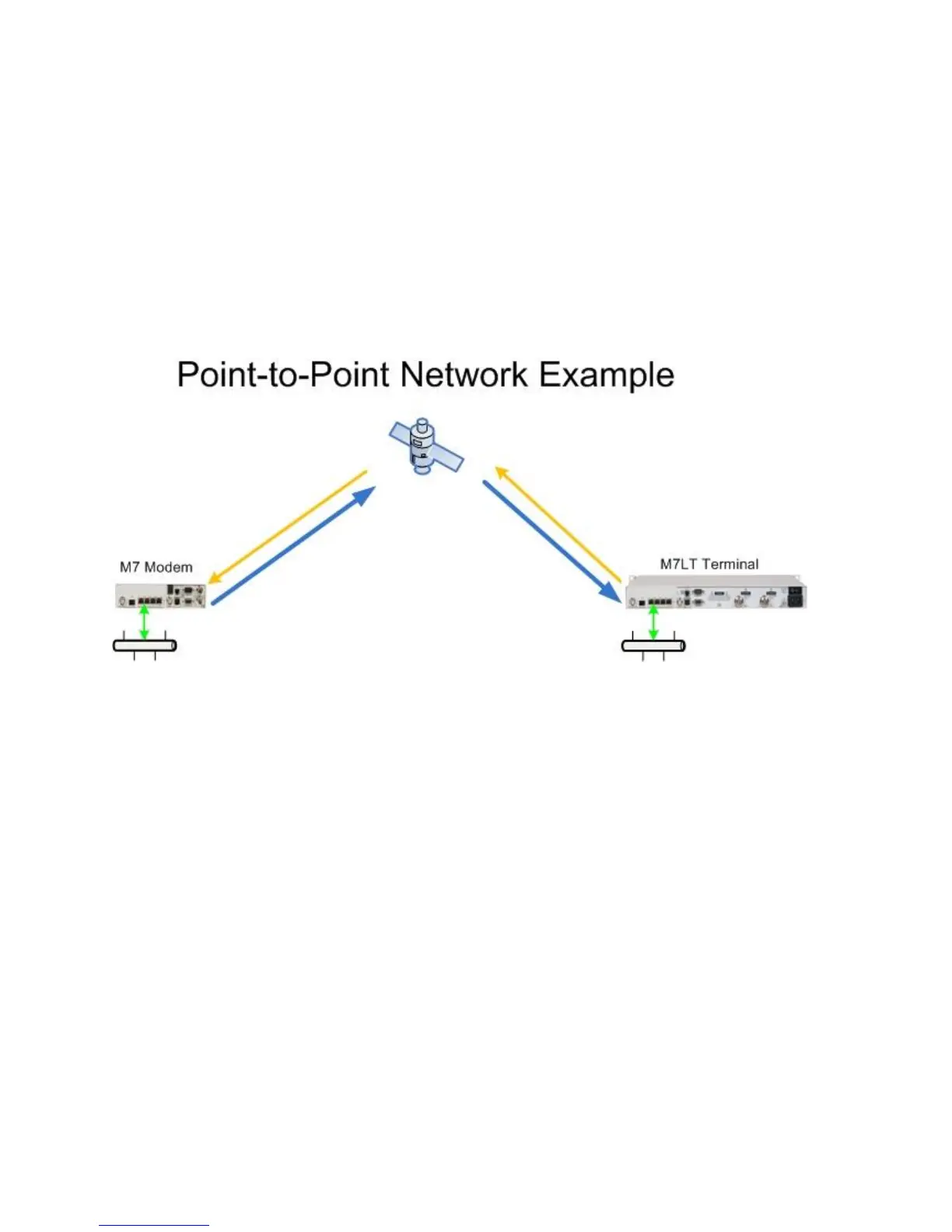
In a Point-to-Point network, the M7 provides the industry leading Eb/No performance and flexible
baseband interface options. This performance improvement and flexible interface support allows the
operator to update legacy networks without changing the teleport infrastructure. The additions of the
Ethernet/IP interfaces to the M7 provide the network operator with the latest technology needed to
extend cellular backhaul connectivity and Internet access to remote locations. When optioned with
the Ethernet/IP interfaces, Ethernet bridging and IP routing capabilities are internal to the M7 which
reduces the number of devices that need to be managed and maintained. A typical PtP network is
shown in Figure 1-2.
Figure 1-2 – Point-to-Point Network
Point-to-Multipoint networks are used to connect a central location to multiple remote locations. The
central location, the Hub, will output a continuous carrier that is received by all of the remote sites and
receive the individual carriers from each of the remote sites on individual demodulators. Within the
shared outbound carrier will be all of the information destined for each of the remote sites. At each of
the remote sites, the M7 with an Ethernet/IP interface will filter, or route, only the information that is to
be received by that site. There is considerable statistical bandwidth savings by using the shared
outbound carrier in an IP based network because of the typical traffic patterns consistent with IP
networks. A typical PtMP network is shown in Figure 1-3


 To Next Page