Operation M7/M7L/M7LT Modular Satellite Modem
1-16 M7/M7L/M7LT - Rev. 0.05
1.5.3.3. Express Ethernet Interface (E7)
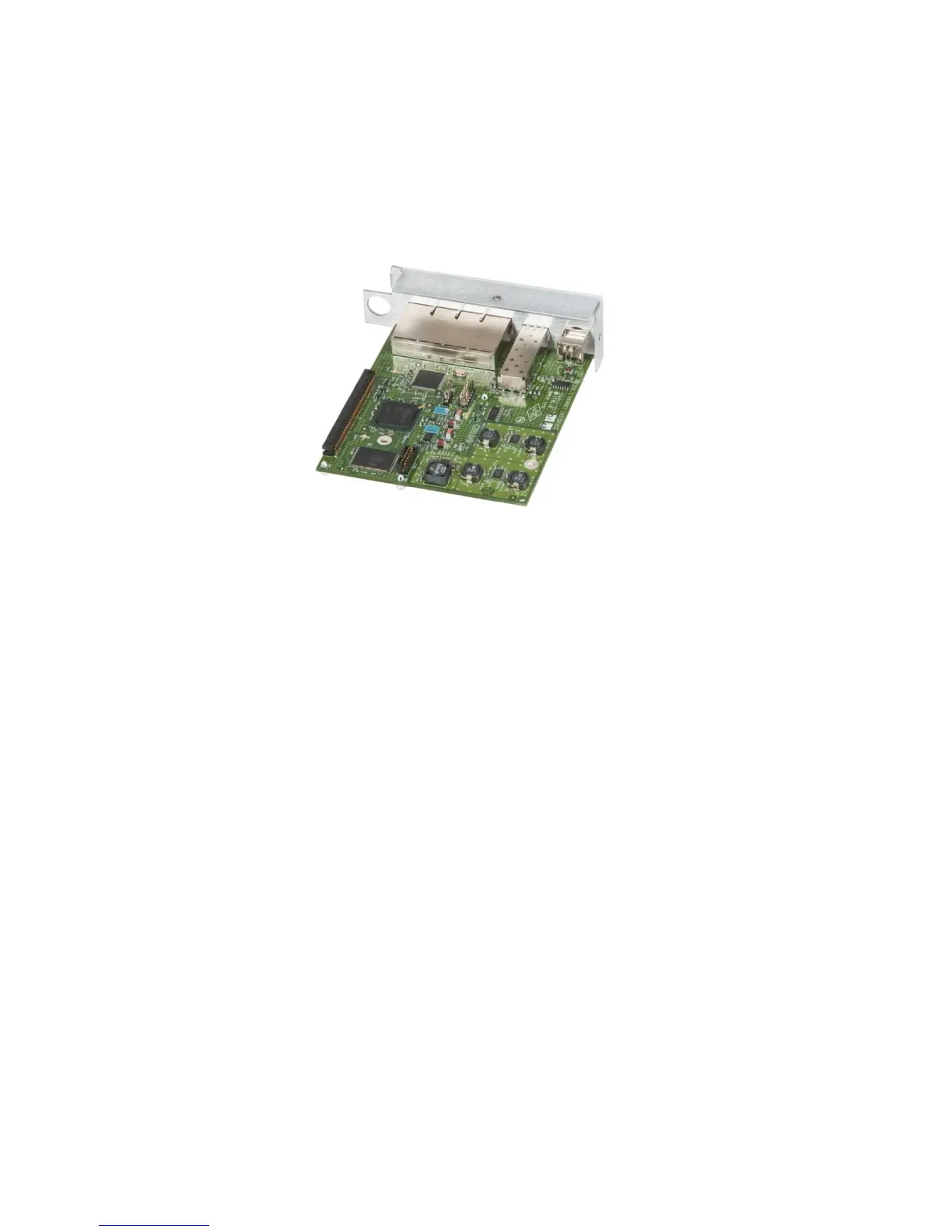
The Express Ethernet interface (E7) card is a layer 2 Gigabit Ethernet bridged interface. The E7
supports connections between GbE networks and the M7 satellite modem as part of point-to-point or
point-to-multipoint Ethernet data transfer. The E7 interface (Figure 1-13) includes 4
10/100/1000Base-T interface ports (RJ-45) and a single SFP port that can be used to support an
addition Ethernet port or an optic fiber connection.
Figure 1-13 – Express Ethernet Interface (E7)
Refer to Table 3-10 for front panel configuration and Section 3.8.2 for technical information on this
interface option.
1.5.3.4. Dual G.703/E1 Interface (G7)
Dual G.703/E1 Interface (Figure 1-14) is a legacy interface standard that is used in Telephony and
Cellular Backhaul applications. The installation of the G7 (Dual G.703/E1) interface provides the M7
modem with an economical access solution for E1 network services over satellite.
The two (2) E1 ports are independent of each other except that they both must be selected for
Balanced or Unbalanced operation. Each E1 port also operates independently on transmit and
receive sides of each port.
Typical use of the G7 interface is in a duplex point to point link with a similarly configured modem at
the other end of the link. The setup of the satellite link is very simple because the modems at both
ends of the link are connected to DTE equipment with this same G.703/E1 interface type. Each port
of the G7 interface can be configured independently for either Full E1.
The G7 fully meet all of the E1 rate 2048 kbit/s specifications including the ITU recommendations:
G.703 - Physical/electrical characteristics of hierarchical digital interfaces.
G.704 - Synchronous frame structures used at 2048, kbit/s hierarchical levels.
G.732- Characteristics of primary PCM multiplex equipment operating at 2048 kbit/s.
G.823 - The control of jitter and wander within digital networks which are based on the 2048 kbit/s
hierarchy.


 To Next Page