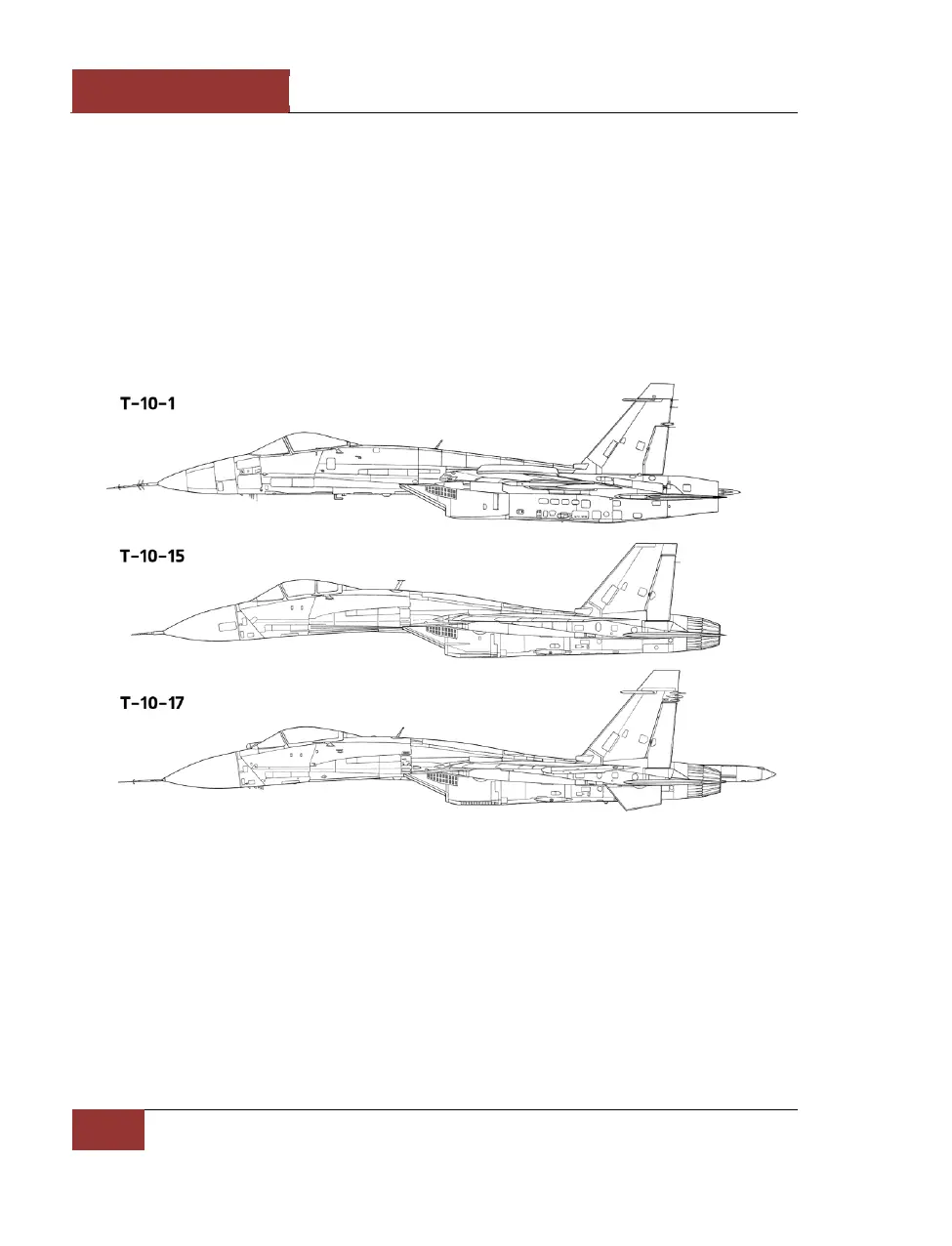
The T-10S had a new wing featuring a straight leading edge, an aerodynamic twist and a
reconfigured sharp leading edge extension. Ogyval wing tips lost the ground to traditional permanent
leading edge sweepback angle ones featuring pylons for air-to-air missiles, which resulted, firstly, in
discarding flutter-preventing weights carried by the T-10 and, secondly, in beefing up the number of
missiles from eight to 10. The wing area grew from 59.4 sq.m to 62 sq.m with the wing high-lift
devices being changed drastically. Ailerons and flaps were replaced with unified control devices -
flaperons, wing leading edges were fitted with slats (the T-10 had no leading edge high-lift devices),
the automatic adaptive deflection mode for the flaperons and leading edge slats was ensured
providing for the fighter's "polar curve envelope" flight concept. The airframe's lifting characteristics
were enhanced through the use of the new wings and leading-edge extensions while maintaining the
negative pitching moment at positive angles of attack and extending significantly the range of
operational angles of attack, which ensured satisfactory lateral stability and prevents buffeting.
Figure 9: T-10 evolution
To reduce drag, the fore part of the airframe was reworked: the airframe cross section in front of and
around the cockpit was decreased, canopy's midsection was reduced while its rearward movement
was enhanced, the airframe's fore part cross section in the area of first fuel tanks was increased.
Besides, airframe and spine fairing couplings were introduced along its whole length, spine fairing's
lateral cross section in the airframe's midsection was reduced, central tail boom arrangement was
altered through addition of a cylindrical tip which was an extension of the rear integral tank. At the
same time, the total internal fuel capacity increased making up 9.4 tonnes. Making the shape of the
engine nacelles more graceful while reducing their weight was achieved through fitting the T-10
aircraft with AL-31F engines featuring top-mounted aircraft and engine accessory gearbox (the T10-3


 To Next Page