and T-10-4 were powered by the AL-31F engines featuring bottom-mounted accessory gearboxes).
While preserving the general arrangement of air intakes, the new aircraft had a new foreign-object
damage (FOD) system introduced for preventing FOD during taxiing, run and take-off through the
use of extendable screens in the air intakes' ducts. Supplementary air inlet ramps were added to the
lower surface of the air intakes.
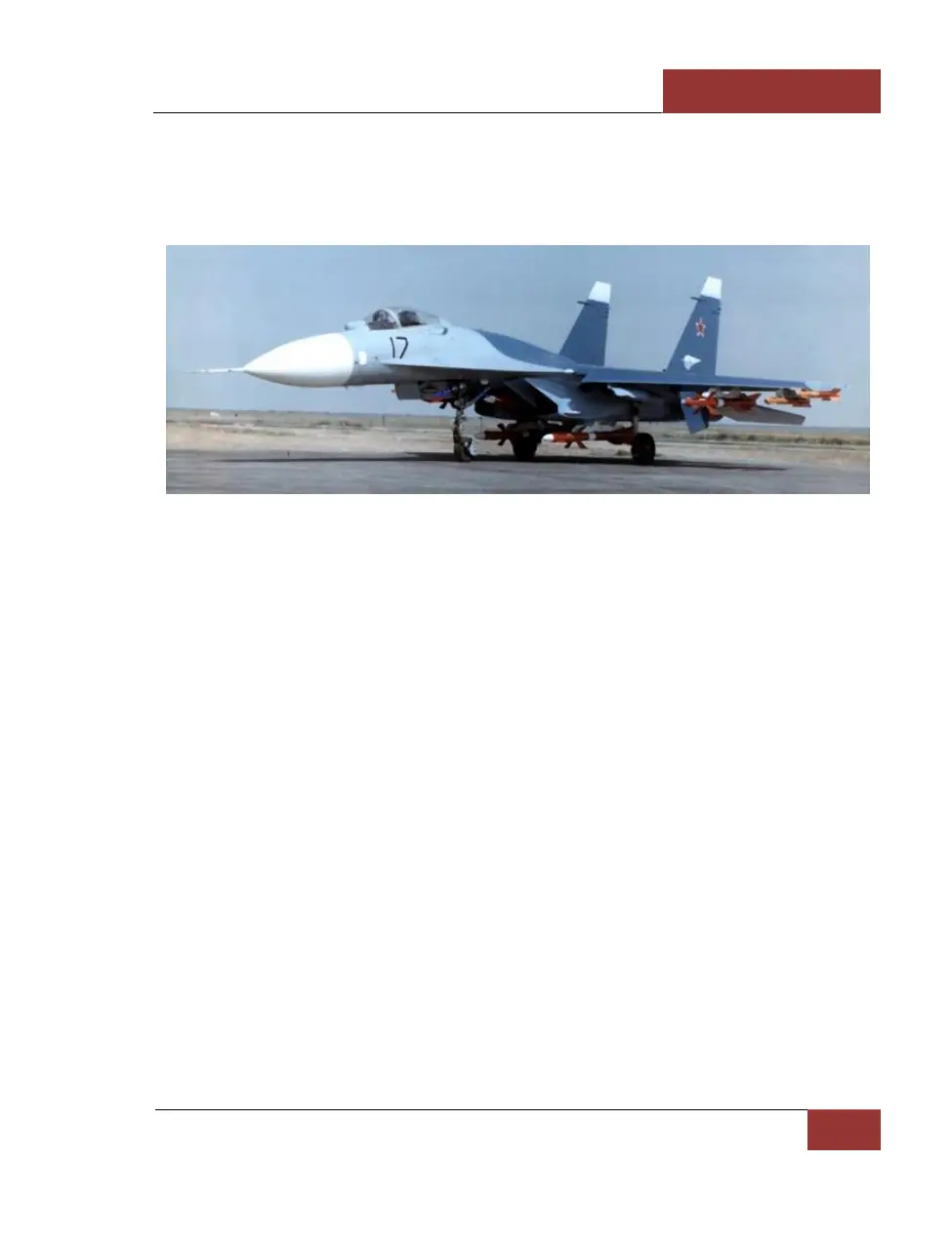
Figure 10: T-10-17 with 10 missiles
To enhance directional and lateral stability through raising efficiency of the corresponding control
surfaces, the empennage underwent substantial redesigning. The two vertical stabilisers were set
wide apart at the reinforced booms on both sides of the engine nacelles with an optimum position for
the stabilisers chosen in the vortex system generated by the leading edge extensions and wing
panels. This resulted in considerable increase in directional stability and controllability of the fighter
at high angles of attack and slipping. Also, the T-10S was fitted with ventral fins increasing its
directional stability and anti-spin performances. Mounting the tails on the tail beams provided an
increase in the tails' and horizontal stabiliser area, as well as to place the stabiliser's actuator fairings
behind the tails. The planeform of the empennage was altered too, while the change in the position
of stabiliser panel rotation semiaxes enhanced their flutter characteristics and allowed the designers
to discard the anti-flutter loads mounted on the T-10. The air brakes - the main landing gear doors
featured by the earlier version and discarded due to horizontal control surface flutter caused by their
extending - were ousted by the large air brake mounted behind the cockpit.
The landing gear was reworked too: main struts were provided with "slant" main pivot, which made it
possible to retract the gear into the wing centre section, thus requiring no folding struts to be
installed. This also allowed to reduce the lifting body's cross section in the area of the landing gear
wells. The nose gear strut was reinforced and moved aft, which enabled better taxiing and decreased
a chance of foreign object damage during taxiing, run and take-off. In general, the fighter's
configuration modification provided the lifting body midsection reduction by 15 percent, which led to
reduction of drag by 18-20 percent in the subsonic and supersonic speed range. This, combined with
an increase in the airframe's lifting characteristics as well as lateral and directional stability and
controllability in all three planes in every flight mode, provided the aircraft with superior
manoeuvrability with special emphasis put on high angles of attack and met the requirements set for
the fighter's range.


 To Next Page