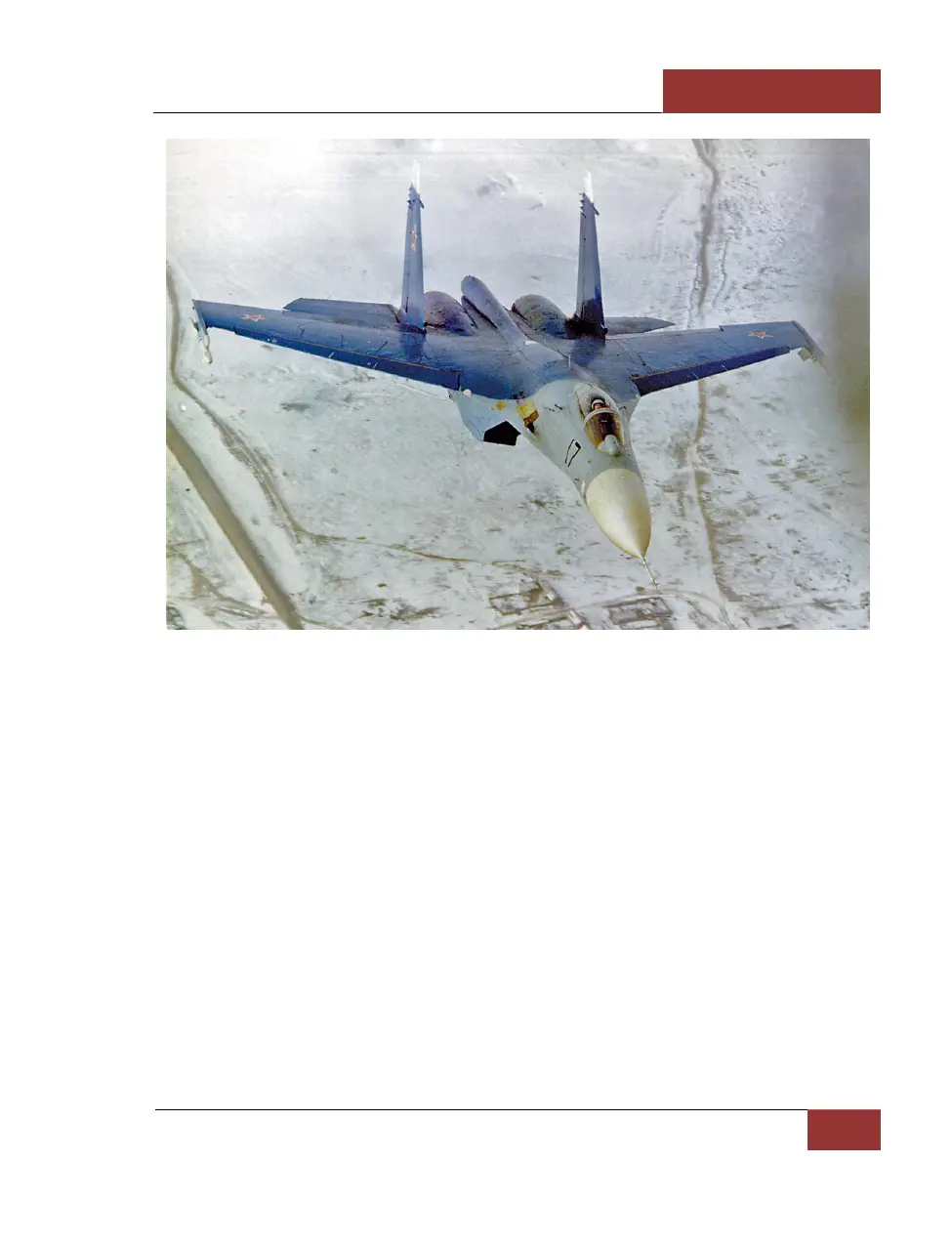
Figure 11: T-10-17 in a test activity
In 1982, the new fighter's testing programme was joined by first new-configuration aircraft
manufactured in Komsomolsk-on-Amur, namely: the T10-15 (later converted into the P-42 record-
maker), T10-16 and above-mentioned T10-17. The fly-out of the first series-built Su-27 took place on
2 June, 1982. The next year, Komsomolsk-based plant delivered another nine fighters, namely, T10-
18, T10-20, T10-21, T10-22, T10-23, T10-24, T10-25, T10-26 and T10-27, most of which were used
in the Su-27 joint official testing held in parallel with establishing series production of the new aircraft
and its fielding with line units. The work on the T10-5 pre-series batch being in full swing too. The
testing resulted in the substantial reworking of the fighter design. Thus, the fore part of the airframe
and the wings were reinforced with the existing fighters being outfitted with additional external
reinforcing plates and those under construction being given reinforced primary structural members
and skin panels. The shape of the tail tips was altered too with previously-designed tail-mounted
weights being discarded. The hinged part of the canopy was made to move up and rearwards (while
earlier it was rear-sliding) with an additional behind-the-headrest metal casement being incorporated
into it. To house the chaff dispenser, the length and height of the flipper - a rear-fuselage bay
between the centre bean and engine nacelles - were increased. The wingtips were modified to carry
ECM pods instead of air-to-air missile launching rails.
In 1984, first Su-27s were fielded with the Soviet Air Force followed by almost a hundred more
fighters having been produced by the end of the next year as well as by Air Force and Air Defence
Forces' units mass transition to the new fighter. The Su-27 joint official testing was completed in the


 To Next Page