and a leading edge extension. According to the developers, the leading edge extension was supposed
to ensure required high-lift characteristics during the aerodynamic focus shifting at supersonic speeds
and generate vortice increasing wing, tail unit and control surface efficiency. At the same time,
Sukhoi was engaged in developing a traditional non-integrated version of the same fighter powered
by two adjacent engines, which were located in the fuselage's aft part, and fitted with side-mounted
air intakes and two vertical stabilisers. In 1972, both versions were submitted to the Air Force board
for examination and consideration. The board was to assess proposals submitted by three aircraft
design bureaux (Sukhoi, Mikoyan and Yakovlev) regarding development of an advanced tactical
fighter slated for entering the service with the Soviet Air Force in the early eighties.
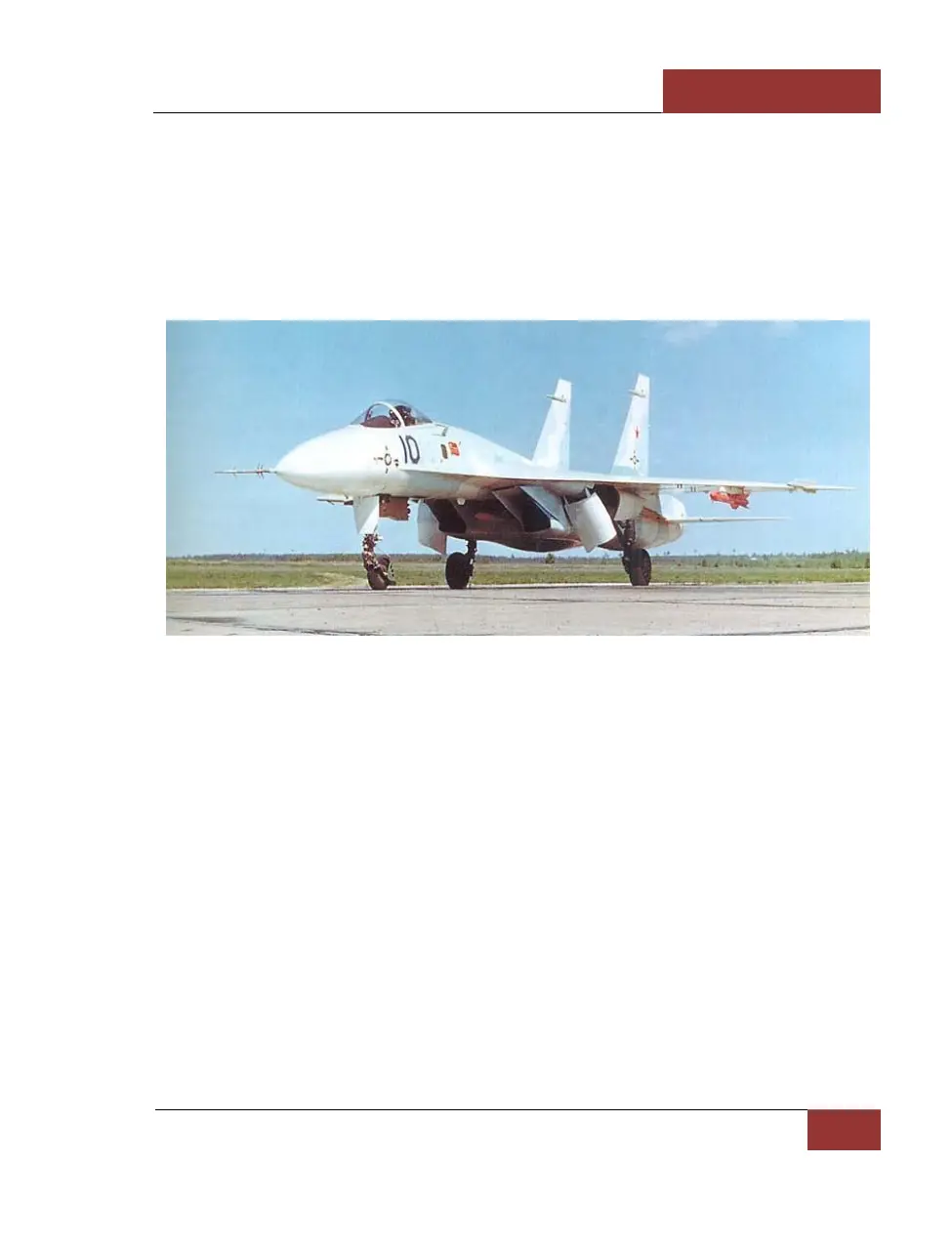
Figure 2: First prototype T-10-1
As a result of thorough evaluation and assessment of all versions submitted for consideration, the
proposals presented by Sukhoi and Mikoyan were approved by the board for further development.
The Su-27 (T-10) programme was to be developed into a heavy multirole advanced tactical fighter,
while the MiG-29 programme was to produce a series-built light advanced tactical fighter. Among the
major combat objectives the both fighters were to meet, there was the dogfight and medium-range
aerial combat capability, interception of aerial targets in the front and rear hemispheres both against
the sky and ground as well as the secondary task of ground target destruction. The Su-27, which had
a better fuel endurance, more weapons load and more sophisticated navigation, self-defence and
communication systems, was intended to operate independently within an air group deep behind the
enemy lines at an operational-tactical range of up to 250-300 km, while a lighter and cheaper MiG-29
would operate only at ranges of up to 100-150 km into the enemy-held territory. The Su-27's
weapons control system was expected to ensure successful countering the F-15 fighter, the most
capable fighter of that time available to the potential opponent, as well as successful engagement
when outnumbered by less capable but numerous fighters (for instance, YF-17, YF-16 and J-6).
Besides, the Su-27 fighter was intended for entering the service with the Soviet Air Defence Forces
after its appropriate reequipping and rearmament.


 To Next Page