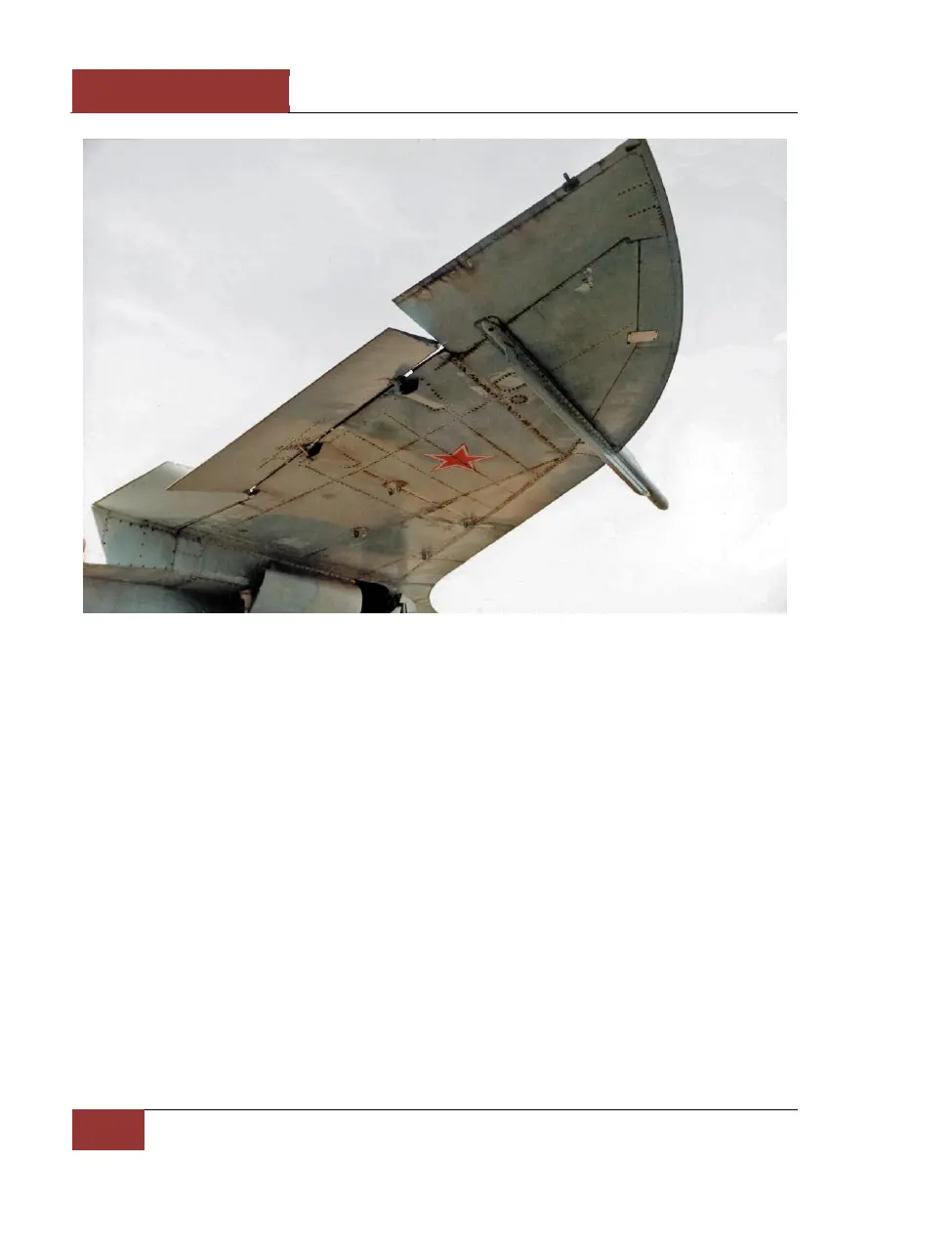
Figure 3: T-10-1 wing
Proceeding from the updated and more specific requirements the client set for the tactical fighter of
the eighties, Sukhoi started in 1972 developing a preliminary design of the T-10 fighter subsequently
followed by the conceptual design stage. During 1970-75, over 15 options of the fighter configuration
were given consideration. Those configurations varied not only in general approaches to the problem
(integrated or classic configuration) but differed in solutions suggested for individual problems
(engine and air intake positioning, landing gear design, type of the control system, etc.). Finally,
preferences were given to the aircraft design with an integrated statically unstable configuration. The
Su-27 was to become the first Soviet unstable fighter with longitudinal in-flight balancing to be
provided by a fly-by-wire control system. Accepting the longitudinal static instability concept (in other
words, "electronic stability") promised a lot of advantages: for the aircraft to balance at a high angle
of attack, the leading edge slat's upward deflection was required with its lift being added to the wing
lift, which allowed significant improvement of the fighter lift with a minor increase in its drag. Due to
the use of the integrated statically unstable configuration, the Su-27 was to acquire outstanding
manoeuvrability allowing the fighter altitude changes unavailable to typical configuration fighters and
an increase in its range of up to 4,000 km without external fuel tanks. There were no other series-
produced fighter in the world boasting similar performances.
The fighter's aerodynamic configuration featured a regular scheme with the empennage being
situated behind the wings on the load-carrying beams on the outer sides of the separated engine
nacelles. The aircraft had twin tails mounted on the engine nacelles. The plane was to be controlled
by the all-moving horizontal stabiliser whose panels could deflect in different directions, as well as by


 To Next Page