ailerons and rudders. The wing high lift devices included flaps. To enable the powerplant to produce
the optimal performances at any speed and altitude, the air intakes mounted under the centrewing
were made controllable by the horizontal ramp. The fore part of the fuselage housed an integral
radar covered by a radio transparent nosecone as well as the cockpit featuring a canopy that
provided good visibility in all directions.
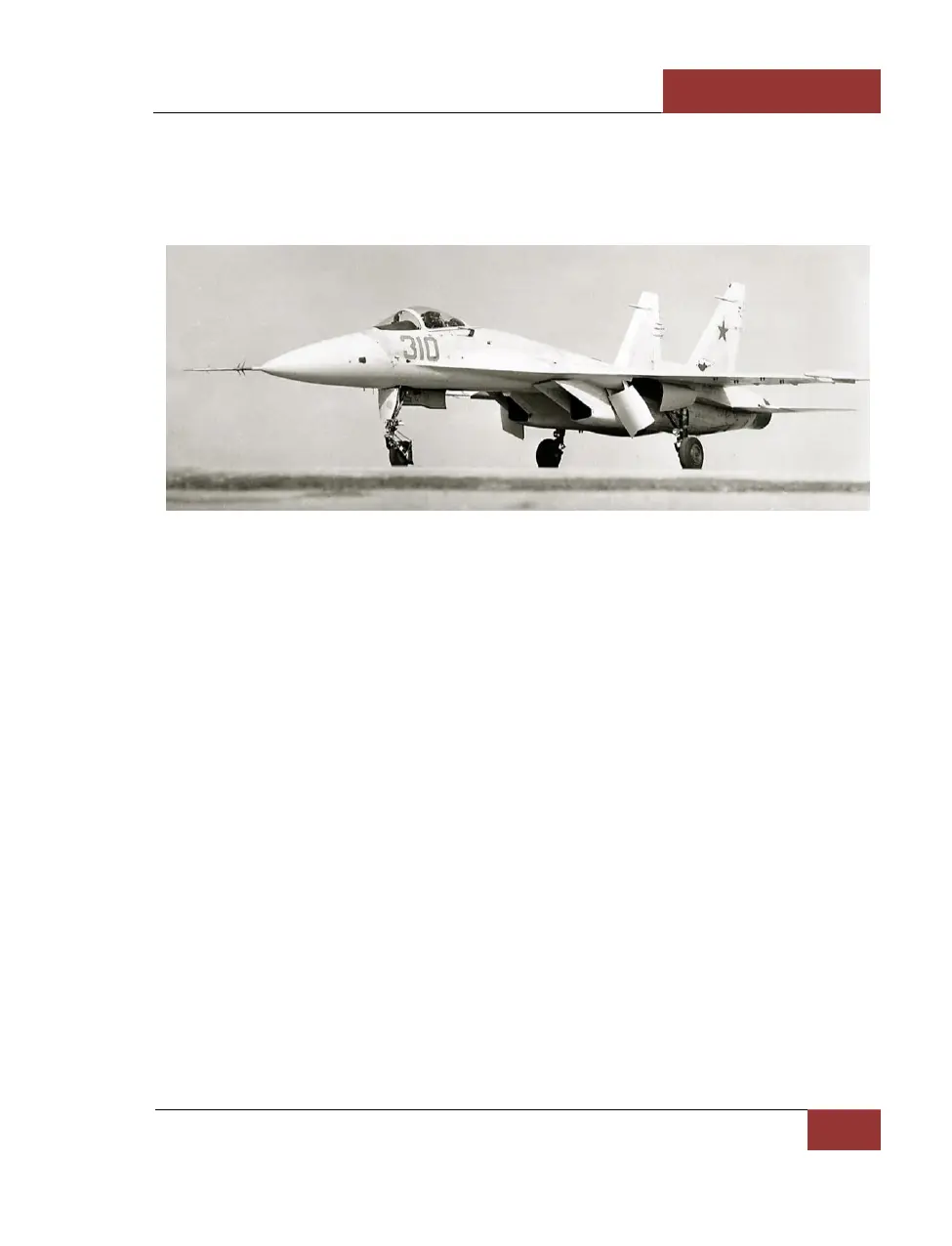
Figure 4: T-10-3
The Su-27 fighter weaponry which included 30 mm high-rate cannon, K-27 medium-range air-to-air
missiles and K-73 or K-14 short-range missiles was to be standardised with that of the MiG-29 light
tactical fighter. The only difference in armament was the warload carried: while the MiG-29 could
house only six missiles, including two K-27 missiles, the Su-27 was capable of carrying eight,
including four K-27s, as well as the K-27E improved longer-range radar-homing and heat-seeking
missiles.
An integrated weaponry control system of both fighters was substantially standardised and, for the
first time in the history of aviation, included two complementing channels - a radar sighting system
and an optoelectronic sighting system, as well as a helmet-mounted sight. The sighting system
initially designed for the Su-27 fighter had better characteristics. The N001 radar was built by the
Phazotron Research and Development Association under the guidance of Victor Grishin. The OLS-27
optics-based detection and ranging system combining an acquisition/tracking IR locator and a laser
rangefinder was developed by the Moscow-based Geophysics Central Design Bureau headed by Chief
Designer D.Khorol.
The landing gear featured a classical tricycle design with the nose strut having been moved far
forward and the gear well placed under the cockpit. The main gear struts were made forward-
retractable into centrewing gear wells with the wheels being turned in the process and the wells'
forward doors serving as air brakes.
The Su-27 fighter powerplant included two powerful and economical AL-31F bypass turbofan engines
producing thrust of 12,500 kg each. They were developed by the Saturn Mechanical Plant headed by
Arkhip Mikhailovich Lyulka and supposed to ensure take-off thrust-to-weight ratio exceeding 1. Low
specific fuel consumption along with about eight tonnes of fuel stored in internal tanks filling most of
the airframe inner space was to ensure required operational range of the fighter.


 To Next Page