32
OPERATIONS
CROSS-CUTTING
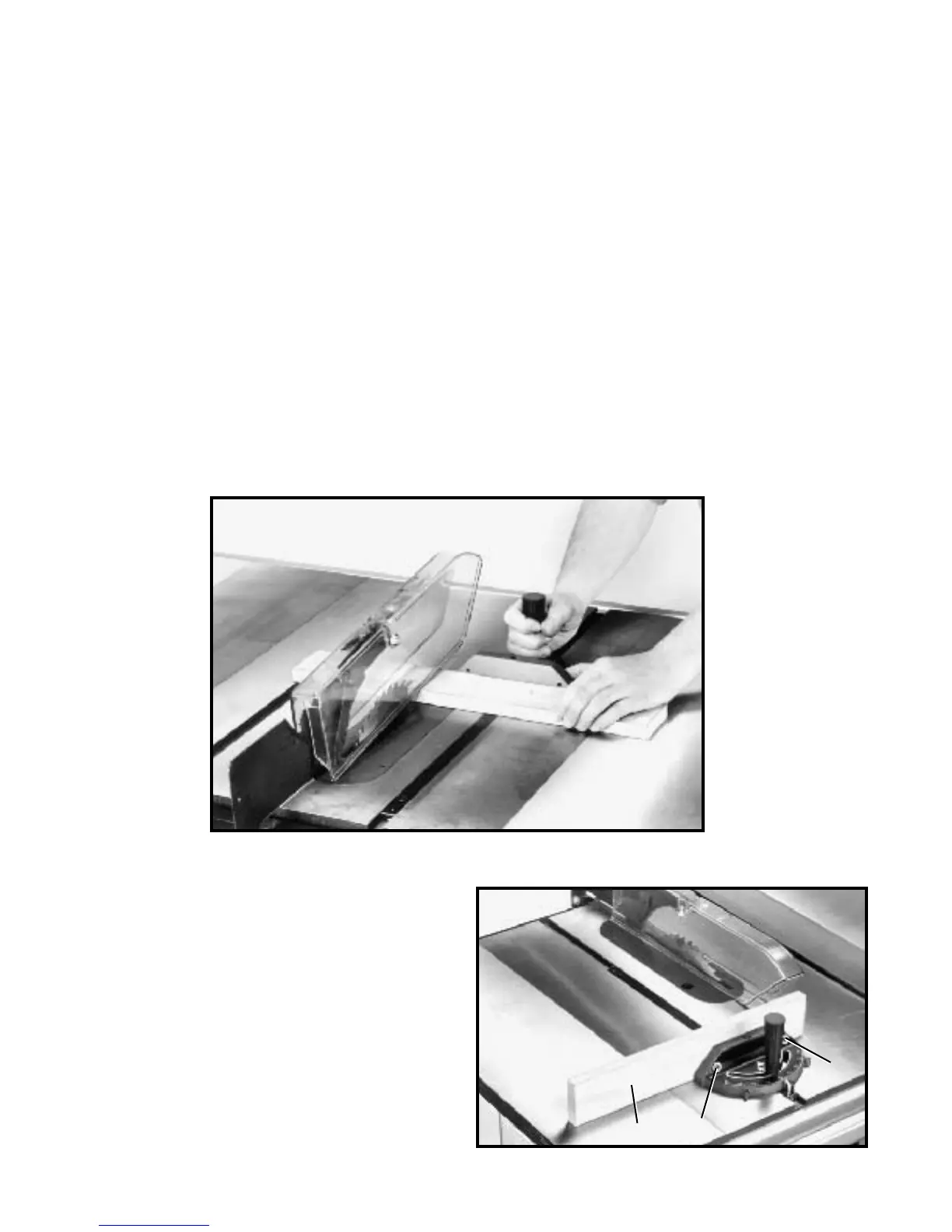
Cross-cutting requires the use of the miter gage to position and guide the work. Place the work against the miter gage
and advance both the gage and work toward the saw blade, as shown in Fig. 102. The miter gage may be used in either
table slot. When bevel cutting (blade tilted), use the lef t miter gage slot so that the blade tilt s away from the miter gage
and your hands.
Start the cut slowly and hold the work firmly against the miter gage and the table. One of the rules in running a saw is
that you never hang onto or touch a free piece of work. Hold the supported piece, not the free piece that is cut off. The
feed in cross-cutting continues until the work is cut in two, and the miter gage and work are pulled back to the st arting
point. Before pulling the work back, it is good practice to give the work a little sideways shif t to move the work slightly
away from the saw blade. Never pick up any short length of free work from the table while the saw is running. A smart
operator never touches a cut-off piece unless it is at least a foot long.
Common sawing operations include ripping and cross-cutting plus a few other standard operations of a fundamental
nature. As with all power tools, there is a cert ain amount of hazard involved with the operation and use of the tool. Using
the tool with the respect and caution demanded as far as safety precautions are concerned, will considerably lessen the
possibility of personal injury. However, if normal safety precautions are overlooked or completely ignored, personal injury
to the operator can result. The following information describes the safe and proper method for performing the most com -
mon sawing operations.
NOTE: THE USE O F ATTACHMENTS AND ACCESSORIES NOT RECOMMENDEDBY DELTA M AY RESULT IN
THE RISK O F INJURY TO PERSONS.
Fig. 102
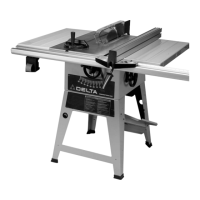
Fig. 103
C
A
A
For added safety and convenience the miter gage can be
fitted with an auxiliary wood-facing (C), as shown in Fig.
103, that should be at least 1 inch higher than the maxi -
mum depth of cut, and should extend out 12 inches or
more to one side or the other depending on which miter
gage slot is being used. This auxiliary wood-facing (C)
can be fastened to the front of the miter gage by using
two wood screws (A) through the holes provided in the
miter gage body and into the wood-facing.


 To Next Page