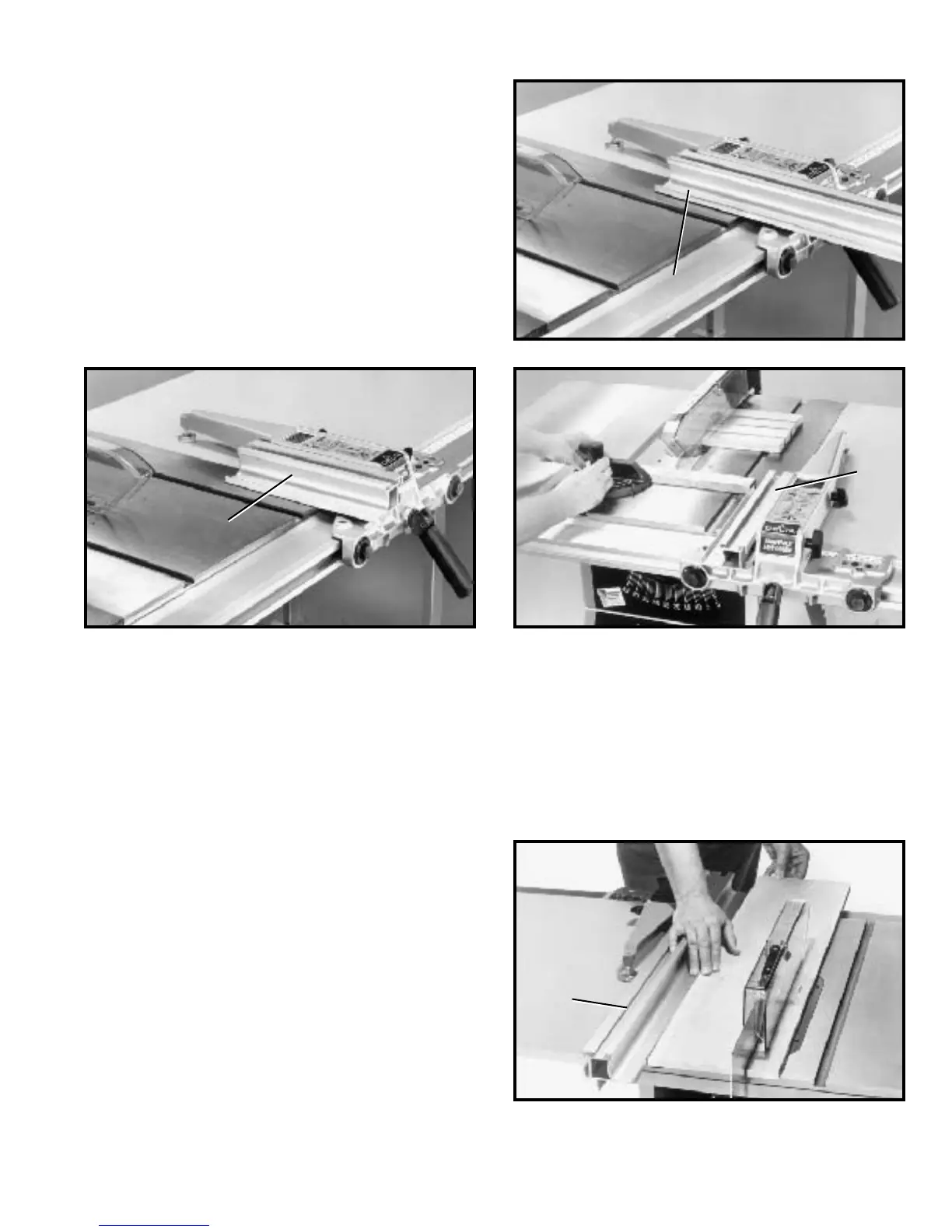
Fig. 104
USING THE FENCE AS A CUT-OFF GAGE
The fence can be used as a cut-off gage when cross
cutting a number of pieces to the same length. IMPOR-
TANT: WHEN USING THE FENCE AS A CUT-OFF
GAGE, IT IS VERY IMPORTANT THAT THE REAR
END OF THE FENCE BE POSITIONED IN FRONT OF
THE SAW BLADE.
When using the fence as a cut-off gage, simply position
the fence (A) to the front as shown in Fig. 104, or pur -
chase the accessory 34-878, 12 long fence (B), as
shown in Fig. 105. Fig. 106, illustrates a typical operation
using the accessory 34-878 12 long fence (B) as a cut-
off gage.
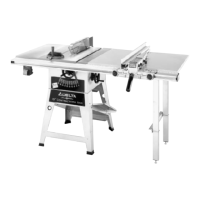
Ripping is the operation of making a lengthwise cut through a board, as shown in Fig. 107, and
the rip fence (A) is used to position and guide the work. One edge of the work rides against the
rip fence while the flat side of the board rest s on the t able. Since the work is pushed along the
fence, it must have a straight edge and make solid contact with the t able. The saw blade guard
must be used. On Delta saws, the guard has anti-kickback fingers to prevent kickback and a split-
ter to prevent the saw kerf from closing and binding the blade.
RIPPING WITH THE UNIFENCE
Never stand in the line of the saw cut when ripping. Hold
the work with both hands and push it along the fence and
into the saw blade as shown in Fig. 107. The work can
then be fed through the saw blade with one or two hands.
After the work is beyond the saw blade and anti-kickback
fingers, the hand is removed from the work. When this is
done the work will either st ay on the t able, tilt up slightly
and be caught by the end of the rear guard or slide off the
table to the floor . Alternately, the feed can continue to the
end of the t able, af ter which the work is lif ted and brought
along the out side edge of the fence. The cut-of f stock
remains on the table and is not touched with the hands
until the saw blade is stopped, unless it is a large piece
allowing safe removal. When ripping boards longer than
three feet, it is recommended that a work support be
used at the rear of the saw to keep the workpiece from
falling of f the saw t able.
Fig. 106Fig. 105
Fig. 107
A
A
B
B
33


 To Next Page