devolo dLAN® 200 AVpro Project Manual
11
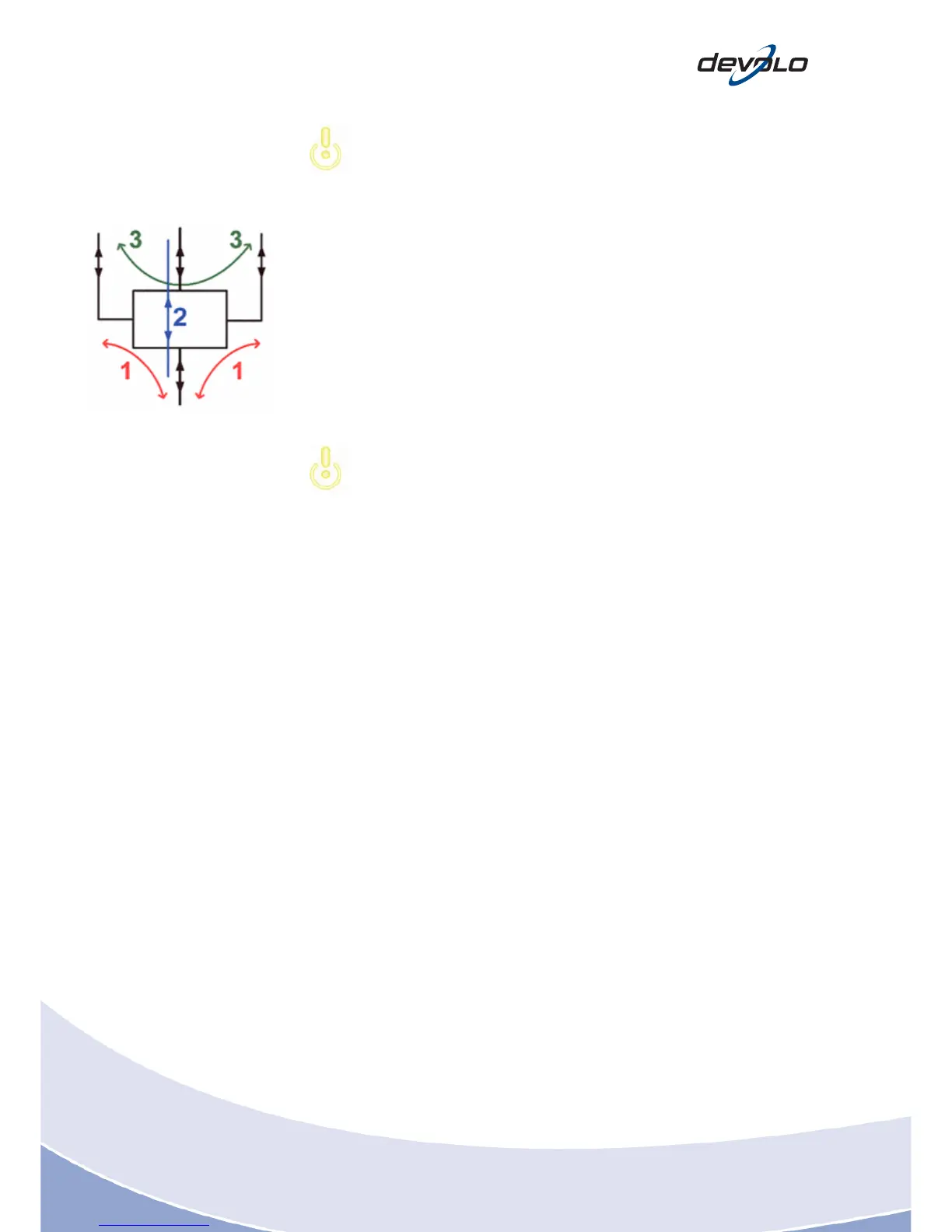
Only use the splitter in the pass-through direction, from input to output (1),
and not between outputs, since very high attenuation (> 22 dB) exists
between the outputs (2).
2) 2x tap
Designation 1: branch
Designation 2: pass-through
Designation 3: decoupling
Branch attenuation: 10 dB to
20 dB
pass-through: 1 dB to 3 dB
decoupling: 30 dB to 50 dB
Shielding requirements: > 80 dB
This option is suitable.
Only use the tap in the pass-through direction, from input to output (1, 2),
and not between outputs (3), since very high attenuation (> 30 dB) exists
between the outputs.
3.4 Back-channel compatibility, a DOCSIS technology term
The 5 MHz and 65 MHz frequency band in Germany (in other countries such as the
USA, 50 MHz) is frequently referred to as the "back channel," since it is used in
DOCSIS cable modem technology to transport the data from the endpoint back to
the provider (i.e. back = back channel). To deploy DOCSIS technology, antenna
networks are frequently converted at great expense to make them back channel-
compatible. This not only means that tree structures need to be converted into star
structures for DOCSIS operation, but that multimedia socket outlets also have to be
used all the time.
All this expense, which, in some cases, costs between 200 and 300 Euros per
housing unit [HU], is unnecessary when you deploy dLAN technology. Neither
converting to a star structure, nor multimedia socket outlets, are necessary for
deploying devolo dLAN technology. Nevertheless, its existence has no negative effect
on the sue of dLAN technology.
Antenna amplifiers represent a special case if the sections to be supplied are even
fitted with them. If they are, you also have the option of bypassing them (see
section 3.5.4).
Reference
is frequently made to noise factors in this relation, and is often referred to
collectively as ingress. Ingress refers to electromagnetic interference caused in
coaxial by transmitters, household appliances, switched-mode power supply units
etc. Interference mainly occurs when the cable or its screening is damaged, plug-in
connections are faulty
(or poorly screened), or the shielding requirement on the cable
is too low. In contrast to DOCSIS-based solutions, dLAN-Technology is highly
resilient to ingress.




 To Next Page