Doc. 065207-02 9/08 25
3 • Operation and Maintenance
3.1 Preparing to Run
3.1.1 Selecting and Preparing Solvent
Precautions
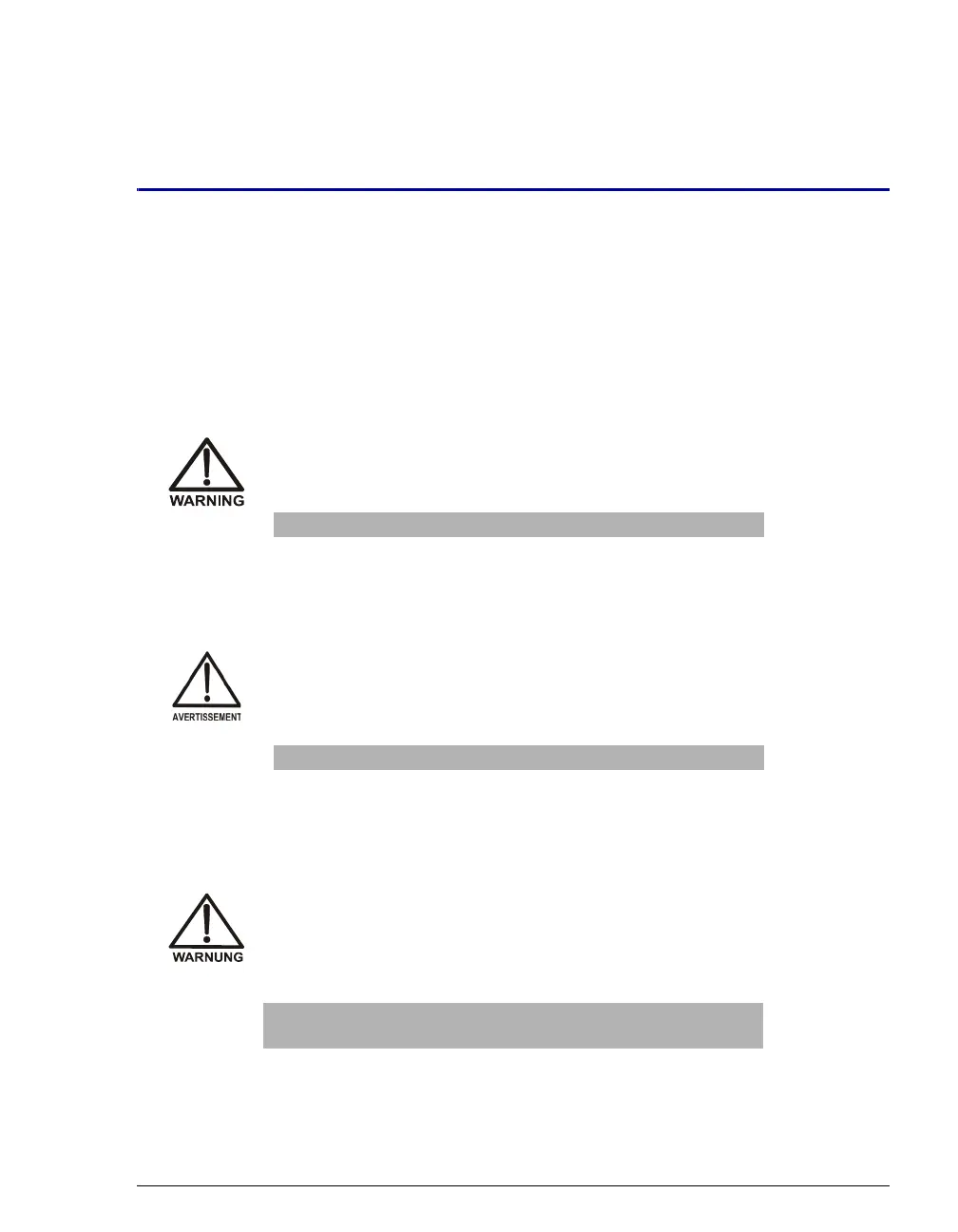
Do not use solvents with an autoignition point below 200 °C. The table
below lists some solvents that should not be used with the ASE 150. If
you have a question about solvent suitability, contact Dionex.
Do Not Use These Solvents Autoignition Point
Carbon disulfide: CS
2
100 °C
Diethylether: (C
2
H
5
)
2
O 180 °C
1,4-dioxane: C
4
H
8
O
2
180 °C
N'utilisez pas de solvants ayant un point éclair inférieur à 200 °C. Le
tableau ci-dessous liste quelques solvants qui ne doivent pas être
utilisés avec l'ASE 150. Contactez Dionex si vous avez un doute
concernant l’usage d’un solvant absent de la liste.
Solvants à ne pas utiliser Point d'auto-inflammation
Disulfure de carbone: CS
2
100 °C
Éther diéthylique: (C
2
H
5
)
2
O 180 °C
1,4-dioxane: C
4
H
8
O
2
180 °C
Verwenden Sie keine Lösungsmittel, deren Selbstentzündungs-
temperatur unter 200°C liegt. Die untenstehende Tabelle zeigt einige
Lösungsmittel, die Sie nicht mit dem ASE 150 verwenden sollten. Bei
Fragen zur Eignung von Lösungsmitteln wenden Sie sich bitte an
Dionex.
Nicht zu verwendende
Lösungsmittel
Selbstentzündungstemperatur
Kohlendisulfid: CS
2
100 °C
Diethyläther: (C
2
H
5
)
2
O180 °C
1,4-dioxan: C
4
H
8
O
2
180 °C


 To Next Page