CALIBRATION
STANDARD
This is not a true calibration to determi
ne the amplitude of the eye movements in
degrees but more an allowance for a correction factor due to the individual anatomical
differences of the orbit of the eye.
These corrections are especially important in the evidence that eye movements are
compared to a target stimulus from a known position (speed). In
is not essential. However, if the mask has been repositioned or removed since the
initial calibration was carried out the procedure must be repeated.
Calibration is recommended for the following tests:
• Gaze
• Saccades
• OKN
• Smooth pursuit
• AHR*
• vHIT*
Note: VHIT and AHR require a head movement’s calibration
.
To set the calibration (See Configuration/ Protocol) o
n protocols setting are determine
what stimulus type you want to use for ca
libration (Center, right, left, down and up)
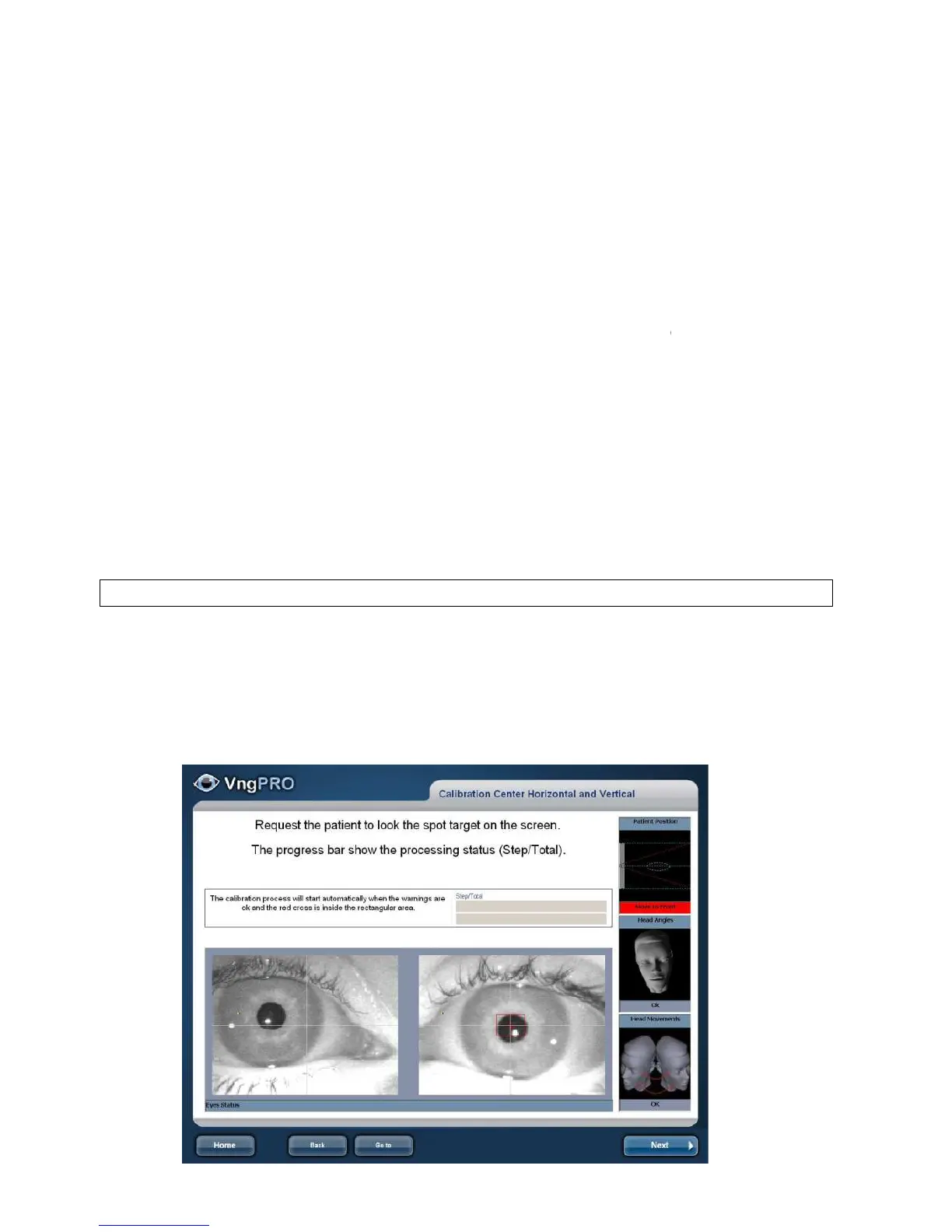
Request the patient tofixate upon points that are projected onto a monitor in a pre
defined pattern for about 5 second while the calibration proceeds. When it iscomplete
the next screen opens automatically.
25
ne the amplitude of the eye movements in
degrees but more an allowance for a correction factor due to the individual anatomical
These corrections are especially important in the evidence that eye movements are
is not essential. However, if the mask has been repositioned or removed since the
n protocols setting are determine
libration (Center, right, left, down and up)
Request the patient tofixate upon points that are projected onto a monitor in a pre
defined pattern for about 5 second while the calibration proceeds. When it iscomplete



 To Next Page