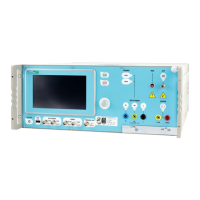
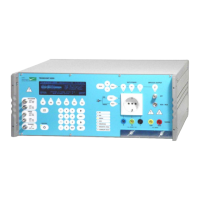
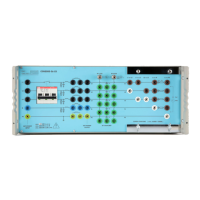
ESD3000-System
23/66
5.2 Practical testing sequence
In practice, the following test procedure has been shown to be reliable:
1. Burst-Testing:
• Burst-testing on mains inputs with a test voltage of 4kV
• Burst-testing of signal and data lines up to 4kV
The energy contained in the burst pulses is relatively small, thereby minimising damage to the test object.
The higher the repetition frequency, the more likely it that weak points become evident in the test object.
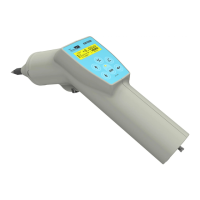
2. ESD-Testing:
With this test, effects induced through the keys and the housing of electronic equipment can be simulated.
• Metallic parts, contacted method up to 8 kV
• Insulated parts, air discharge up to 15 kV
In practice, an item that has undergone burst testing shows a better immunity to ESD, than one which has
not. Likewise, an item that has undergone burst testing shows a better immunity to current injection or cw
field tests.
3 Surge-testing:
• Surge testing mains up to 2 kV
This should be used to test input protection elements and protection circuits installed in electronic
equipment. The energy content is very high in the surge test, and can destroy elements in the EUT.
• Surge testing signal and data lines up to 1 kV
4 Mains simulation:
As a consequence of the increasing number of non-linear loads, the quality of the mains gets worse and
worse. To be sure that electronic equipment can withstand the mains interference, test are such as:
Mains interruption, Mains under and over voltage variation, harmonics simulation etc. are required.
5 Further testing:
For most EUT, the described transient tests are sufficient. Further testing of the product to determine
differences, e.g. with regards to the effects of magnetic field on monitors or on protection elements, may be
needed.
Conclusion:
The product determines which kind of EMC test must be applied. It is also important, that EMC testing
should only be carried out by trained personnel, with a knowledge of how the test object should function, and
some knowledge of transients and EMC. The four tests, with their range of impulse types, simulate only
single signals, and do not cover the complete range of EMP phenomena. However, if no more failures were
registered, after a period of EMC testing with electronic equipment and systems in practical operation, it
would not be justified to impose additional EMC tests.
Further EMC test information can be obtained from EMC Partner or from our representatives.


 To Next Page