Eureka Manta Manual Page 29 of 67
D.5 S
ensor Response Factor (SRF)
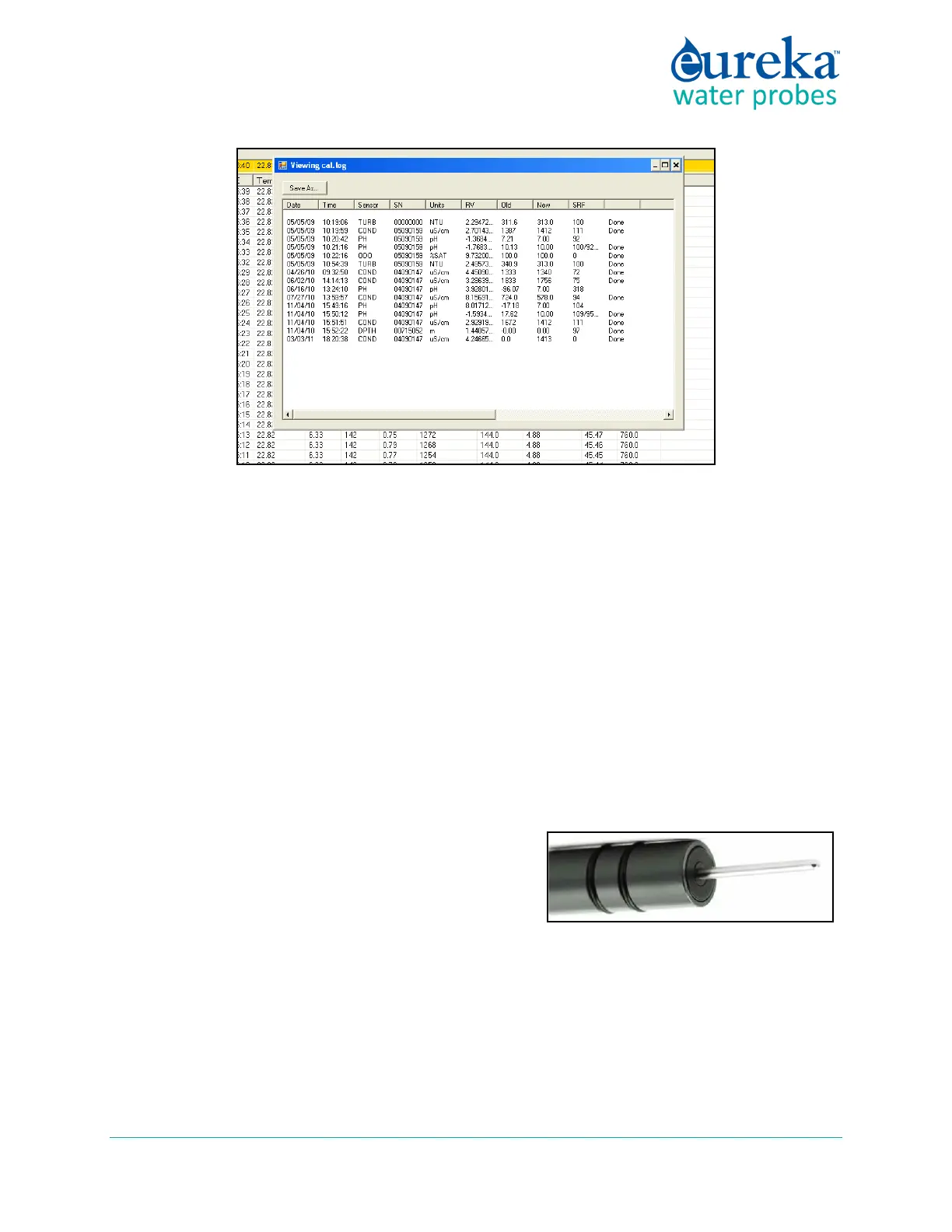
Also included in the Calibration Record is each calibration’s Sensor Response Factor (SRF). Suppose that a
typical Conductivity sensor reports 100 μA in a 1413 μS/cm standard. If your Conductivity sensor reports
100 μA in that same calibration solution, then your SRF is 100% (some parameters, such as pH, have a
more complex SRF calculation, but the effect is the same). If your response is 80 μA, your SRF would be
80%. When you press the OK button to accept a calibration, the Manta automatically accepts your
calibration if the SRF is between 60% and 140%. If the SRF falls outside that range, you will be cautioned
to check your standard value, make sure the sensor is clean, make sure the reading has stabilized, etc. But
you can elect to accept any SRF.
D.6 T
emperature
The Temperature sensor is an electrical resistor (thermistor)
whose resistance changes predictably with temperature. The
sensor is protected by a stainless-steel tube. Thermistors are
very stable with time, and so do not require calibration.
D.7 Dis
solved Oxygen
The optical dissolved-oxygen sensor comprises a blue-light source, a sensing surface, and a red-light
receiver. The sensing surface is an oxygen-active compound stabilized in an oxygen-permeable polymer,
usually silicone. When the sensing surface is exposed to water (or air, for that matter), oxygen diffuses
into the sensing surface according to the amount (partial pressure) of oxygen in the water. The oxygen-



 To Next Page