Eureka Manta Manual Page 39 of 67
Temperature of the sample water to calculate Ammonia (as mg/L-N). You can also display Total Ammonia;
the sum of Ammonia and Ammonium.
Note that Ammonium and Nitrate ISE’s suffer interference from positive ions, especially potassium and
sodium, and Sodium ISE’s suffer interference from positive ions, especially potassium and ammonium.
The Chloride ISE does not normally suffer from interfering ions.
Note that Eureka’s Sodium ISE has a plastic membrane with a wider pH range (pH 3 – 10) and less pH
interference than the traditional sodium ISE’s (which are made with glass membranes). This sensor is
specified to have a 10-second response time and a range of 0.05 – 2,300 mg/L Na+. The sodium ISE can
be immersed to 15 meters of water without damage, but there may be a pressure effect on the reading.
Although Eureka testing on a limited sample size showed this error to be within our ±20% accuracy
specification, we recommend that users check the performance of their particular sensors under actual
field conditions.
Note that that the Sodium ISE has a slow response to changes in temperature and may take many minutes
to reach a final reading when the temperature changes significantly.
If your Manta is equipped with more than one ISE, use care when replacing tips so that you don’t put a tip
on the wrong sensor (for example put a Nitrate on the Sodium sensor).
ISE calibration is more complex than calibrations for most other sensors, but we’ve made it as simple as
possible in Calibrating Ion-Selective Electrodes: The Difference between Activity and Concentration. This
document can be found on the Eureka Flash Drive and Eureka’s Web page (www.WaterProbes.com).
D.16 Total Dissolved Gas (TDG)
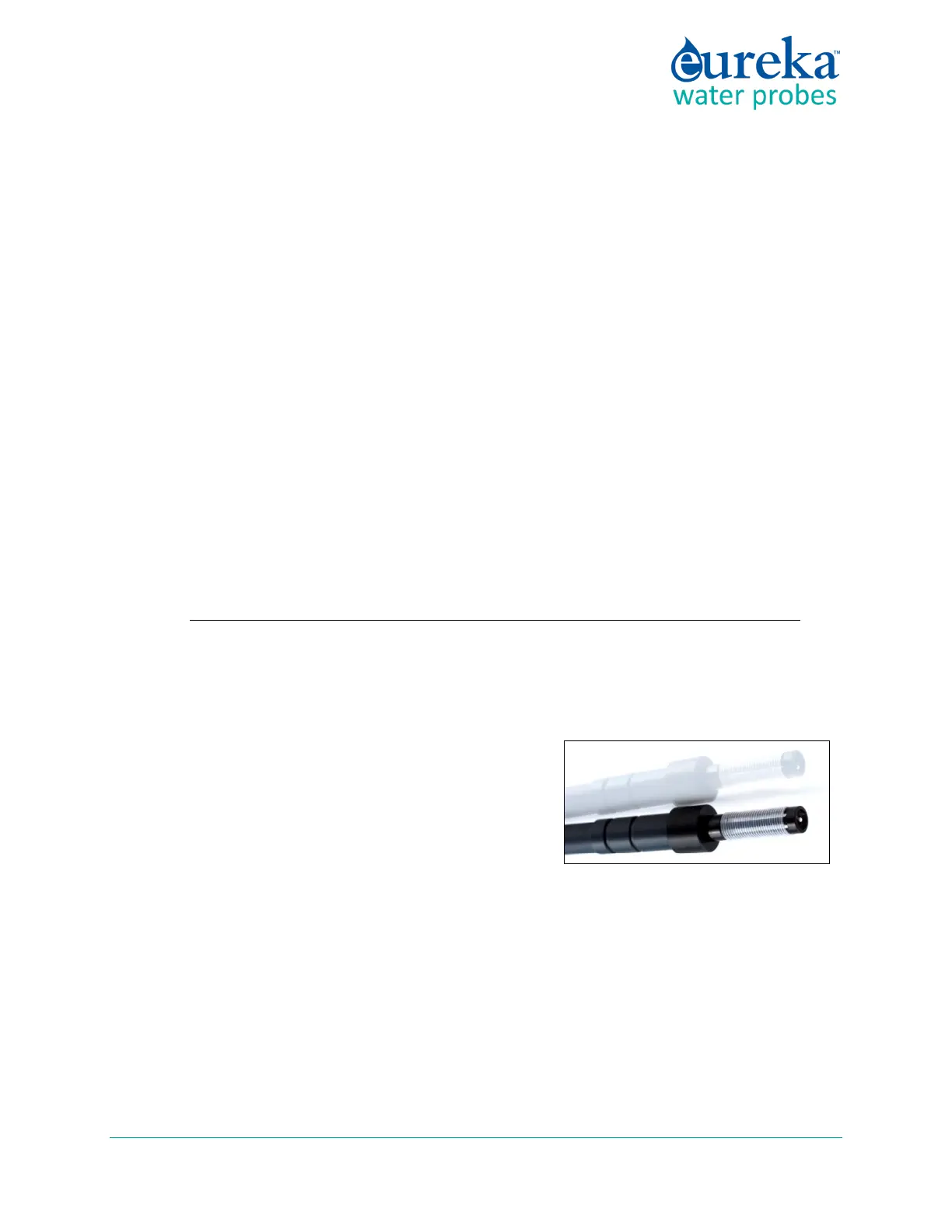
The TDG sensor is a pressure transducer (the same one used for
the 10-meter depth sensor) attached to a “membrane”. This
membrane is a long piece of thin-wall, silicone tubing whose job
is matching gas partial pressures inside the tube with those of
the surrounding water. The sum of those partial pressures is
measured by the transducer, and that’s the TDG of the water.
Aside from keeping the membrane as clean as possible without tearing the tubing, the TDG sensor
requires no maintenance. When the membrane is torn or is just too dirty, the membrane assembly must
be replaced. Simply unscrew the old membrane and screw on a new membrane. Screw it on finger-tight,
plus 1/4 turn.
Silicone rubber is chosen for the membrane material because gases pass through silicone readily. This
means that response time for silicone is much faster than if the membrane were, say, Teflon. However, if
the membrane is soaked in water for more than a few hours, the silicone absorbs just enough water to
slow the gas transfer considerably. This is not usually a problem for unattended monitoring applications
(the TDG doesn’t change very quickly anyway) but can be annoying if you are doing daily spot-checks. In



 To Next Page