Eureka Manta Manual Page 61 of 67
You’ve been paying $200 a year to replace DO caps, haven’t you? It’s OK; lots of people have been in
the same boat. Now that you are a Manta owner, you can expect your DO caps to last five years or
more. You can see the condition of your cap when you calibrate DO. (D.7)
10 How often should I change my turbidity wipers?
Wipers usually last for years, but you should change yours if it gets stiff or has nicks in it. (D.13)
11 Can I customize the Manta with different configurations of sensors?
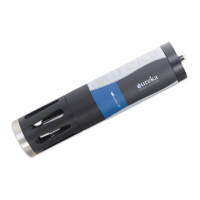
We can fit up to 12 sensors in just about any combination you need. (D.1)
12 Can I replace the sensors myself, or do I have to ship the Manta back to Eureka?
You have been led to believe that sensors need “wet-mateable connectors”, haven’t you? So that you
can change failed sensors easily? Eureka sensors seldom need replacement – that’s why they have a
three-year warranty instead of the one-year warranty offered for lesser sensors. But if you have a
problem, Manta sensors are easy to replace. Contact Eureka Customer Service for assistance.
13 Why can your turbidity read negative?
We let the Turbidity reading go negative to indicate a problem with the Turbidity Low calibration. If,
for instance, you calibrate at zero with water that is actually 5 NTU, then any sample less than 5 NTU
will read negative. Recalibration would be in order. Some manufacturers “clip” their Turbidity
readings at zero to avoid this question, but that’s misleading and throwing away perfectly good
information. (D.13)
14 How long do ISE tips last?
The usual rule is six weeks, but you may get more or less than that. Change tips often to be safe, but
you may learn a better rule of thumb as you review your data. (D.15)
G3 Calibration and Maintenance
1 How do I know when I need to calibrate my sensors?
The simple answer is that frequent calibration will give you better data. The more meticulous you are
with calibration, the better data you will gather. If you are uncertain whether you need to calibrate,
check your sensors against a known sample. If the reading is within the accuracy specification and/or
your accuracy expectations, there is no need to calibrate.
Experience and your program’s accuracy expectations will help determine calibration frequency for
the various sensors. If, for instance, your reservoir discharge is hovering near the regulatory minimum
for dissolved oxygen, you should pay special attention to DO calibration frequency and technique. On
the other hand, if a conductivity accuracy of +/- 10% is OK, you needn’t calibrate conductivity very
often. (D.2)



 To Next Page