Eureka Manta Manual Page 38 of 67
The maintenance procedure is pretty much the same for all fluorometers:
1 cleaning the sensor – Rinse the chlorophyll sensor in fresh water following each deployment, ideally
until it is completely clean again. Do not let the chlorophyll sensor come in contact with any organic
solvents, such as acetone and methanol, or strong acids and bases.
2 cleaning the optics – Visually inspect the optical window after each deployment following a soaking
in fresh water. Use optical tissue to clean the window with soapy water, if needed.
D.15 Ion-Selective Electrodes (ISE’s)
ISE’s are traditionally used in the laboratory at a constant,
moderate temperature, with ionic strength adjusters added to
each sample so that the sample and calibration solution have
roughly the same ionic strength. ISE’s can provide valuable
information in the field, for instance in watching short-term
trends, but their calibration requirements, stability, and
accuracy are not nearly as simple and reliable as those for DO, conductivity, turbidity, etc. For field use,
Eureka makes several theoretical and empirical corrections to elicit the best possible field performance.
ISE’s operates much like a pH electrode except that the pH glass is replaced by a membrane that is
selective for the analyte of interest (ammonium, chloride, nitrate, sodium). The electrode’s filling solution
contains a salt of the analyte, and the difference between that salt’s concentration and the analyte
concentration in your water produces a charge separation. That charge separation is measured, relative
to the reference electrode, as a voltage that changes predictably with changes in the analyte
concentration in the water adjacent the membrane.
It’s best not to let your ISE dry out, so place a small amount of tap water in the storage cup to ensure
100% humidity. The sensing elements (tip) for Nitrate and Ammonium ISE’s have lifetimes of about 90
days. Then, you must replace the tip by unscrewing it from the sensor body and screwing in a new tip.
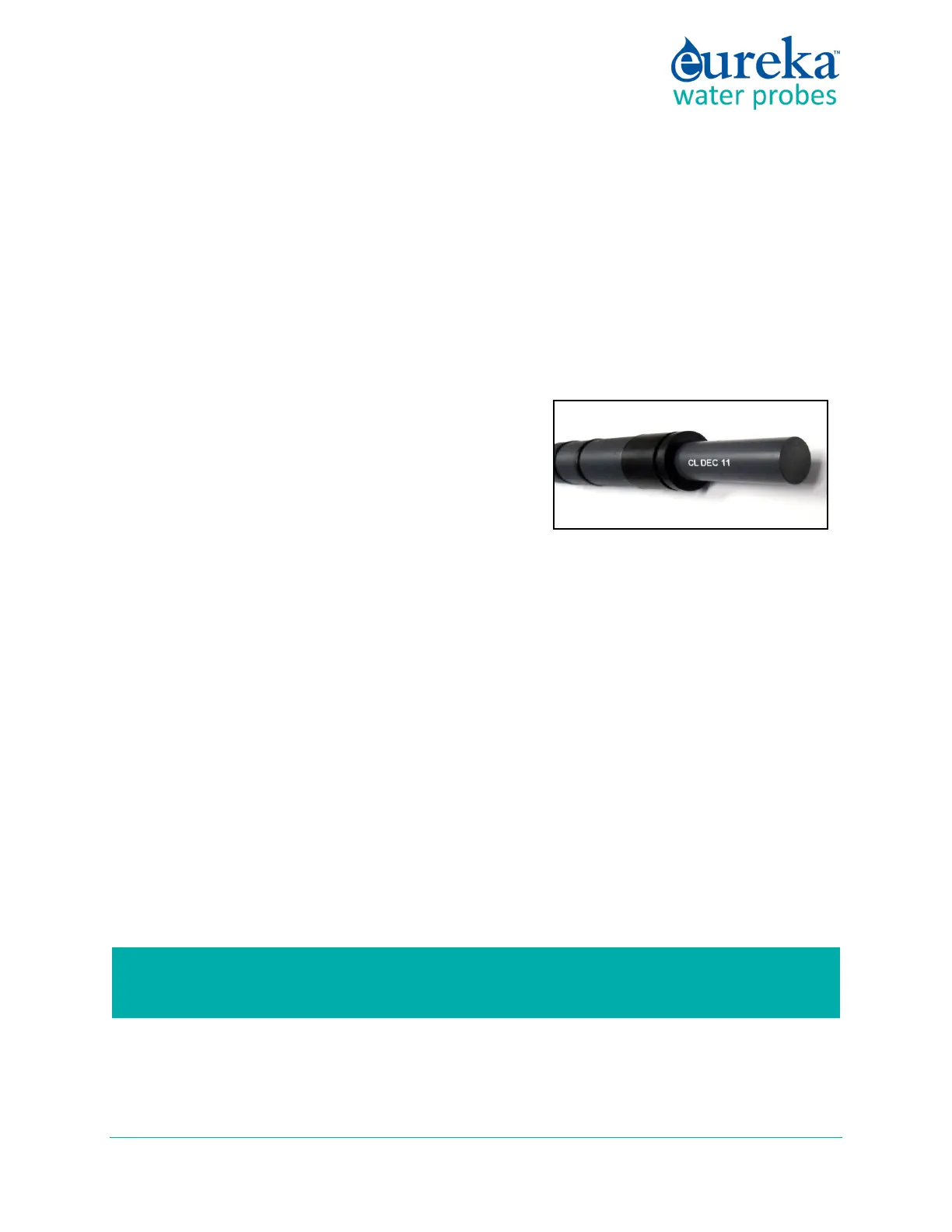
Each sensor body is programmed for a specific ISE; the ISE is identified by a series of rings or dots. One
ring or dot means the sensor body is programmed for a Chloride ISE; two mean Calcium, three mean
Nitrate, four mean Ammonium, 5 mean Bromide, and six mean Sodium.
It’s a good idea to limit the submersion of ISE’s to about 10 meters. If you need to go
deeper than that with the other sensors, you can use a plug for the ISE electrode.
Note that the Ammonium ISE senses ammonium, but at pH’s higher than about 8 the ammonium (NH4+)
is mostly converted into ammonia gas (NH3). Eureka’s software uses the pH, Conductivity, and



 To Next Page