Eureka Manta Manual Page 35 of 67
If that’s not good enough for you, there’s always Vented Depth, or Stage. Vented Depth uses the same
transducer as does Depth, except that there’s a tiny hole in the back of the transducer. If you have a
vented cable (a cable that has a tube running through it), atmospheric pressure is sensed by the
transducer via the little hole. Changes in barometric pressure will not affect the depth reading.
Vented-Depth cables have a desiccant-filled housing at their surface end. The desiccant keeps water from
condensing in the vent tube by letting vapor escape through a small Gortex patch. Keep that housing clean
and replace the desiccants every year or so.
D.13 Turbidity
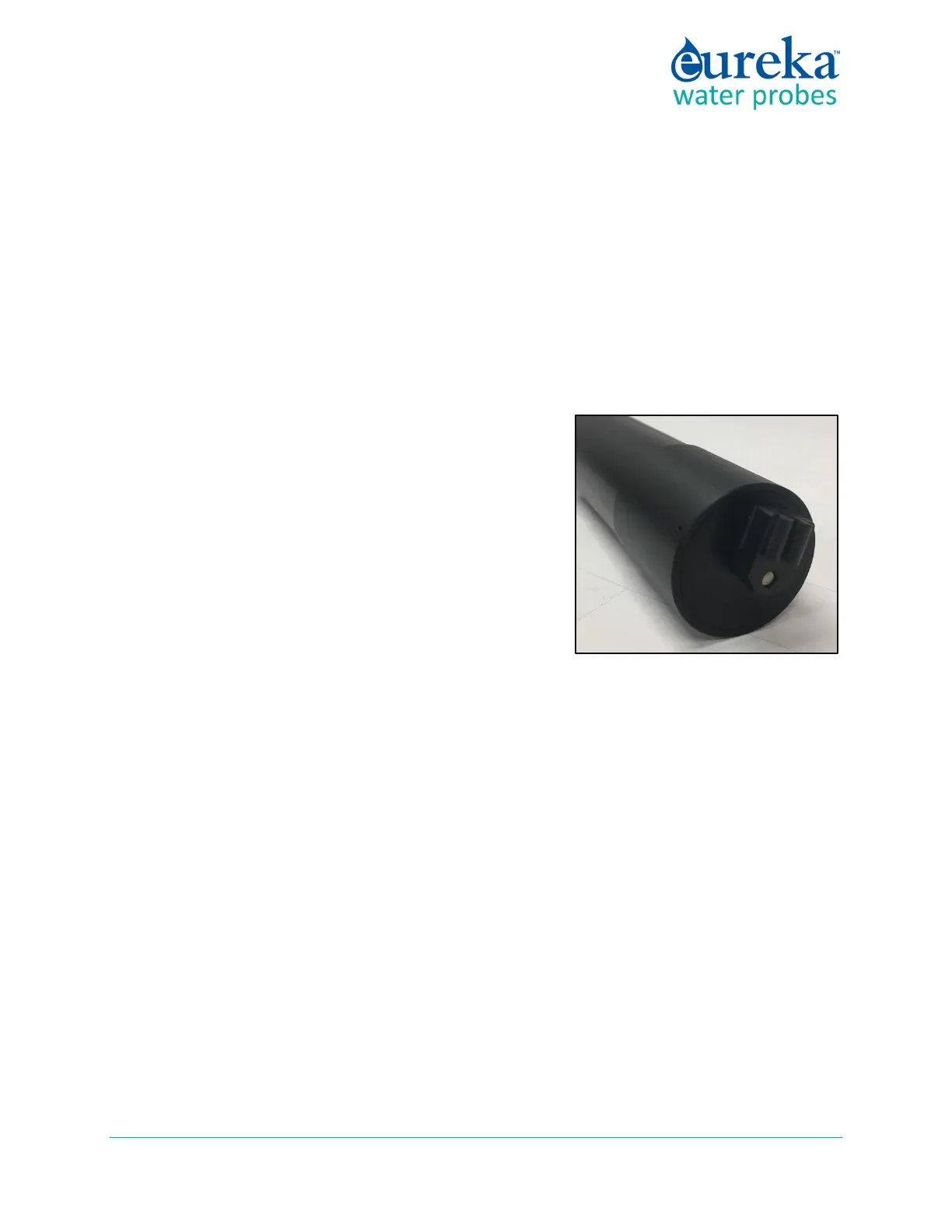
Turbidity is measured as the fraction of an infrared light beam
that is scattered at 90° to that beam. More particles in the water
mean more of that light is scattered, so the Turbidity reading is
higher. Any
material that accumulates on the optical surfaces of the Turbidity
sensor is indistinguishable from material in the water, so most
Turbidity sensors have little wipers to clean the window(s).
Turbidity sensors require no regular maintenance, but you might
check occasionally to make sure the optical window (i.e. the little
glass port on the front of the sensor) has not been damaged by
overzealous wiping.
Turbidity uses a two-point calibration; one point is zero turbidity and the other point should be a standard
approximating the turbidity of the water you intend to monitor.
Make sure you use enough calibration standard to cover the sensor’s “optical volume” – imagine a tennis
ball stuck on the end of the sensor; make sure there are no objects in the volume represented by that
ball. One common method is keeping calibration solutions in one-liter, dark, wide-neck bottles with a non-
reflective finish (such as Nalgene 2106 bottles in amber, available from Eureka).
For the zero calibration:
1 Make sure the Turbidity sensor is fully immersed (i.e. at least 1 ½ inches of solution over the sensor)
in zero-turbidity standard and has an unobstructed optical path.
2 Follow the Manta2 Control Software’s calibration instructions.
For the other calibration point:
1 Rinse your sensors several times with the standard you’ll use for calibration.
2 Make sure the Turbidity sensor is fully immersed (i.e. at least 1 ½ inches of solution over the sensor)
in the standard and has an unobstructed optical path.



 To Next Page