Contents and general instructions
XIII
Festo P.BE-CB-COMP-EN en 1102d
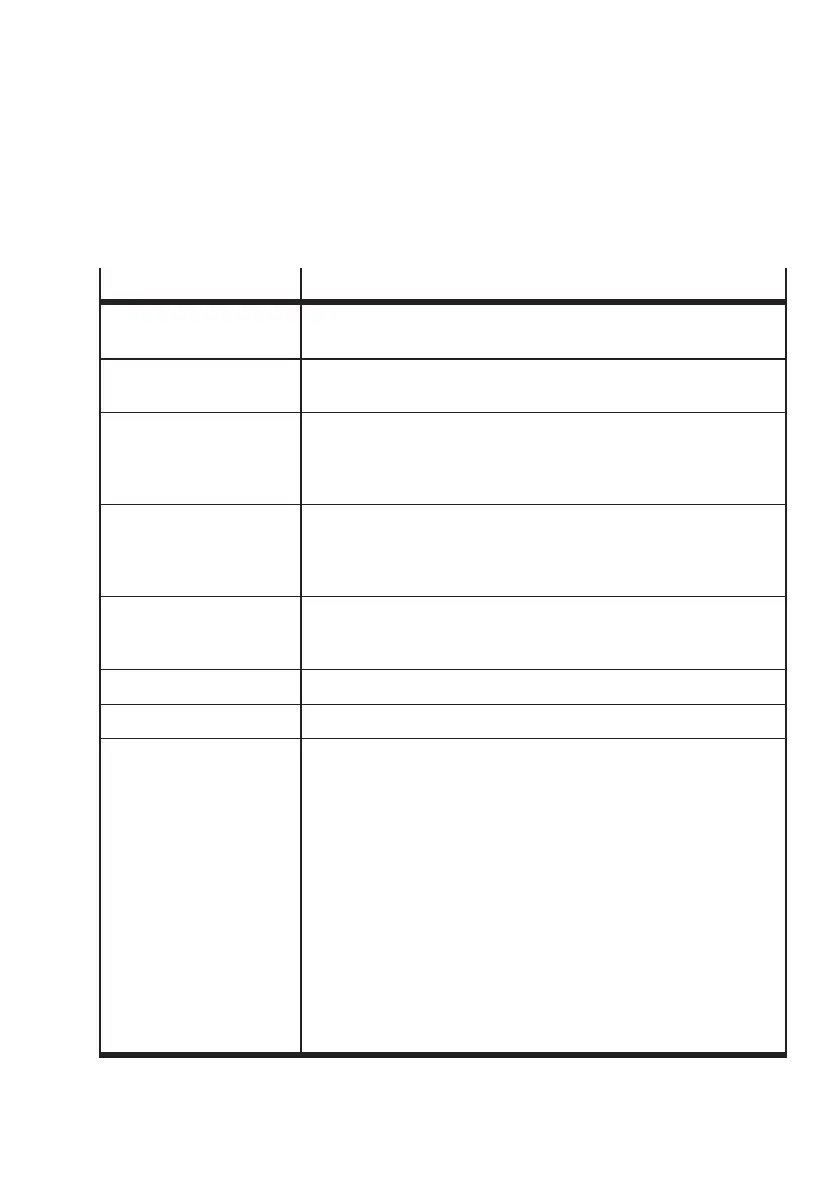
Product-specific terms and abbreviations
Term/abbreviation Significance
AUTO mode Operating mode of the Checkbox for automatic par t s testing
(pre-set when CHB-C-X is started).
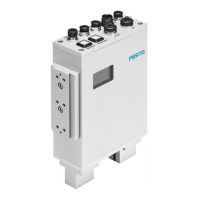
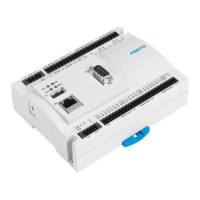
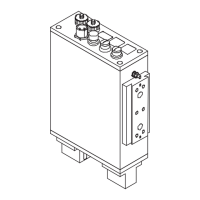
CHB-C-X Adeviceof the type Checkbox Compact (withouttranspor t ing device)for
identifying c onveyed par ts of a parts type.
C-value During the Teac h procedure the C-value shows the extent of the
scatter of characteristics of the sample par ts. The C-value specifies
the maximum value of the scatter of characteristics for the current
feature which differs to the greatest extent.
Deviat ion The Checkbox assesses the feature of an inspect ion part wh ich differs
most from the Teach data. The smaller the value of the inspection part
deviation, the more accurately the inspection part c orresponds to the
sample pa rt s.
Feature Characteristic features are ascertained from the contour data of the
sample and inspection parts. These are e.g. length, height, etc. as well
as a feature for each configuration tool ( CheckOpti).
Good part An inspection part on which all features lie within the tolerance.
Inspection parts All parts shown during the test procedure.
Laser class Labelling of the laser beam according to EN 60825-1:1994 + A1:2002
+ A2:2001. Laser devices are classified according to increasing degree
of danger into c lasses 1, 2, 3A, 3B and 4.
Class 2
An ac c idental, brief exposure ( up t o 0.25s) will not damage the eye.
With longer lasting exposure, damage to the eye is possible.
Laser devices of class 2 may be used without further protective meas-
ures, providing it can be guaranteed that during operation t he user is
not required to look intentionally over a long period (longer than
0.25 s), or to look repeatedly into the laser beam or mirror-reflected
laser beam.
Class 3B
Lasers of class 3B can produce serious eye damage.
Longer radiation of a class 3B laser onto the skin causes erythema
formation (reddened skin), pigmenting, burns or photochemical
damage.


 To Next Page