Section 4: Using the Model 9100: Conductance Function 4.8-9
Final Width = 215mm
Conductance Function Action
The UUT drives the current I
G
through R
IN
via the Hi terminal, and draws I
G
out via the
Lo terminal. The value of R
IN
can be one of six possible values, selected automatically
to accommodate the value of current I
G
. This first stage acts as a current-to-voltage
converter, whose output is a negative DC voltage of value I
G
x R
IN
, with respect to the
virtual ground at the converter input. This voltage is presented as input to the gain-control
amplifier '-g'
The system gain (g) is set by the Total Conductance Demand value (G
T
) transferred by
DAC to control the gain of amplifier '-g'. The final amplifier is switched by
R
STD
and
R
SET
in decade values. It generates a negative DC output voltage V
G
, equal to I
G
÷ G
T
,
across the Hi and Lo terminals; while sourcing the current I
G
drawn by the UUT from the
Lo terminal.
The value of the virtual conductance
G
T
is given by:
G
T
= [1 / (g x R
IN
)] x (R
SET
/ R
STD)
4.8.5.5 4-Wire Connections for Conductance Function
In order to protect the 9100 output, fuses and low-value protection resistors are placed
internally in series with each of the current-carrying wires. Also, as noted earlier, the
external current-carrying wires have their own resistance. The Lead-Impedance
Compensation Bridge is used to compensate for these impedances between the voltage
V
G
and the UUT input. The 9100 is protected against excessive current to ground. If this
occurs the output is switched off.
In Fig. 4.8.2, the 9100 and UUT are shown in 4-wire connection. One pair of wires passes
I
G
(Hi and Lo at the 9100), while the second pair (Hi Sense and Lo Sense) senses the
voltage at the UUT input terminals. The bridge receives the sensed voltage from the UUT
terminals. If this is not exactly the same as V
G
, the bridge compensates for any volts drops
in the protection circuitry and connecting leads, maintaining V
G
at the UUT input.
It is most important that a four-wire connection be used for Conductance function. The
Model 9105 leadset, supplied with the 9100, provides a four-wire connection. It is
recommended that the leadset be fitted, using its four short banana leads, whenever the
9100 is being used in Conductance function.
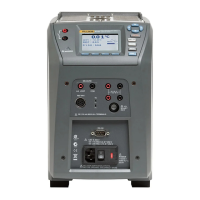
When a four-wire connection is being used, the '
4 WIRE' screen key beneath the 9100
LCD display should be selected (light characters on dark background). The firmware will
then place the 9100 into 4-wire mode at times when this is advantageous.
Refer to pages 4.8.2/3.
Caution:
The greatest error exists when 2-wire connections are being used, with 4-wire selected.


 To Next Page