Need help?
Do you have a question about the FOM INDUSTRIE BLITZ and is the answer not in the manual?
Explains the purpose and design of the BLITZ sawing machine for aluminum or light alloy profiles.
Outlines the terms and conditions of the machine's warranty, covering defects and exclusions.
Introduces the manual's content, covering installation, operation, and maintenance of the BLITZ machine.
Details the machine's ID plate, its location, and the importance of quoting serial numbers.
Identifies and locates various warning and information plates affixed to the machine.
Illustrates the machine's cutting capacity at different angles and blade sizes (e.g., BLITZ 55, 50, 60L).
Lists detailed technical data, features, and optional configurations of the BLITZ sawing machine.
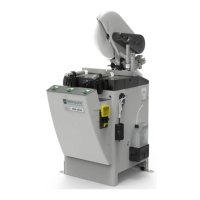
Identifies and illustrates the main components of the standard BLITZ machine version.
Provides noise level values (Lwa, LpA) according to ISO 3746/77 standards.
Emphasizes operator knowledge of controls and machine characteristics for safe operation.
Defines the specific materials (aluminum/light alloy) and conditions for safe machine operation.
Details crucial safety precautions for operators, work environment, and handling of materials.
Lists and describes the various safety devices integrated into the machine for protection.
Identifies hazardous areas and perimeter delimitation procedures for safe operation near the machine.
Discusses residual risks associated with optional chip removal belts and general conclusions.
Provides instructions for safely lifting and moving the machine during transport and installation.
Lists essential checks to perform regarding installation location, lighting, and machine condition.
Guides the user through the process of setting up the machine, including releasing heads.
Details the procedure for accurately levelling the machine using adjustable feet for stability.
Explains how to secure the machine to the floor using supplied brackets and plugs.
Describes how to check and adjust the alignment of the mobile head roller table for precision.
Identifies the components of the machine's control console, including monitor and PC interface.
Explains the operation and purpose of buttons and selectors on the main control panel.
Details controls located on the electrical cabinet, such as key selectors for cutting modes.
Outlines preparatory steps for safe electrical and pneumatic connections to the machine.
Guides the user through performing cutting operations in manual mode.
Explains how to perform cutting operations using the optional step-by-step cycle.
Explains how to adjust the speed at which the saw blade moves during cutting.
Details how to adjust the flow of cutting lubricant to the blades.
Describes the positioning, adjustment, and safety features of the horizontal vices.
Explains the use and adjustment of the optional supplementary vertical vice.
Details the positioning, exclusion, and operation of the internal vertical vice.
Explains how the minimum cut distance varies based on head inclination and shows relevant figures.
Describes setting and performing cuts at various angles using electronic control.
Provides basic rules and checks for performing cutting operations correctly and safely.
Offers advice on choosing appropriate saw blades and highlights compatibility requirements.
Guides on correctly positioning profiles using the vice jaws for optimal cutting quality.
Details how to achieve efficient profile clamping for accurate cutting results.
Explains how to adjust the profile height measurer if it is present on the machine.
Illustrates basic examples and variables for calculating the required cutting length.
Provides specific rules and recommendations for angled cuts below 20 degrees.
Details the fitting and adjustment of the optional retractable middle profile support.
Explains how to use the optional step-by-step kit for making specific 90° cuts.
General recommendations and warnings before performing maintenance operations on the machine.
Lists simple daily maintenance tasks, including checking lubrication oil and air pressure.
Outlines periodic maintenance tasks, including lubrication of mechanical parts and cleaning.
Provides a step-by-step guide for safely replacing a worn or damaged saw blade.
Details the procedure for replacing a faulty pressure switch on the machine.
Explains how to substitute solenoid valves for electro-pneumatic controlled operations.
Guides on replacing a faulty remote control switch if the motor does not start.
Describes how to remove and replace the special clamping pads on the machine's vices.
Details the procedure for replacing the horizontal vice cylinder.
Explains how to replace the vertical vice cylinder, including internal and supplementary types.
Provides instructions for cleaning the vice cylinder stop valve and its components.
Details the steps for replacing the swarf conveyor belt, including tensioning and alignment.
Lists common machine problems, their possible causes, and recommended remedies for efficient operation.
Advises contacting the manufacturer for authorized machine disposal procedures in compliance with legislation.
Refers to attached electrical and pneumatic diagrams for detailed system understanding.
Lists materials subject to wear and tear for spare parts ordering.
Lists materials subject to probable wear or breakage for spare parts ordering.
Lists materials subject to unlikely wear or breakage for spare parts ordering.
 General
| Brand | FOM INDUSTRIE |
|---|---|
| Model | BLITZ |
| Category | Saw |
| Language | English |

 To Next Page