Avoid tire pressures that are too low in all the
tires, including the spare wheel.
Underinflated tires can:
R
fail from being overheated
R
adversely affect handling
R
wear excessively and/or unevenly
R
have an adverse effect on fuel consumption
Overinflated tires
G
WARNING
Tires with excessively high pressure can burst
because they are damaged more easily by
road debris, potholes etc. In addition, they
also suffer from irregular wear, which can
severely impair the braking properties and the
driving characteristics. There is a risk of an
accident.
Avoid tire pressures that are too high in all the
tires, including the spare wheel.
Overinflated tires can:
R
increase the braking distance
R
adversely affect handling
R
wear excessively and/or unevenly
R
adversely affect ride comfort
R
be more susceptible to damage
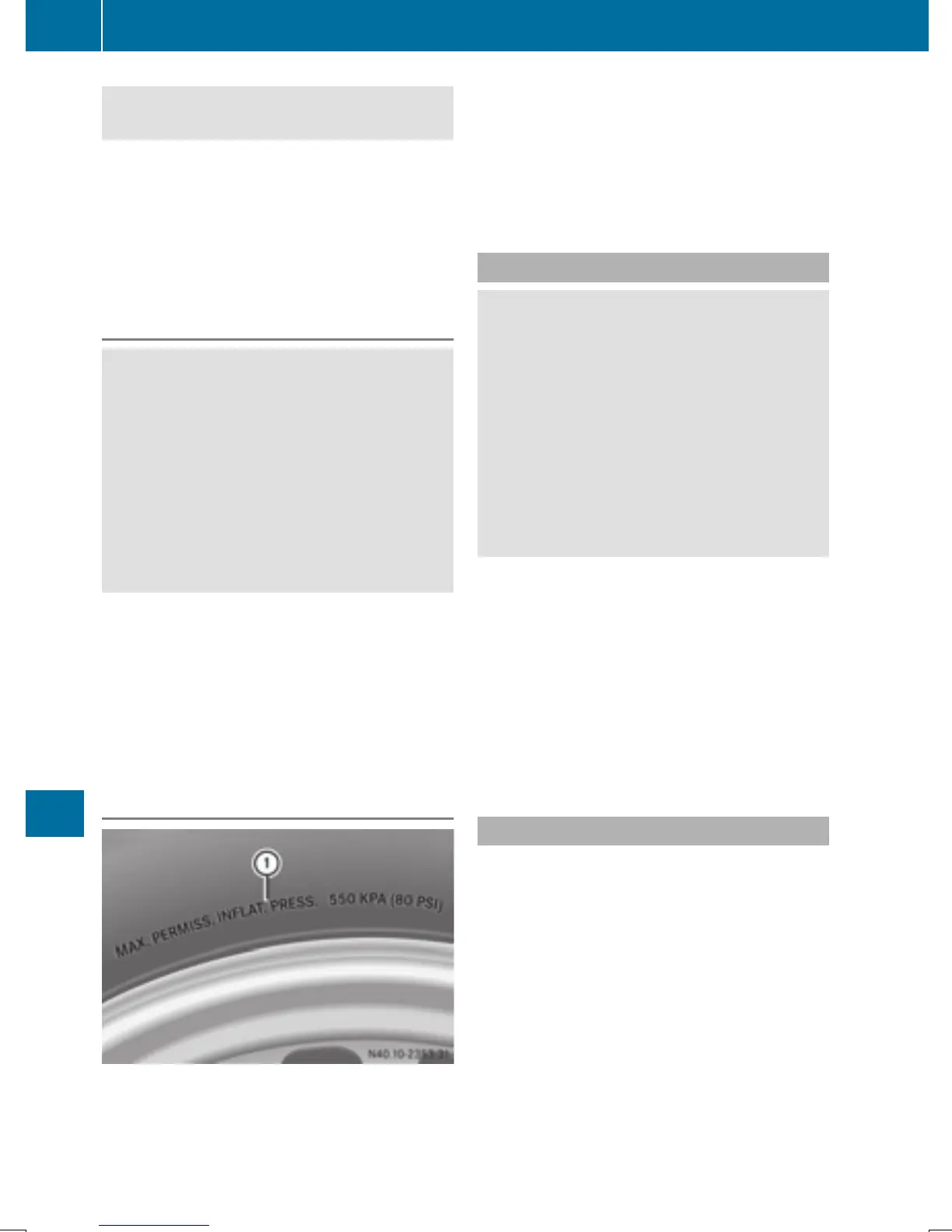
Maximum tire pressures
:
Maximum permitted tire pressure (exam-
ple)
Never exceed the maximum permissible tire
inflation pressure. When adjusting the tire
pressures always observe the recommended
tire pressure for your vehicle (Y page 288).
i
The actual values for tires are specific to
each vehicle and may deviate from the val-
ues in the illustration.
Tire valve (snap-in valve)
G
WARNING
Tire valve that are not approved for your vehi-
cle by the distributor named on the inside
cover page may result in a loss of tire pres-
sure. This may affect road safety. There is a
risk of an accident.
Only use tire valve that are approved for your
vehicle by the distributor named on the inside
cover page. Always make sure you have the
correct tire valve type for the tires on your
vehicle.
!
Do not screw additional weights (check
valves, etc.) onto the tire valves. The elec-
tronic components could thus be damaged.
Only for vehicles without a tire pressure mon-
itor:
For safety reasons, Mercedes-Benz recom-
mends that you only use tire valves that have
been tested for use on your vehicle.
Checking the tire pressure manually
In order to determine and adjust the tire pres-
sures, proceed as follows:
X
Remove the valve cap of the tire you wish to
check.
X
Press the tire pressure gauge securely onto
the valve.
X
Read the tire pressure and compare it with
the recommended value on the loading
information table or the tire pressure table
(Y page 288).
X
If the tire pressure is too low, increase it to
the recommended value.
290
Tire pressure
Wheels and tires


 To Next Page