e.bloxx A6-2CF
CONFIGURATION
HB_EBLOXX-A62CF_E_V19.doc
65
Gantner Instruments Test & Measurement GmbH
5.4.5 Alarm
To protect men and machine it is necessary to set alarm levels. Will a level be reached by one of a conditioned signals a
alarm signal will be generated. The output of an alarmc channel is the digital state 0 or 1. This can be read by the host
or can be used for further conditioning like boolean algebra (e.g. if alarm 1 and alarm 2 and alarm 3 than set V6). For
the response time to detect a alarm the same rule like for the artihmitc functions are valid. That means the time depens
on the number of taken number of variables. The minimum time is 1 ms, tha maximum time wil be approx. 20 ms.
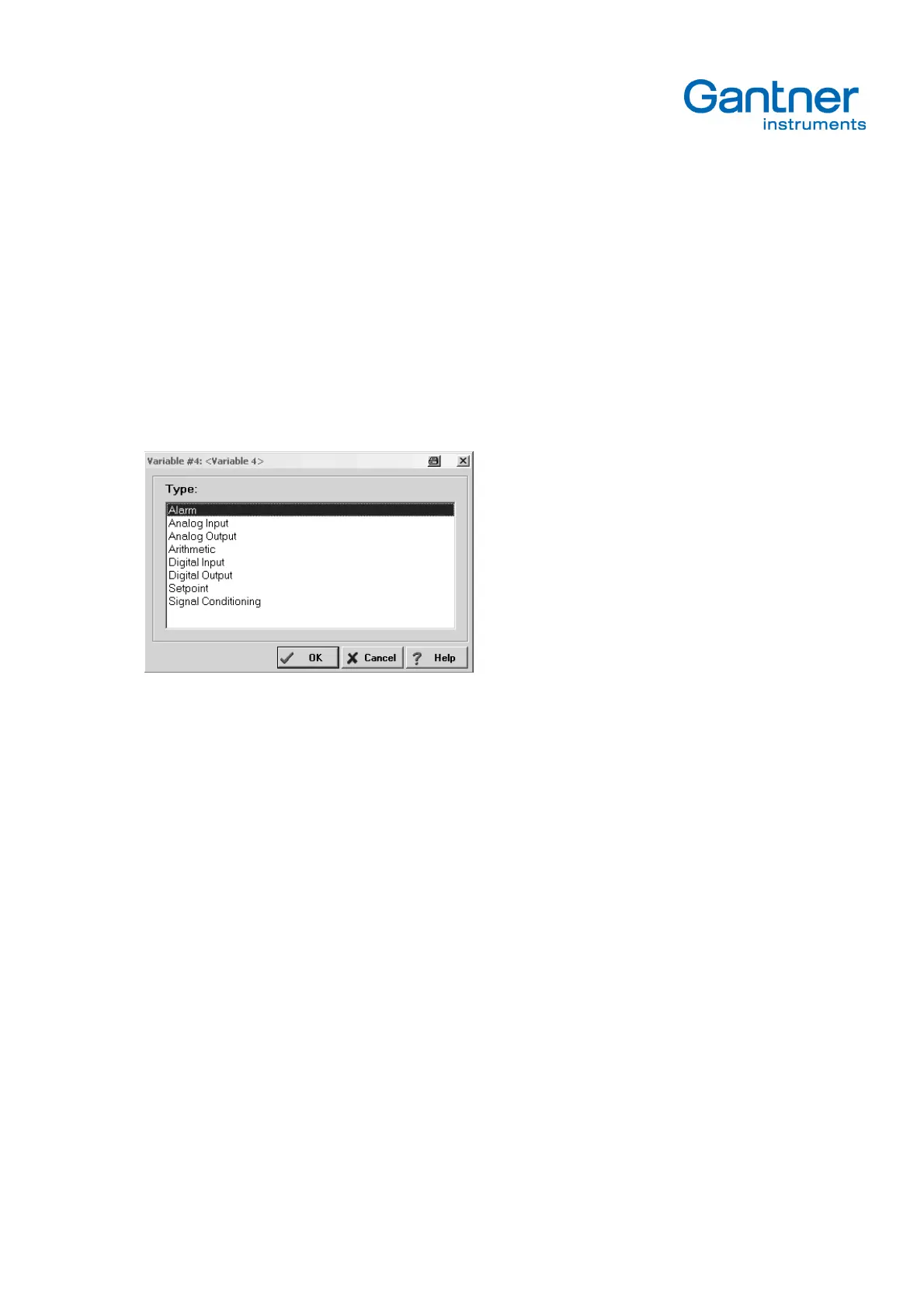
To set an alarm it is necessary to define a new variable. For that option click at any field in a row.
Column "Type"
Select
Alarm
in the window that opens when clicking on that column.
Columns "Variable Name" and "Format/Adjustment"
According to chapter
5.4.2 Signal Conditioning
.
Columns "Sensor", "Type of", "Connection" and "Terminals"
These columns are not relevant for the signal conditioning.
Column "Additionals"
In this column it is possible to set limit switches/thresholds. There are up to 4 thresholds each alarm channel possible.
The result will be a logical OR combination of all 4 thresholds.
The thresholds provide the function to compare a variable with another variable or with a constant. The variable could
be a measured value, a conditioned value or a value set by host (setpoint).


 To Next Page