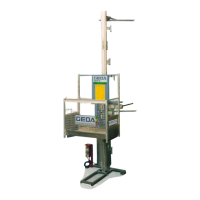
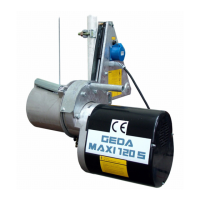
This document is an operating manual for the GEDA PH 650 temporary construction hoist, which is designed for transporting personnel and loads in non-public areas by authorized persons. The hoist can be configured as a Single (one car on the mast) or Twin (two cars on the mast) system, utilizing a GEDA mast system with two gear racks and a corresponding base enclosure.
Function Description
The GEDA PH 650 hoist facilitates vertical transportation on construction sites. It features a car that can be controlled from within the car itself or from ground and landing stations. The control systems include keypads for landing preselection and joysticks with multiple switching positions for precise movement. For safety, the hoist is equipped with an enclosure at the bottom stop position to prevent unauthorized access, and landing-level safety doors protect against falls when the car is not present. Car doors further secure occupants during transport. In emergencies, the hoist offers an "EMERGENCY STOP" function, an intercom system for communication, and an emergency lowering device to evacuate trapped persons by manually releasing motor brakes.
The hoist's operation is subject to strict safety protocols, including daily visual and function inspections before use. These checks ensure the integrity of load-bearing elements, clear travel paths, functional safety equipment, and proper operation of switch boxes. Any defects must be reported and rectified by trained personnel.
Important Technical Specifications
The GEDA PH 650 operates within specific environmental conditions:
- Temperature Range: -4°F (-20°C) to 86°F (+30°C) as standard. With special equipment (e.g., switch cabinet fan, air conditioning), it can operate above 86°F (+30°C).
- Wind Speed:
- Operation / Maintenance / Repair: Maximum 35 mph (56 km/h) in the USA, and maximum 45 mph (72 km/h) in other countries.
- Assembly: Maximum 28 mph (45 km/h).
- Operation is prohibited in wind velocities exceeding 45 mph (72 km/h).
- Lifting Speed: Available in various speeds: 40 m/min (131 ft/min), 60 m/min (196 ft/min) for USA, 65 m/min (213 ft/min), and 90 m/min (295 ft/min).
- Safety Gear Triggering Speed: Ranges from approximately 48 m/min (157 ft/min) for 40 m/min drives to approximately 108 m/min (354 ft/min) for 90 m/min drives.
- Gravitational Acceleration in Car with EMERGENCY OFF: Less than 1 g.
- Lifting Capacities:
- Ladder in the car: Maximum 330 lb (150 kg).
- GEDA PH 650 with car PH 2032: 4400 lb (2000 kg) / max. 25 persons.
- GEDA PH 650 with car PH 2737: 6000 lb (2700 kg) / max. 28 persons.
- GEDA PH 650 with car PH 3240: 7055 lb (3200 kg) / max. 30 persons.
- Drive: Technical information is found on the drive's nameplate.
Usage Features
The hoist offers several modes of operation:
- Normal Mode:
- Control in the car – Stop Next Landing: Allows the operator to stop the car at the next landing above or below by pressing the "Stop Next Landing" button. The car moves slowly to the selected landing.
- Control in the car – Landing Preselection: Operators can enter a desired landing number via a keypad, and the car will travel to that destination.
- Control in the car – Joystick with 5 switching positions: Provides fine control over car movement, with two positions for slow and fast ascent, two for slow and fast descent, and a center "OFF" position to stop the car.
- Control in the car – Joystick with 3 switching positions (Australia): Similar to the 5-position joystick but with simplified control for travel upwards and downwards.
- Ground-station switch box: Allows control of the hoist from the ground, including main switch, EMERGENCY STOP, UP/DOWN buttons, and "Stop Next Landing" functionality.
- Landing switch box: Enables stopping the car at any time using an EMERGENCY STOP button, and provides UP/DOWN buttons and "Stop Next Landing" functionality for specific landing levels.
- Car doors: Vertical sliding doors, with some models featuring a ramp, ensure safe entry and exit. The ramp must rest on the landing floor and transition plate of the safety door.
- Special Mode:
- Drop-test control: Used to test the safety gear.
- Assembly control: Used during assembly, with a control unit on the car roof and an assembly crane control unit. This mode can activate permanent lubrication.
Maintenance Features
- Daily Inspections: Required before operation, including visual checks of the hoist, warning notices, safety equipment, and switch boxes.
- Daily Cleaning: Involves external and internal cleaning of the hoist, switch boxes, and control panels, as well as the surrounding area. Specific cleaning agents and personal protective equipment are mandated.
- Repair and Servicing: Only trained and qualified personnel are authorized to perform maintenance, repair, and electrical tasks. The hoist must be turned off at the main switch and secured against unauthorized switch-on before any work begins.
- Spare Parts: Only original GEDA spare parts are to be used to ensure full function, safety, and reliability. Ordering requires specific information such as type, year of manufacture, serial number, item number, and quantity.
- Lubrication: The hoist includes a lubrication device, with warnings for lack of grease (ERROR 38). Assembly mode can trigger increased lubrication.
- Emergency Lowering Device: Allows manual release of motor brakes to slowly lower the car in an emergency, with instructions to stop every 3.3 – 6.6 ft (2 meters) to prevent brake overheating.
- Troubleshooting: The display module shows error codes (e.g., ERROR 03 for "Door 'A' open", ERROR 10 for "EMERGENCY LIMIT UP car moved too high") to help diagnose malfunctions. A fault table provides causes and remedial actions for common issues like motor problems, car movement issues, and safety gear activation.
- Roof Hatch and Ladder: Provides access to the car roof for maintenance, repair, assembly, or evacuation. The ladder is extendible, and the roof hatch can be unlocked with a triangular wrench. A bar is installed for safe entry/exit from the roof.

 Need help?
 General

 To Next Page