GSK CNC Equipment Co., Ltd.
70
max. axial working load, i.e. F
a0
=1/3F
maz
. If F
maz
is hard to get, F
a0
=
(0.1~0.12)C
a
(N) is suggested for use.
C
a
——The rated load of ball screw that can be looked up in the
sample
h
sp
—— Ball screw lead(mm)
K ——Pre-fastened torque coefficient of ball screw, 0.1-0.2
P ——axial external load of ball screw(N), P=F+µW
F ——Axial cutting force of ball screw(N)
W ——Load in normal direction(N),W=W
1
+P
1
W
1
——Gravity of moving parts(N), including max. loading gravity
P
1
——Clamping force of splinting (etc. headstock)
µ —— Slideway frictional coefficient, for slideway clung with ClC
4
board, µ=0.09; for lubrication, µ=0.03-0.05; for linear rolling slideway, µ=0.003-
0.004
η
1
—— Efficiency of ball screw, 0.90-0.95
M
B
—— Frictional torque of supporting bearing, namely, start torque
(N•m), which can be looked up in the sample of bearing
for ball screw
z
1
—— Tooth number of gear 1
z
2
—— Tooth number of gear 2
Select a servo motor which satisfies the following inequation:
M
1
≤ Ms
M
s
is the rated torque of the servo motor.
② Calculation for inertia matched
The following inequation is generally recommended for use among motor
inertia J
M
, load inertia J
L
(converted to motor shaft), general inertia J
r
:
4
1
≤
M
L
J
J
≤ 1 , 0.5 ≤
r
M
J
J
≤ 0.8 or 0.2 ≤
r
L
J
J
≤ 0.5
The motor rotor inertia J
M
can be looked up in the sample manual. The
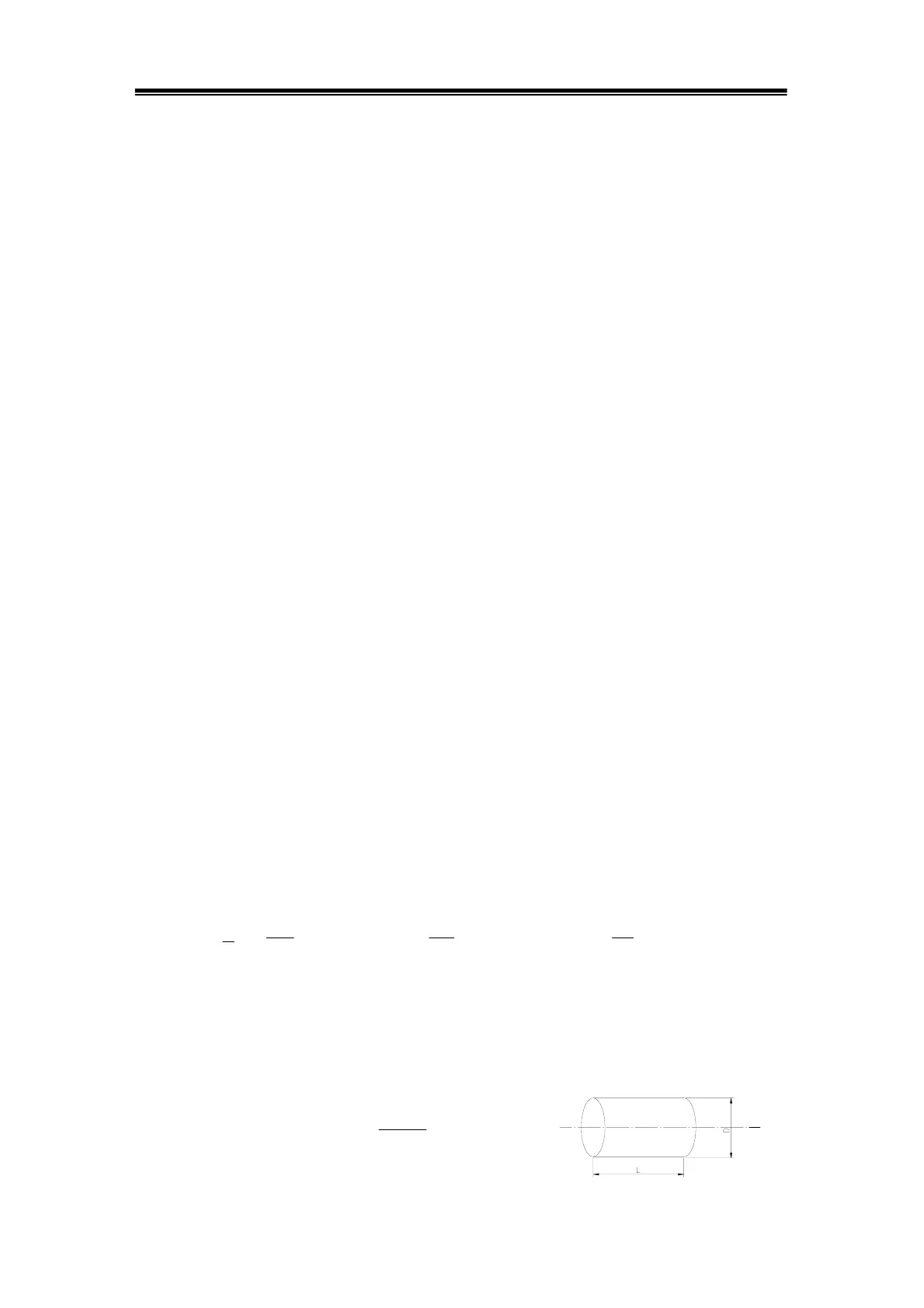
calculation for load inertia is as follows:
1. The inertia of rotary object Ball screw, coupling, gear, tooth form belt
etc. are all rotary objects.
J=
g×32
D
4
L(kg*m
2
)



 To Next Page