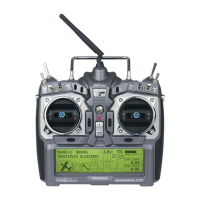
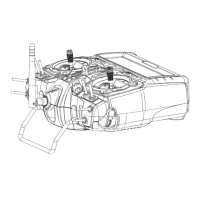
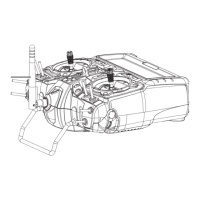
Need help?
Do you have a question about the HITEC Flash 8 and is the answer not in the manual?
Key information regarding product changes, safety, and disposal guidelines.
Details on FCC compliance and California Proposition 65 warning.
Lists available system settings like Channel, Trim Step, Trainer, Sensor, Spectra, Mode, Management, and Info.
Details common programming functions across all model types.
Explains programming for fixed-wing aircraft, including mixes and control adjustments.
Details programming options specific to helicopter models.
Highlights key features like 2.4GHz signal, 8-channel capability, and resolution.
Provides critical safety suggestions for model aircraft operation.
Information on obtaining help via phone, email, and the Hitec website.
Guidance on navigating the manual and using the radio's interface controls.
Details specifications for the transmitter and available receivers.
Instructions for connecting, charging, and selecting battery types.
Guide to adjusting stick length, tension, and changing transmitter modes.
Describes startup and in-flight warnings for the transmitter.
Illustrates connection diagrams for Maxima series receivers.
Details antenna installation for optimal signal capture.
Describes Optima/Minima receiver features and connection options.
Step-by-step guide to link receivers to the transmitter.
Instructions for setting up fail-safe and hold modes for safety.
Overview of telemetry capabilities and sensor compatibility.
Procedure for checking transmitter-receiver signal strength before flight.
Instructions for using scan mode to find clearest frequencies.
Guide to using Secure Link Technology for compatible models.
Step-by-step guide for setting up a standard sport plane model.
Step-by-step guide for setting up a basic CCPM helicopter.
Instructions for navigating and using the system menu.
Options for creating, selecting, copying, resetting, deleting, and renaming models.
Setup for fixed-wing aircraft, including wing and tail configurations.
Setup for gliders, including wing and tail configurations.
Configuration of swashplate types (e.g., 120°, 140°, 90°).
Customizing channel assignments for functions and transmitter controls.
Setting the amount of servo movement for each trim adjustment.
Configuring the FLASH 8 for master/slave training setups.
Information on using telemetry sensors with Optima receivers.
Managing receiver type, range checks, and binding.
Choosing between control modes 1-4 for transmitter operation.
Adjusting backlight, contrast, battery type, and feedback settings.
Shows current firmware version and language settings.
Guide to using common programming options like REVERSE, SUB TRIM, D/R & EXP.
Setting the direction of servo rotation for channels 1-8.
Adjusting the center point of servos for precise neutral positioning.
Configuring dual rates and exponential curves for servo control.
Fine-tuning maximum servo movement for each channel.
Adjusting servo transit speed for smoother control.
Setting up custom mixes for advanced control functions.
Programming flight conditions for different phases of flight.
Setting up and managing flight timers for duration tracking.
Displaying graphic feedback of control inputs and servo positions.
Enabling a safety feature to prevent accidental throttle application.
Details functions like AIL DIFF, ELEVON MIX, V-TAIL MIX, etc.
Adjusting upward aileron movement for adverse yaw correction.
Configuring elevon controls for flying wing aircraft.
Setting travel limits for V-tail servos.
Configuring a two-servo elevator or 'split' elevator setup.
Automatically applying rudder input with aileron commands.
Adjusting elevator inputs to control camber surfaces.
Adjusting wing control surfaces for camber by raising or lowering.
Avoiding pitch changes when flaps are deployed.
Using aileron, flap, and elevator as an air brake for landing.
Configuring wing surfaces as air brakes using flaps and ailerons.
Settings for gyro sensitivity and assignment for flight stabilization.
Setting a kill switch for glow or gas motors.
Defining five points for throttle response curve modification.
Details functions for helicopters like FLT.COND, THRO CUT, GYRO, etc.
Setting custom trim and mix settings for helicopter flight phases.
Setting a programmed throttle position for engine safety.
Programming a throttle position while allowing collective pitch control.
Adjusting gyro sensitivity and rate for helicopter tail stabilization.
Reducing yaw effects from head speed or blade pitch changes.
Increasing main rotor RPM in response to swash control commands.
Fine-tuning swash plate travel for accurate collective and cyclic control.
Defining five points for throttle response curve modification.
Defining five points for collective pitch response curve modification.
Overview of telemetry data and compatible sensors.
Viewing real-time latitude, longitude, altitude, and speed data.
Showing RPM data for electric, glow, or gas motors.
Displaying temperature readings from up to four sensors.
Displaying receiver voltage and electric motor power parameters.
Displaying current draw for each servo connected to the Servo Manager.
Displaying airspeed and rate-of-climb data.
Using PC interfaces or voice systems for telemetry data access.
 General
| Interface | - |
|---|---|
| Input type | Press buttons |
| Product color | Black, Silver |
| Built-in display | Yes |
| Maximum range | - m |
| Frequency band | 2.4 GHz |
| Channels quantity | 8 channels |
 Weight and Dimensions
| Weight | - g |
|---|

 To Next Page