6
Example 2 - Status Registers and Queues
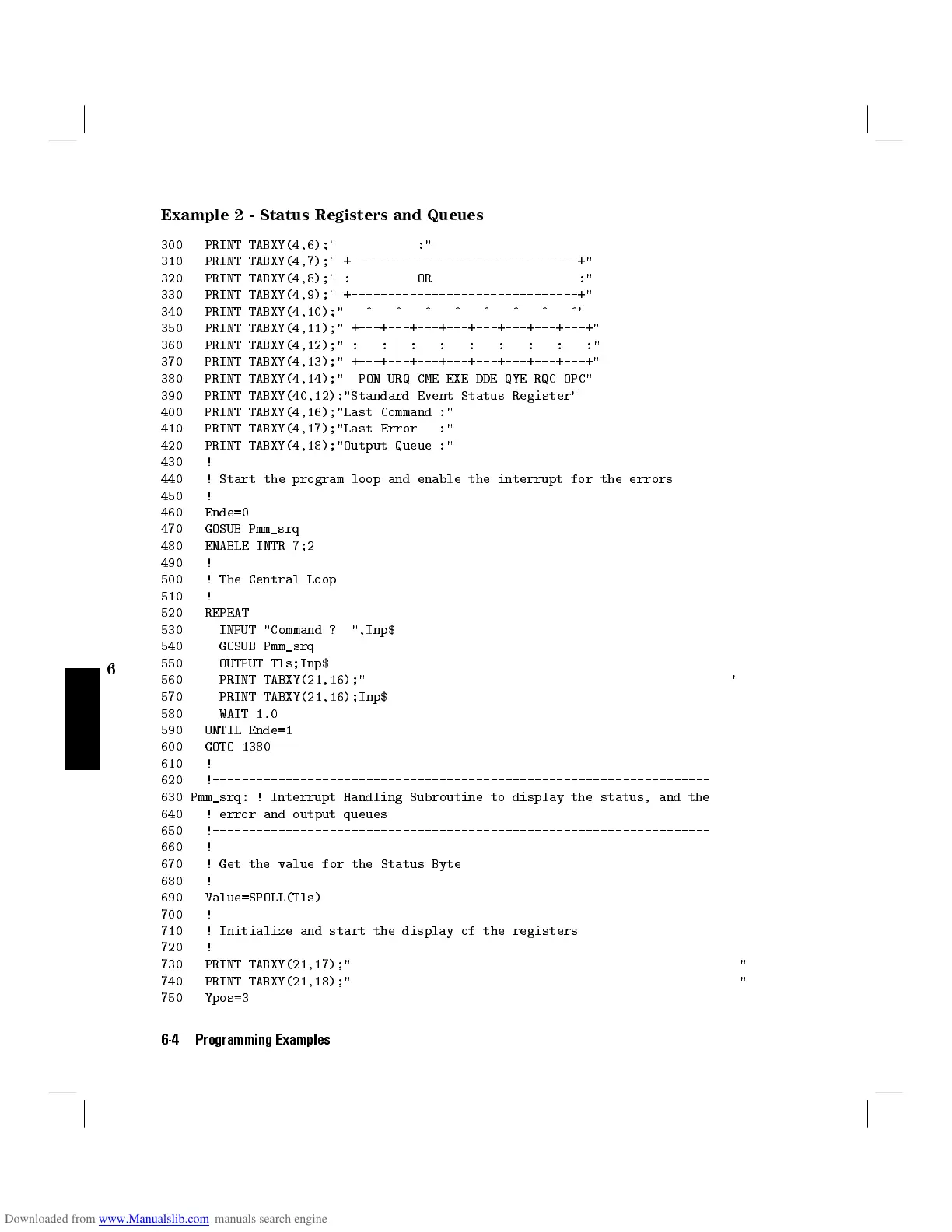
300 PRINT TABXY(4,6);" :"
310 PRINT TABXY(4,7);" +-------------------------------+"
320 PRINT TABXY(4,8);" : OR :"
330 PRINT TABXY(4,9);" +-------------------------------+"
340 PRINT TABXY(4,10);" ^ ^ ^ ^ ^ ^ ^ ^"
350 PRINT TABXY(4,11);" +---+---+---+---+---+---+---+---+"
360 PRINT TABXY(4,12);" : : : : : : : : :"
370 PRINT TABXY(4,13);" +---+---+---+---+---+---+---+---+"
380 PRINT TABXY(4,14);" PON URQ CME EXE DDE QYE RQC OPC"
390 PRINT TABXY(40,12);"Standard Event Status Register"
400 PRINT TABXY(4,16);"Last Command :"
410 PRINT TABXY(4,17);"Last Error :"
420 PRINT TABXY(4,18);"Output Queue :"
430 !
440 ! Start the program loop and enable the interrupt for the errors
450 !
460 Ende=0
470 GOSUB Pmm_srq
480 ENABLE INTR 7;2
490 !
500 ! The Central Loop
510 !
520 REPEAT
530 INPUT "Command ? ",Inp$
540 GOSUB Pmm_srq
550 OUTPUT Tls;Inp$
560 PRINT TABXY(21,16);" "
570 PRINT TABXY(21,16);Inp$
580 WAIT 1.0
590 UNTIL Ende=1
600 GOTO 1380
610 !
620 !--------------------------------------------------------------------
630 Pmm_srq: ! Interrupt Handling Subroutine to display the status, and the
640 ! error and output queues
650 !--------------------------------------------------------------------
660 !
670 ! Get the value for the Status Byte
680 !
690 Value=SPOLL(Tls)
700 !
710 ! Initialize and start the display of the registers
720 !
730 PRINT TABXY(21,17);" "
740 PRINT TABXY(21,18);" "
750 Ypos=3
6-4 Programming Examples


 To Next Page