The StellarMate Plus Manual
232 / 341
saturated during the focusing process. A magnitude 3 or 4 star is often sufficient.
Ekos then begins the focusing process by commanding the focuser to focus
inwards or outwards, and re-measures the HFR. This establishes a V-shaped
curve in which the sweet spot of optimal focus is at the center of the V-curve,
and the slope of which depends on the properties of the telescope and camera in
use. In Ekos, a full V-curve is never constructed as the focusing process works
iteratively, so under most circumstances, a half V-curve shape as illustrated in the
Focus Module image is measured.
Because the HFR varies linearly with focus distance, it is possible to calculate the
optimal focus point. In practice, Ekos operates iteratively by moving in discrete
steps, decided initially by the user-configurable step size and later by the slope
of the V-curve, to get closer to the optimal focus position where it then changes
gears and performs smaller, finer moves to reach the optimal focus. In the
default Iterative algorithm, the focus process stops when the measured HFR is
within the configurable tolerance of the minimum recorded HFR in the process. In
other words, whenever the process starts searching for a solution within a
narrowly limited range, it checks if the current HFR is within % difference
compared to the minimum HFR recorded, and if this condition is met then the
autofocus process is considered successful. The default value is set to 1% and is
sufficient for most situations. The Step options specify the number of initial ticks
the focuser has to move. If the image is severely out of focus, we set the step
size high (i.e. > 250). On the other hand, if the focus is close to optimal focus, we
set the step size to a more reasonable range (< 50). It takes trial and error to find
the best starting tick, but Ekos only uses that for the first focus motion, as all
subsequent motions depend on the V-Curve slope calculations.
When using the Polynomial algorithm, the process starts in the Iterative mode, but
once we cross to the other side of the V-curve (i.e. once HFR values start
increasing again after decreasing for a while), the Ekos performs polynomial
fitting to find a solution that predicts the minimum possible HFR position. If a
valid solution is found, the autofocus process is considered successful.
While Ekos Focus Module supports relative focusers, it is highly
recommended to use absolute focusers.
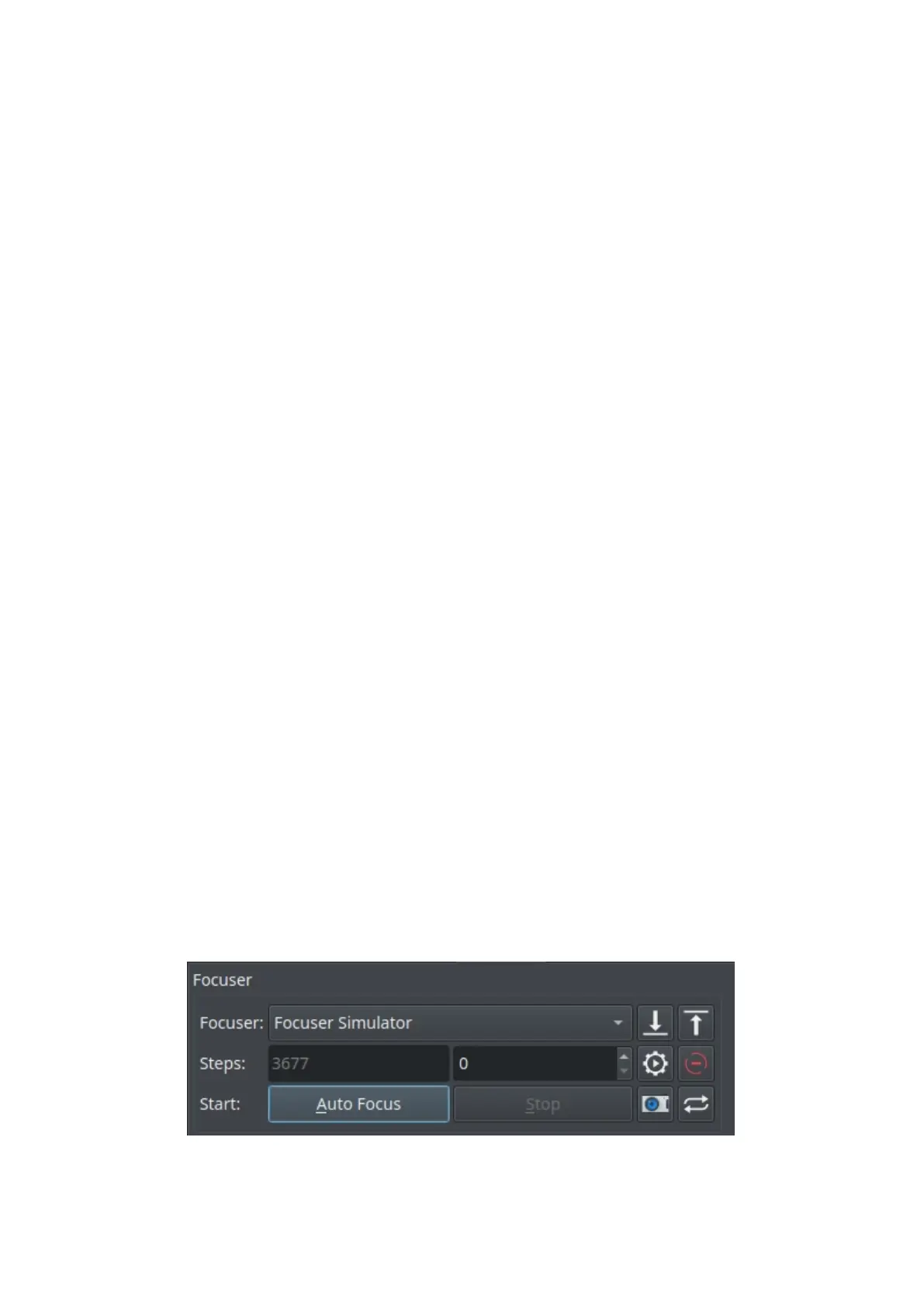
Focuser Group
Any INDI-compatible focuser is supported. It is recommended to
use absolute focusers since their absolute position is known on power up. In INDI,



 To Next Page