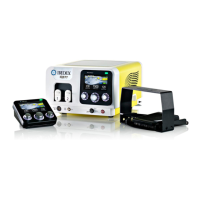
PASCAL
®
Synthesis Ophthalmic Scanning Laser Systems Page 21 of 141
88292-EN, Rev D
Protecting Non-target Tissues
Never place hands or other objects in the path of the laser beam. Severe burns could occur.
Except during actual treatment, the system must always be in STANDBY mode. Maintaining
the system in STANDBY mode prevents accidental laser exposure if the footswitch is
inadvertently depressed.
Only the person aiming the laser beam should have access to the footswitch. Use caution
depressing the footswitch when it is in proximity to a footswitch for other equipment. Make
sure the footswitch depressed is the correct one to avoid accidental laser exposure.
Operational Safety
Read this operating manual thoroughly and be familiar with its contents prior to using this
equipment.
If excessive or unintended eye movement is a concern, treatment is not recommended.
Exercise caution while setting treatment parameters (for example exposure time and the
number of spots per pattern) when laser burns are to be delivered in the non-macular area
for long time periods leading to longer grid completion times. Please be aware that with
longer completion times, the possibility of patient movement increases the risk of treatment
of unintended targets.
Verify eye safety filter is properly attached to the slit lamp prior to use.
Always verify the power settings on the screen prior to pressing the footswitch.
Verify adjustments to laser parameters on the monitor before pressing the footswitch.
Verify that the slit lamp eyepieces are adjusted to your settings before each use, especially
in a multi-user practice. Only when the eyepieces are properly adjusted is the laser confocal
with the microscope. The laser spot diameter will not be accurate and may result in over
treatment or under treatment if the eyepieces are not properly adjusted.
When the system is in READY mode, if the aiming beam is not present, is distorted, or is
incomplete, do not proceed with treatment. Turn off the machine and contact service.
It is the responsibility of the physician to select appropriate combinations of repetition rate
and exposure time to avoid overexposure or unintended exposure.
It is the responsibility of the physician to verify that the pattern visualized through the slit
lamp is the same as the pattern displayed on the control panel. A discrepancy between
patterns could indicate a hardware failure. Should this occur, discontinue treatment and



 To Next Page