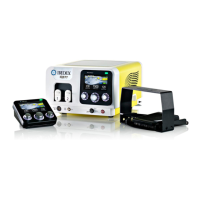
PASCAL
®
Synthesis Ophthalmic Scanning Laser Systems Page 26 of 141
88292-EN, Rev D
The laser system utilizes an electronic laser safety shutter. The system will not be able to
emit laser light unless all safety conditions are met prior to depressing the footswitch. The
safety shutter is activated when the system is off, during the self-test at turn-on, in STANDBY
mode or when the safety monitor detects a fault.
Location of Controls
Controls are located on the touch screen control panel.
Manual Reset
If laser emission is externally interrupted during treatment by activation of the door interlock,
the system will automatically go into STANDBY and the safety shutter will revert to a closed
position. To resume treatment, reset the system by placing the laser in READY.
If laser emission is interrupted by main electrical power loss, the system will automatically
turn off. To resume treatment after an electrical power loss, the system must first be manually
restarted by rotating the key switch to the ON position.
Electrical Fault Detection Circuitry
If the electronic system detects a fault condition, laser exposure cannot occur. The laser is
disabled, the safety shutter is closed and the footswitch is disabled. Some fault conditions may
be cleared by the operator. See “Troubleshooting” for additional information.
Location of Regulatory and Other System Labels
As required by the regulatory bodies, appropriate warning labels have been mounted in
specified locations on the instrument to indicate conditions under which the user could be
subjected to laser radiation. Location and description of caution, warning and system labels
are described on the following pages.
Ophthalmic Applications
PASCAL Synthesis Ophthalmic Scanning Laser System is used to treat ocular diseases in
both the posterior and anterior chambers of the eye. The laser systems are well-suited for
treating the eye, because they have minimal effect on transparent tissues and materials.
PASCAL Synthesis laser energy can be efficiently delivered to opaque structures of the eye
through the transparent cornea, aqueous humor, lens and vitreous humor, allowing many
conditions to be treated by non-invasive techniques. Laser energy is delivered to opaque
structures within the eye through a slit lamp that has been specially adapted for use as a
laser delivery system.
The delivery system includes a lens system to focus the laser energy and vary the size of the
laser spot in the plane of observation of the slit lamp. It includes a mechanism to manipulate
the position of the laser beam without moving the slit lamp. Laser energy is delivered to the
slit lamp through a flexible fiber optic.
For most procedures, a laser contact lens is used to direct laser energy to the part of the eye
being treated. The contact lens may have mirrors so that laser energy can be delivered to



 To Next Page