61
8 Configuration
8.8 Timer “tFct”
tFct: Timer function
Time-dependent control actions can be carried out with the help of the timer. The
timer signal (timer 1+ 2) shows whether the timer is active. It can be output via the
binary outputs or processed internally.
The timers are started or canceled via the binary functions.
v Chapter 8.6 “Binary functions “binF””
The current timer run times can be viewed at the operator level (process data).
Configuration
Analog inputs
Controller
Generator
Limit comparators
Outputs
Binary functions
Display
Timer
Interfaces
Timer 1 tF1 ➔
Timer 2 tF2 ➔
Symbol Value/selection Description
Function
Fnct
0
1
2
3
4
5
6
no function
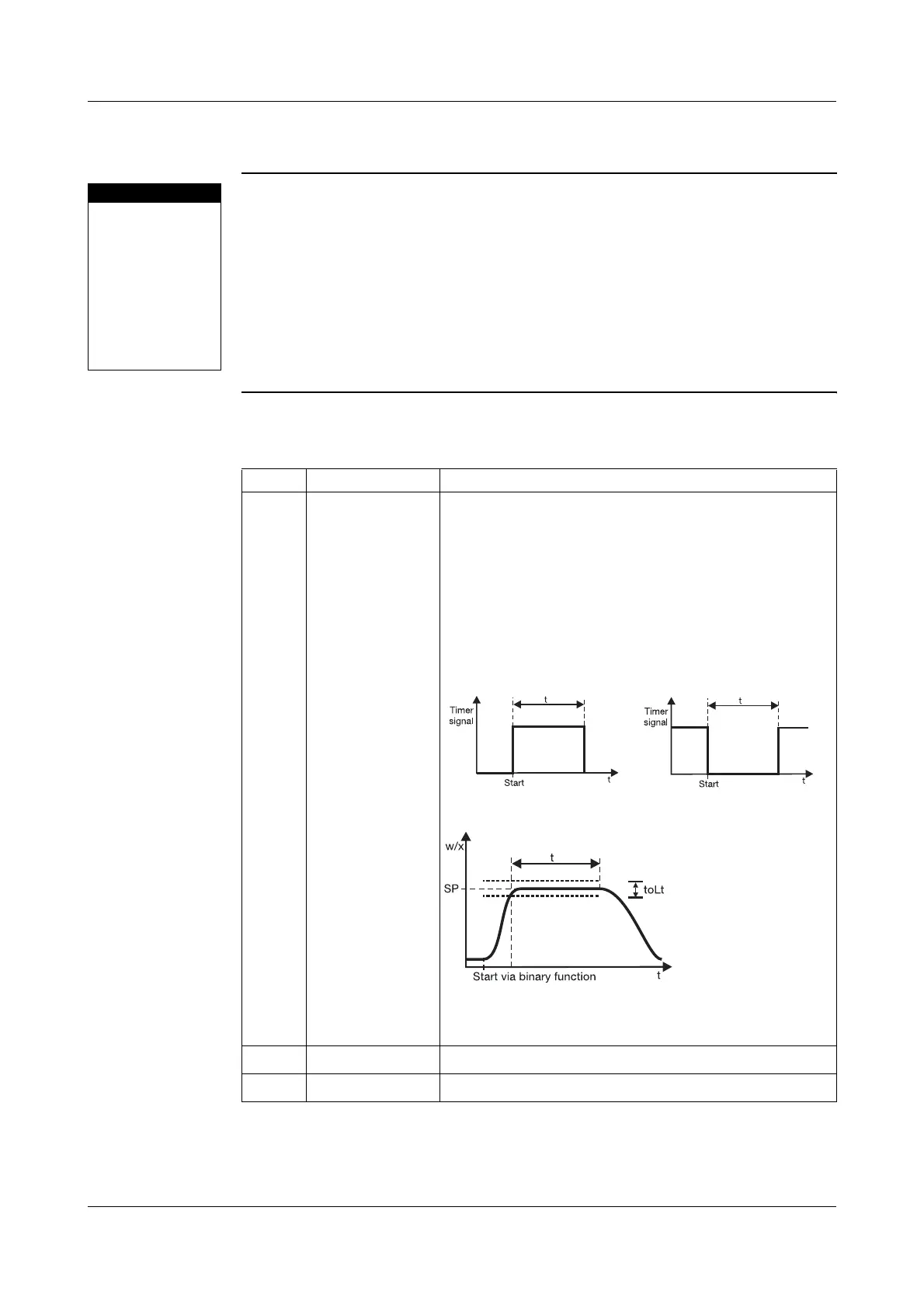
with timer running: timer signal=1 (signal is active) /
unit of time: hh:mm
with timer running: timer signal=0 (signal is inactive) /
unit of time: hh:mm
tolerance band / unit of time: hh:mm
with timer running: timer signal=1 (signal is active) /
unit of time: mm:ss
with timer running: timer signal=0 (signal is inactive) /
unit of time: mm:ss
tolerance band / unit of time: mm:ss
Signal active Signal inactive
Function: “Tolerance band”
The time runs when the process value has reached a tolerance
band around the setpoint.
Timer signal = 1 (signal is active) from the start of the function
until the time has expired.
Timer setting
t
0...99:59 Time input (unit of time, see “Function”)
Tolerance limit
toLt
0…999 0=off
Factory settings are shown bold.



 To Next Page