suspension bellows of the truck and
separate it from the Low-loader.
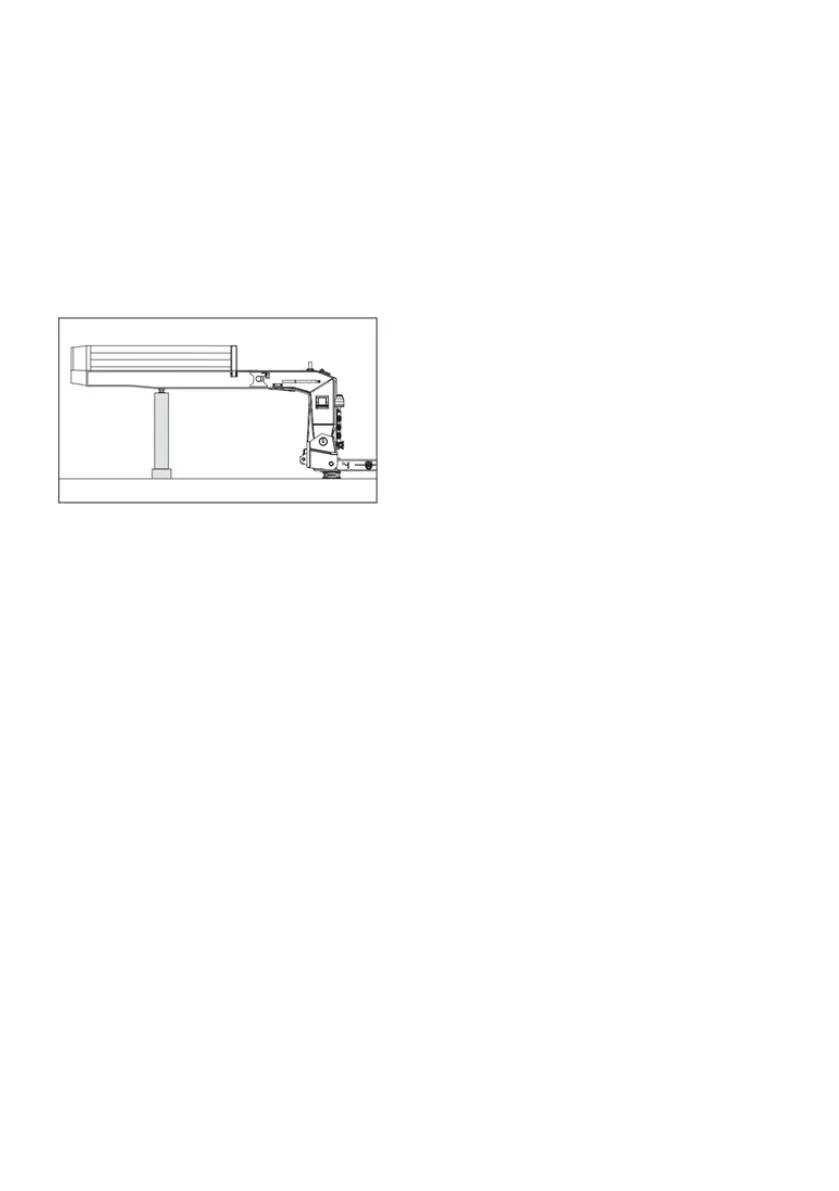
5.2.3. Parking of the Low-Loader
In case you will park your Low-Loader,
which is not connected to the truck, for a
long time, place the aluminium support
under the gooseneck and loading plat-
form, as shown in the picture on the side,
and park it with minimum pressure on
the gooseneck lowering-lifting cylinders
and airbags.
Parked Low-Loader
5.3. Loading – Unloading Operations
Safety Reminder
• During the loading/unloading opera-
tions, the parking brake must be ac-
tivated, and the vehicle must be
fixed with Wheel chocks.
• To prevent slipping, tipping or sink-
ing of the vehicle, the vehicle must
be parked on a flat and firm surface.
• Ensure that you made a proper load
distribution in compliance with all
laws, rules and regulations.
• The suspension of the vehicle may
be raised during the loading/ un-
loading process. Because of this
reason, the vehicle height may be
bigger than the permitted height lim-
its. Always set the trailer in the driv-
ing position after loading and
unloading. Always check height lim-
its when entering tunnels and
passages.
• Make sure that the weight or dimen-
sions of the load do not exceed the
technical and legal limits.
• Note that vehicle stability may be af-
fected by the load distribution, the
braking distance may be longer and
a larger turning radius may be
required.
• During loading, consider the laws of
the countries you are going to and
passing through, as well as the
laws.
• Give attention to the maximum axle
weight and total weight.
• Comply all national/international
laws, rules, and regulations about
loading and occupational safety.
5.4. Cautions During the Parking and
Stopping
• Involuntary trailer movements, un-
stable posture and insufficient
safety at night may occur serious
accidents and injuries.
• Use the parking brake and wheel
chocks while stopping.
• If you are going to park the vehicle
in a public traffic area, you must use
the necessary marking plate in ac-
cordance with legal regulations.
5.5. Loading
• The load must be fixed so that it
does not move while the vehicle is
in motion or during sudden stops.
• Distribute any load as low as possi-
ble on the loading floor. The load's
center of gravity must always be
above the vehicle's centerline.
• After the loading / unloading opera-
tion is completed, all the final side
structures are securely in place.


 To Next Page