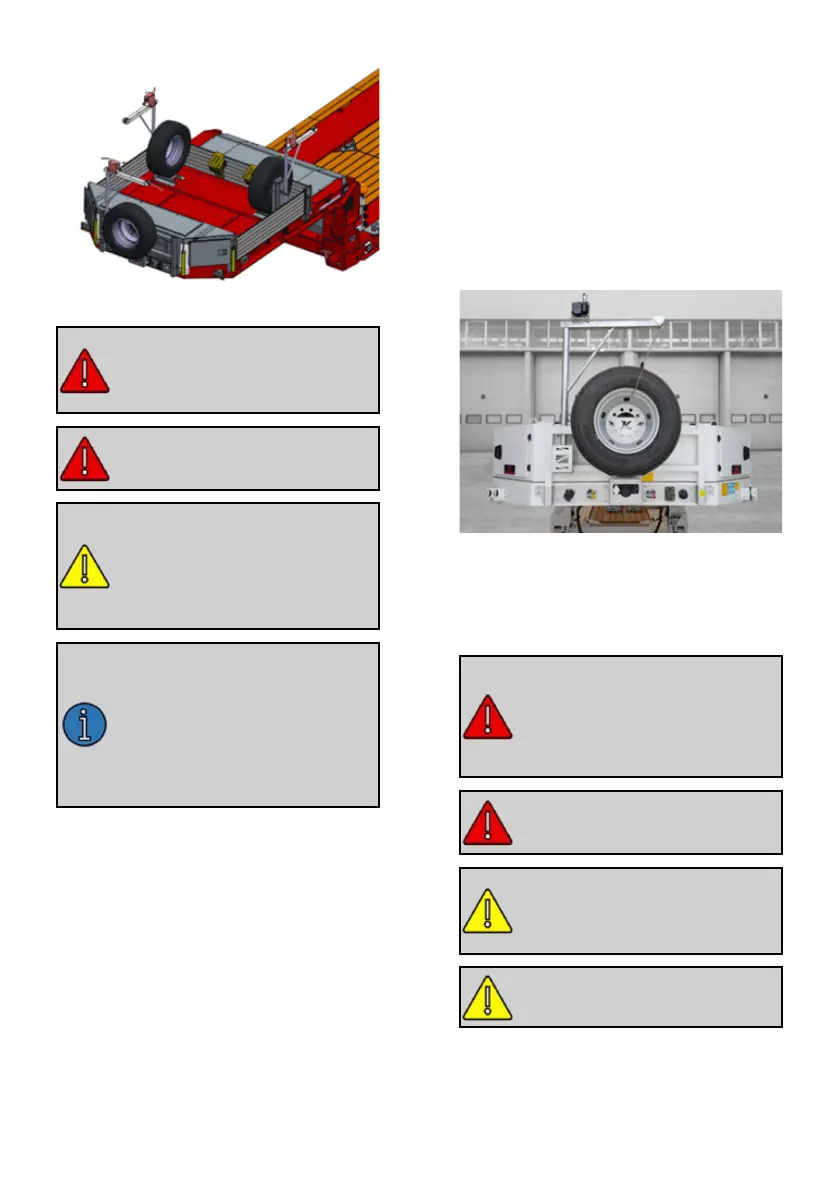
Spare holder
Make sure that you put the ne-
cessary warning signs and ta-
ke the safety precautions
during the tire change.
Driving with insufficiently se-
cured spare tire (s) can cause
traffic accidents.
Since tires are heavy parts,
pay attention to ergonomics
and occupational health and
safety rules during tire repla-
cement. There is a risk of
pinching, falling, and cutting.
For whatever tire the spare ti-
re carrier is designed for,
carry only that type of tire in
the carrier. Follow the rules
and regulations when remo-
ving/installing or maintaining
the spare tire or regarding the
spare tire carrier.
3.9. Spare Tire Lowering Crane
The crane system is used to lower the
spare tire and is supplied upon request
by the customer
• Attach the carabiner at the end of
the crane rope to the rim of the
spare tire.
• Wind the rope by turning the mecha-
nism handle on the crane. The
raised tire will come out of its slot.
• Turn the crane arm until the tire is
out of the vehicle.
• Open the rope by turning the mech-
anism handle on the crane. The tire
will go down.
• Remove the carabiner at the end of
the rope from the rim.
• Collect the rope by wrapping it on
the crane again. Attach the carabi-
ner to the fixing pin on the rear of
the spare wheel.
Spare tire lowering crane
3.10. Wheel Chock
There are two units wheel chocks and
holders in the vehicle.
The vehicle must be secured
with wheel chocks when par-
ked on a slope area, during
the loading and unloading
operations or when parked
without a tractor.
Only place wheel chocks on
wheels on fixed axles, never
on idle/steer axles.
When the wheel chocks is fi-
xed inside the holder, be sure
that the pins will be mounted
properly.
After driving operations, place
the wheel chocks properly.
3.10.1. Pin Type Wheel Chock Holder
Removing the wheel chock from hold-
ers:Pull out the cotter pin (1) located at
the end of the wheel chock holder. Then


 To Next Page