of tractors, trucks, trailers, semi-trailers
along with how and how much of the ton-
nage and dimensions of these loads are
to be secured.
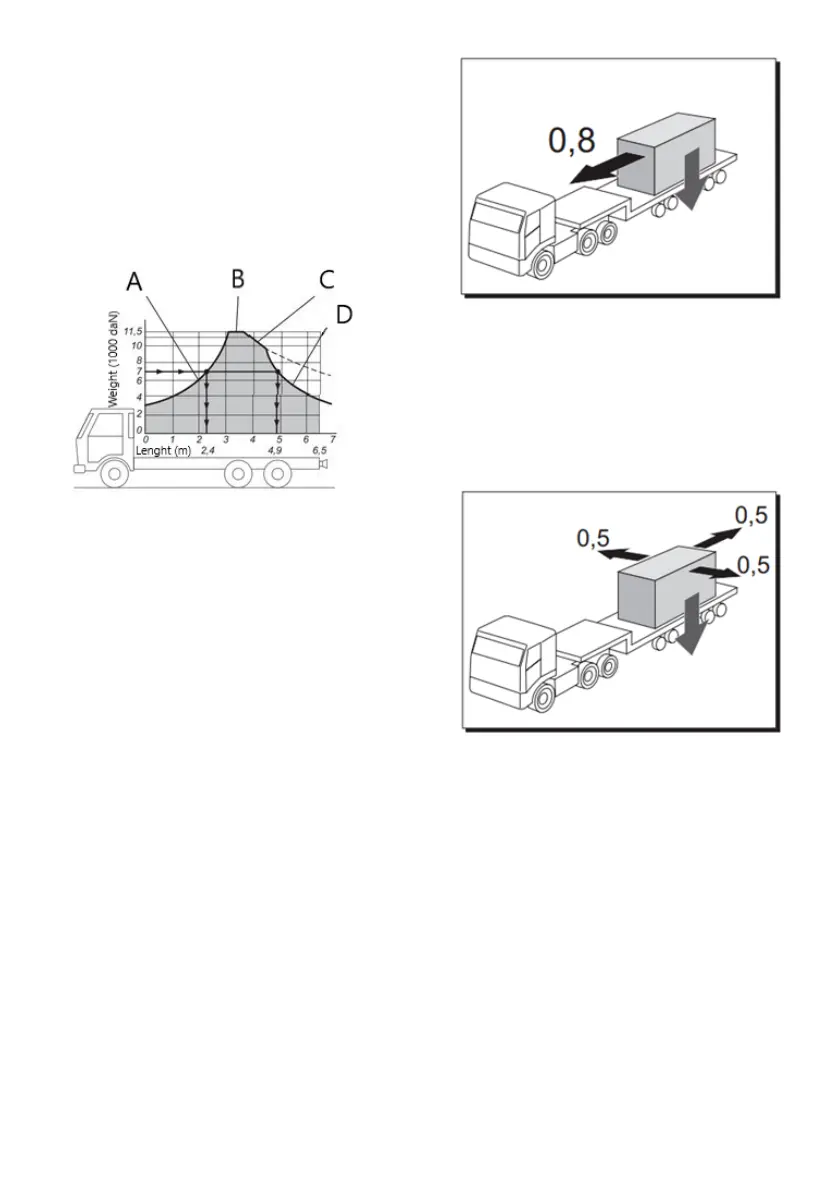
For instance, here, the distribution of the
load amount that can be carried by a 6x2
truck per its axle, to the vehicle’s weight
center according to its horizontal and
vertical distance.
Load Distribution
A- Permissible front axle weight
B- Permissible maximum weight
C- Permissible rear axle weight
D- Driving characteristic change limit
7.2. Load Distribution and Load
Limits of Truck-Semi-Trailer
Combination
In order to determine the characteristics
of the load lashing device required for
daily use, the maximum lashing forces
have been defined, taking into account
the tensile forces encountered during
normal driving, emergency braking and
sudden steering manoeuvres.
The following two clamping force re-
quirements, expressed as a ratio of the
load weight force, shall apply.
Forward lashing (for sudden braking)
0.8% or 80% of the load weight force.
A load with a weight force of 1000 daN
must be secured against forward slipping
with at least 800 daN.
Fastening forward
Backward and lateral fastening (obstacle
avoidance/standstill acceleration) 0.5%
or 50%.
A load with a weight force of 1000 daN
must be fastened with at least 500 daN
against shear in these three directions.
Backward and lateral lashing
7.2.1. Downlink Load Lashing
The basic principle of downward lashing
is based on applying an additional hori-
zontal connecting force to increase the
inertia force to reach the maximum al-
lowable horizontal lashing force (0.8 of
the weight force for forward lashing).
7.2.1.1. Lashing the Tie Straps
Lashing angle ~90°
Attachment straps should be as perpen-
dicular as possible to ensure that the
tension force applied using the ratchet
tensioner presses down on the load as
much as possible.


 To Next Page