6482-901-01 Rev. A / August 2012 Return to Section Topics D-3
Model 6482 Dual-Channel Picoammeter / Voltage Source Reference Manual Appendix D: Measurement Considerations
that the recommended source resistance varies by measurement range because the R
F
value
also depends on the measurement range.
Source capacitance
The source capacitance of the device under test (DUT) will also affect the noise performance of
the Model 6482 ammeters. In general, as source capacitance increases, the noise gain also
increases.
The elements of interest for this discussion are the capacitance (C
DUT
) of the DUT and the internal
feedback capacitance (C
F
) for the ammeter. Taking into account the capacitive reactance of these
two elements, our previous noise gain formula must be modified as follows:
Output V
NOISE
= Input V
NOISE
(1 + Z
F
/Z
DUT
)
where;
• Output V
NOISE
is the noise seen at the output of the ammeter.
• Input V
NOISE
is the noise seen at the input of the ammeter.
•Z
F
is the internal feedback impedance for the ammeter that is formed by C
F
and R
F
.
•Z
DUT
is the internal impedance of the DUT that is formed by C
DUT
and R
DUT
.
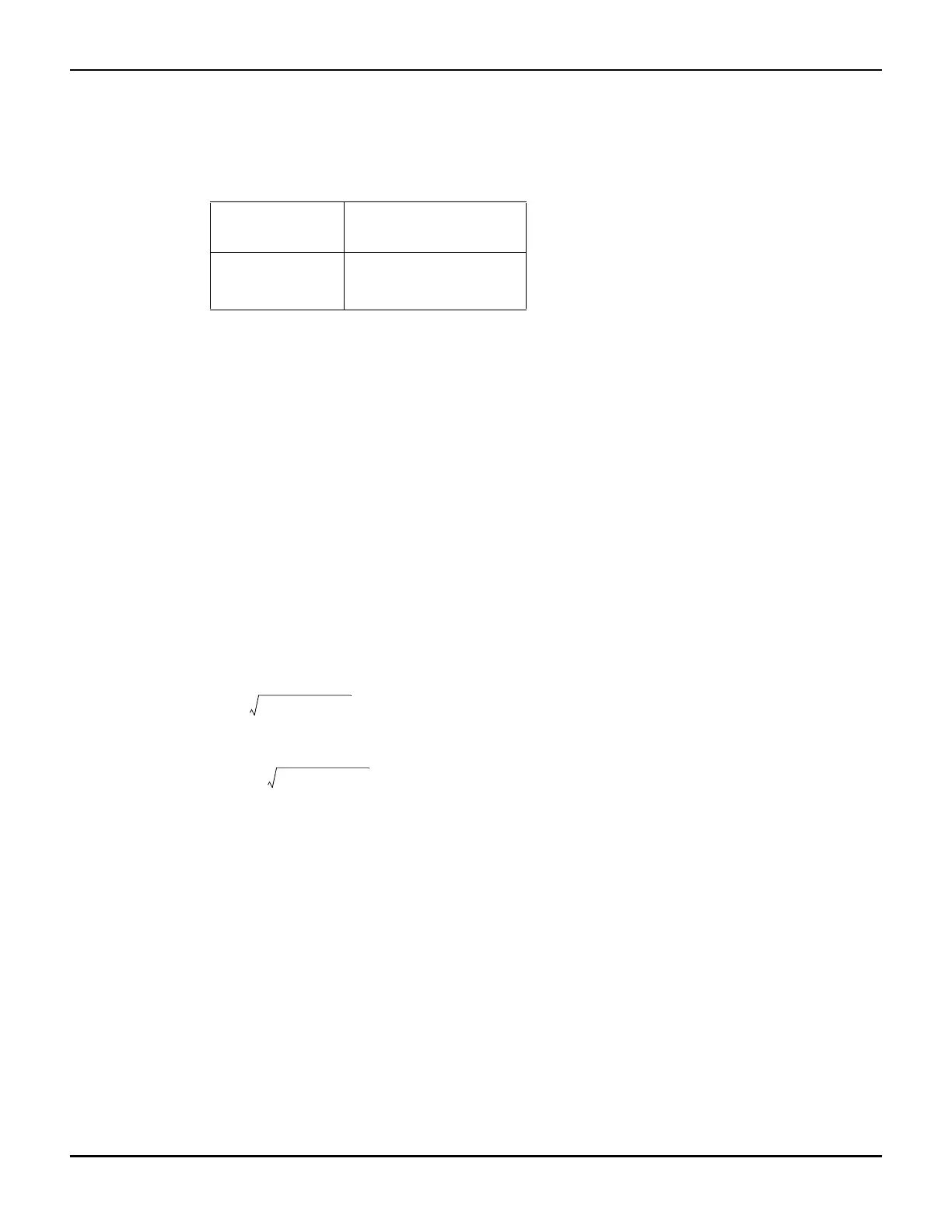
Furthermore,
and
Note that as C
S
increases in value, Z
DUT
decreases in value, thereby increasing the noise gain.
Again, at the point where Z
DUT
= Z
F
, the input noise is amplified by a factor of two.
Generated currents
Any extraneous generated currents in the test system will add to the configured current, causing
errors. Currents can be internally generated, as in the case of instrument input offset current, or
they can come from external sources such as insulators and cables.
Offset currents
Internal offset current: The ideal ammeter should read zero when its input terminals are left
open. Practical ammeters, however, do have some small current that flows when the input is open.
This current is known as the input offset current, and it is caused by bias currents of active devices
as well as by leakage currents through insulators within the instrument.
The internal input offset current adds to the source current so that the meter measures the sum of
the two currents:
Table D-1
Minimum recommended source resistance values
I-measure range
Minimum recommended
source resistance
1 nA – 200 nA
2 µA – 200 µA
2 mA and 20 mA
1 MΩ to 100 MΩ
1 kΩ to 100 kΩ
1 Ω to 100 Ω
Z
F
R
F
2πfR
F
C
F
()
2
1+
--------------------------------------------=
Z
DUT
R
S
2πfR
S
C
S
()
2
1+
--------------------------------------------=


 To Next Page