
 Need help?
Do you have a question about the Kintech Engineering ORBIT 360 and is the answer not in the manual?
Provides Kintech Engineering contact details for assistance and support.
Outlines the warranty terms and conditions for the Orbit 360 data logger.
Information regarding copyrights and how to provide feedback on the manual.
Guidelines for the proper recycling and disposal of the Orbit 360 data logger.
Instructions on how to obtain technical support and find answers to questions.
Overview of Orbit 360 data logger models and their features.
Details on available models and optional accessories for the Orbit 360.
Instructions on obtaining the Atlas software and a valid license.
Specifies the necessary hardware and software for using the Orbit 360.
Steps for configuring the Orbit 360 data logger using Atlas software.
Configuring the main dashboard settings in Atlas for the Orbit 360.
Setting up general identification, language, and site information in Atlas.
Configuring sensor connections and data collection parameters in Atlas.
Setting up modem and connection passwords for the Orbit 360 in Atlas.
Configuring automatic data download schedules within Atlas.
Procedures for uploading configuration files to the SD card via PC or logger.
Steps for installing and operating the Orbit 360 data logger in the field.
How to download recorded data from the Orbit 360 using Atlas.
Detailed description of the Orbit 360 data logger's capabilities and specifications.
General information and characteristics of the Orbit 360 data logger.
Explanation of the sampling rate and data capture for the Orbit 360.
Details on configurable averaging periods and data timestamping.
Explanation of the data flow and management process for Kintech loggers.
How and when configuration changes made in Atlas take effect on the logger.
How to reset the Orbit 360 data logger by disconnecting power.
Information about the internal tilt sensor and its function for met mast stability.
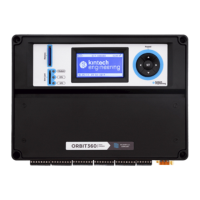
Visual guide identifying the main components of the Orbit 360 logger.
Describes the LCD display and the information it provides.
Explains the use of the keypad for navigation and parameter changes.
Details the meaning of the Modem, CPU, and GPS status LEDs.
Information on recommended external batteries and connection for the Orbit 360.
Proper grounding procedures for lightning protection and logger safety.
Description of the internal quad-band GSM-GPRS modem.
Description of the internal GPS module and its time/coordinate update function.
Functionality of the internal RTC for maintaining date and time.
Port used for connecting the data logger to a Modbus TCP SCADA system.
Details on the external SD/MMC memory slot and compatible card types.
Location and insertion procedure for the SIM card in the logger.
Description of the 92 removable terminals and their grouping.
Configuration and operation of alarms and actuators based on measured values.
Overview of the Atlas software for managing and connecting to data loggers.
Specifies the operating voltage requirements for the Orbit 360 data logger.
Details stress ratings that may cause permanent damage to the device.
Technical details for the various output terminals of the Orbit 360.
Overview of specifications for frequency, analog, and RS485 input channels.
Details on communication options like GSM/GPRS, Iridium, BGAN, and direct COM.
Specifications for data sampling rate, recording intervals, and storage.
How the logger conserves power during supply issues.
Technical characteristics of optional internal backup batteries.
Dimensions, weight, display, keypad, and LED specifications.
Pre-installation checks and recommendations for site visits.
Steps for configuring the logger before installation, using SD card or keypad.
Essential grounding and lightning protection measures for met masts.
Guidelines for installing GSM and GPS antennas for optimal signal reception.
Instructions for connecting various sensors to the logger's terminals.
Procedure for safely powering on the Orbit 360 data logger.
How to navigate menus and operate the logger using its five-button keypad.
Procedure for safely powering down the Orbit 360 data logger.
Explanation of the logger's LCD display areas and information shown.
How to edit parameter values directly on the logger's display.
How to navigate through the logger's menus using the keypad.
Viewing real-time and averaged data for analog channels 1-8.
Viewing real-time and averaged data for analog channels 9-23.
Displays system parameters like firmware, serial number, and communication status.
Information on signal strength, RX buffer, and access point name for the modem.
Information on serial channels that did not answer since the last download.
Summary of Modbus communication status, including FSM and RX buffer.
Displays geographical coordinates, GPS status, and number of satellites.
Shows instantaneous, max, and min battery voltage for status checks.
Displays stored data duration, firmware/hardware versions, and logger model.
Access to configure logger parameters like modem type and SIM PIN.
Selection of different Modbus RTU options and baud rates.
Setting the first two digits of the site ID for unique logger identification.
Setting the second two digits of the site ID for unique logger identification.
Setting the third two digits of the site ID for unique logger identification.
Configuring the first two digits of the SIM PIN code for security.
Configuring the second two digits of the SIM PIN code for security.
Choosing the display language for the logger menus from available options.
Reserved setting; do not edit without Kintech Engineering assistance.
Reserved setting; do not edit without Kintech Engineering assistance.
Configuring the type of sensor connected to each logger channel.
Setting the logger's hour, minute, day, month, and year for timestamps.
Performing on-site configurations using the logger's SD card.
Steps to change the SIM card PIN code on the data logger.
Reconfiguring logger channels after replacing a sensor.
Procedures for removing and managing the SD card for data download.
Explanation of full access and real-time data passwords for logger access.
Information about embedding passwords in raw data files for third-party use.
Details on the built-in GSM/GPRS modem, its capabilities, and recommended usage.
How the logger connects to the internet using GPRS and APN settings.
How LNS helps Atlas find logger IP addresses with dynamic IPs.
Features and benefits of Kintech's global SIM cards for data loggers.
Explanation of Circuit Switched Data communication via GSM calls.
Using SMS for logger status checks and basic parameter modification.
Configuring the logger to send data and reports via email.
Overview of satellite communication solutions like Iridium and BGAN.
Details on the Iridium connectivity system, its hardware, and setup.
Key features of the Iridium system for wind resource assessment.
Instructions for installing the Iridium antenna and modem on the logger side.
Instructions for setting up the Iridium system on the office side.
Details on the BGAN satellite module for remote data access.
Key features of the BGAN system for heavy data traffic.
Steps for orienting and connecting the BGAN antenna and modem.
Office-side installation notes for BGAN system.
Using direct RS-232 communication for logger functions.
Recommendations for troubleshooting communication issues with the logger.
Step-by-step guide to identify and resolve internet connectivity issues.
Steps to identify and resolve common failures in satellite telemetry.
Setting up which variables to provide in Modbus telegrams using Atlas software.
Guidance on troubleshooting Modbus RTU using the modscan32 application.
Details on different Modbus adaptations like Acciona, Suzlon, and Enercon.
Setting up TCP parameters in Atlas software for Modbus TCP communication.
 General
| Brand | Kintech Engineering |
|---|---|
| Model | ORBIT 360 |
| Category | Data Loggers |
| Language | English |

 To Next Page