Note:
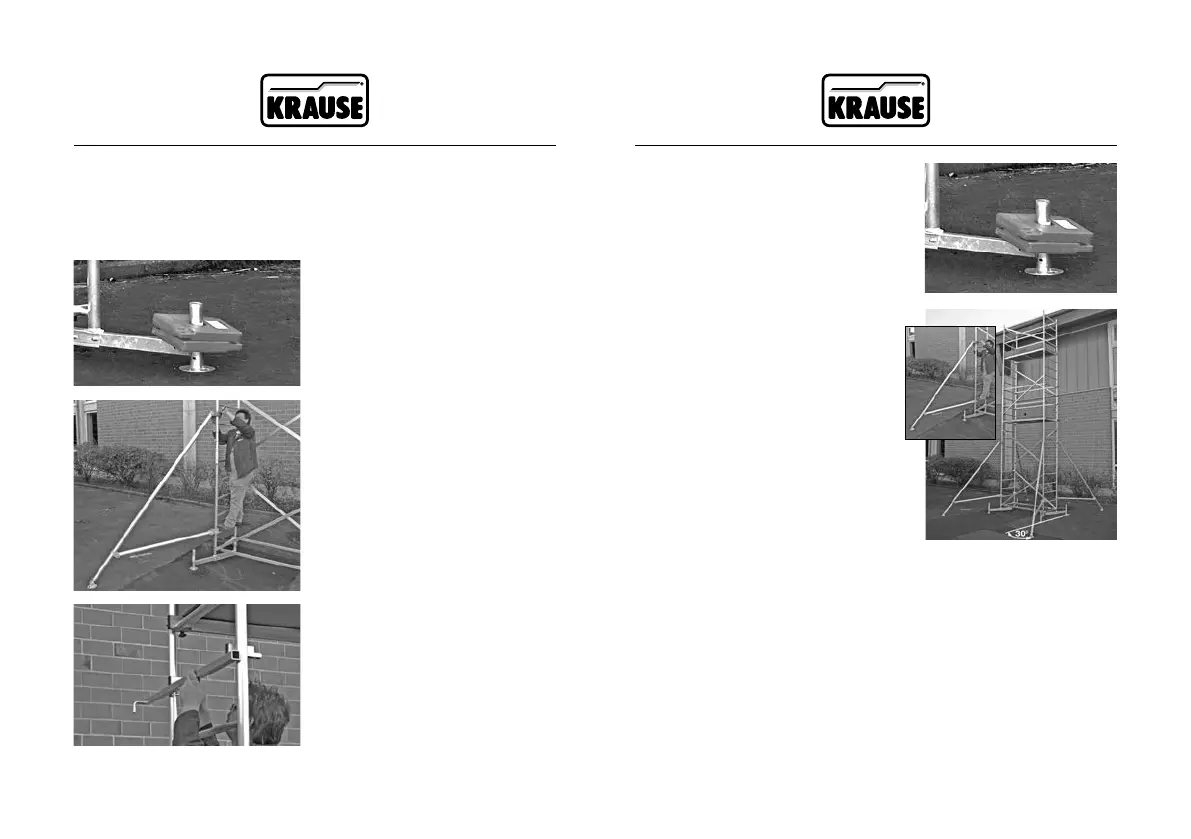
Free-standing scaffolds must be secured against tilting with ballasts, outriggers
and set of stabilisers. For details regarding the number of required ballast weights
and outriggers, refer to the table on page 71.
The picture shows a ballast element
on the traverse.
For details, see page 71
The picture shows an attached
outrigger.
For details, see page 71
The picture shows how to adjust a
stabilizing set.
For details, see page 72
Basicscaffoldwithrstandsecondextension
69 70
Basicscaffoldwithrstandsecondextension
4.5 Ballast load
Free-standing scaffolds must be secured
against tilting with ballasts or outriggers.
Stabilisers can be used in addition to the
above, but not as a substitute for ballast
weights or outriggers. For details regarding
the number of required ballast weights and
outriggers, refer to the table below.
4.6 Assembly option with
outriggers
The optional available outriggers can
be used for the additional safe support
of the scaffold. The assembly of the outrig-
gers must be executed with adequate care.
Theoutriggersmustbexedsturdilywith
thescaffold.Thexingpointsoftheout-
riggers at the scaffold are also used as
anti-twist safeguard.
The feets of the outriggers must be placed
rmlyontheground.Ifnecessary,usesturdy
and altitude equalizing base inserts.
The execution of the outriggers can differ to
the here shown version.


 To Next Page
 Loading...