Chapter 9 Advanced features
Page 9-6 MAN 0384
Transforming results
The basic result produced by the analysis is a volume distribution which is the vol-
ume proportion within each size class of the total volume of the particles. It is pos-
sible to convert this volume distribution to a number, volume or length
distribution. After volume the next most useful distribution type is probably
number, which reports the number proportion of particles in each size class.
The transformation can be expressed mathematically as:
where Xi is the transformed percentage distribution, Vi is the volume distribution
result, di is the mean size of class i and n is the required distribution type (1 for sur-
face, 2 for length and 3 for number).
Note
A small volume of particles of small sizes can be transformed to a signifi-
cant part of a number distribution. If this small volume is just due to noise
or other errors in the measurement, it may swamp the actual desired distri-
bution. These small errors in the measurement are, in effect, magnified by
the transformation. Consider using the Reduce result range facility to
isolate the significant part of the volume distribution before performing
the transformation.
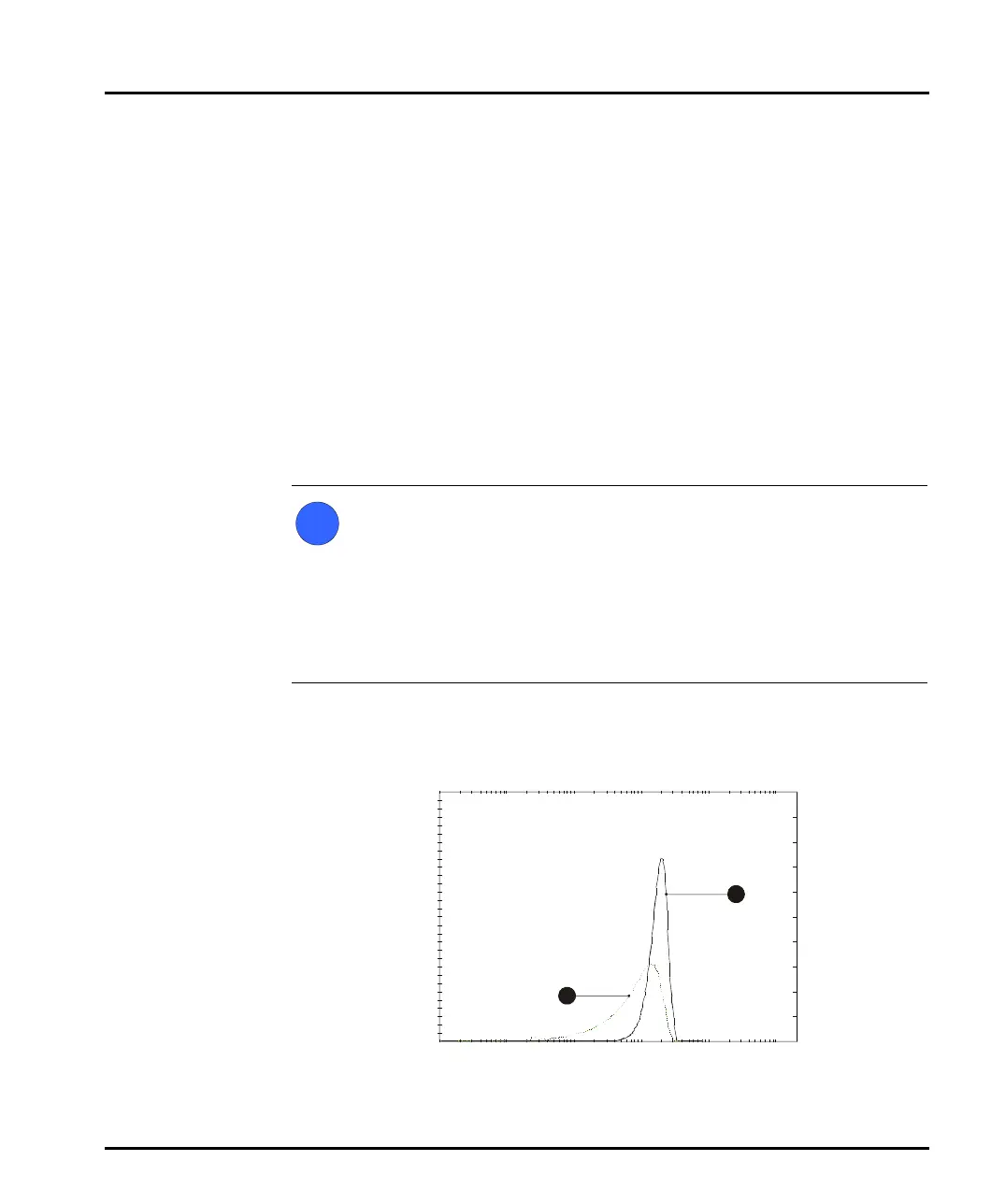
The example below shows the result of transforming a skewed volume distribution
to number .
ill 1874
X
i
100V
i
d
i
n
⁄
ΣV
i
d
i
n
⁄
-------------------------
i
%
30
Particle Diameter (µm.)
0
10
20
0.1 1.0 10.0 100.0 1000.0 10000.0
1
2
1
MAN0384-1.0 Mastersizer 2000.book Page 6 Tuesday, March 20, 2007 8:56 AM



 To Next Page