6
Addressable Loop Response Time
The overall system response time for devices on the AML loop
depends on how many devices are on each loop.
The response times below include three factors:
• input debounce time
• addressable reporting and confirmation time
• processing time required by the panel to activate the output
Response Time (seconds)
Response Time = 1.348 + (0.036 x # of zones)
Use this formula on the PGM with the greater number of zones to
find the loop response for both PGMs.
Addressable Loop Current Calculation
Each addressable multiplex loop can draw a maximum of 170mA
of current from the main panel. In order to determine the amount
of current required for the AML loop, complete the following
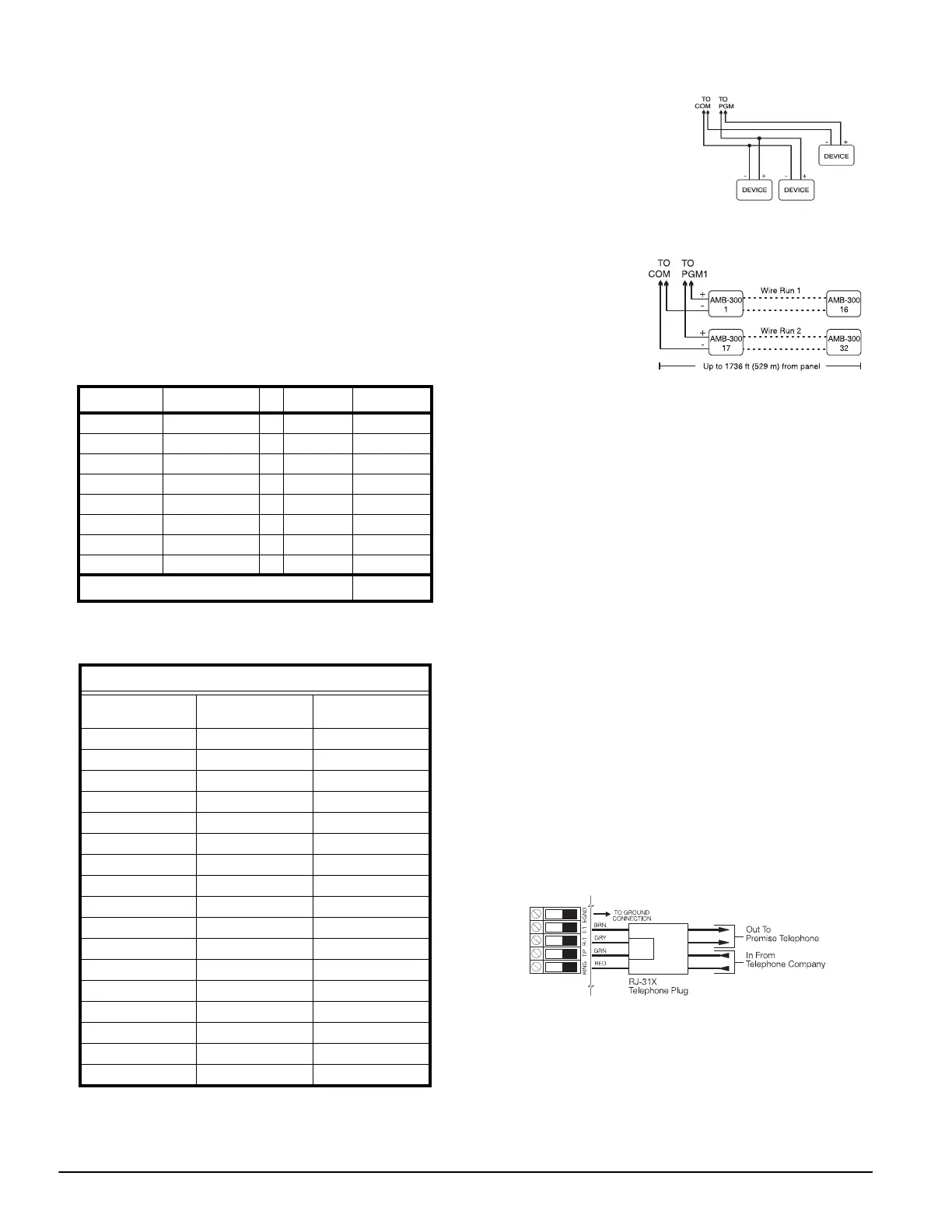
chart:
When more AML devices are added to a single loop, the current
draw increases. The loop wire length must be limited to the fol
-
lowing distances depending on the total loop curent:
Addressable Loop Wiring
AML devices can be home-
run, connected in a daisy
chain, or T-tapped. Wire the
AML loop according to the
following diagram:
This configuration is only
used for AML devices.
Please see the Installation
Instructions provided with
each device for more information regarding operation and wiring.
For longer wire runs,
you can split the
addressable devices
onto two or more
loops from the COM
and PGM terminals.
For example, 32
AMB-300 detectors
(2.5mA each) take 80mA total. In one 18AWG wire run, this
would allow a maximum length of 720 feet (220 m). If you split
the 32 devices into two wire runs of 16 detectors each, using
18AWG wire, each wire run could be 1736 feet (529 m) long. See
the diagram above.
NOTE: No end-of-line resistors are required when installing these
devices.
NOTE: Once the devices are connected, the PGM terminal must be
configured for AML operation and each device must be enrolled. See
Section 4.4 ’Enrolling AML Devices’ for instructions.
NOTE: Do not use shielded wire runs in parallel with each other.
Do not run either AML wire run in parallel with the Combus. Main
-
tain minimum 2” separation between all AML wiring and Combus
wiring.
2.10 Wiring Powered Devices (AUX, SAUX+)
AUX – Auxiliary Power
These terminals can be used to power motion detectors, glass
break detectors and other devices requiring power. The AUX
(positive) and GND (negative) terminals can provide up to
500mA of current.
SAUX+ – Switched Auxiliary Power
This terminal provides positive power (12VDC) and can be de-
energized via the [*][7][2] keypad command (provided that the
output is programmed as Command Output #2). Typically, this
output is used for providing power to latching type devices that
require a power interruption in order to reset.
2.11 Telephone Line Wiring
The telephone terminals provide connections to the incoming
telephone lines for central station reporting. The wires from the
RJ-31X jack must be connected in the following manner:
NOTE: There must be no other telephone equipment connected
between the control panel and the incoming telephone line (e.g.
answering machines, fax machines, telephones, etc.). Ensure that
plugs and jacks meet the dimension, tolerance and metallic plating
requirements of 47 CFR Part 68 Subpart F.
Addressable Loop Current Calculation Chart
Item Current (mA) x Quantity Tot al (m A)
AMS-220/T 0.8 x
AMB-300 2.5 x
AMB-500 .75 x
AMB-600 3.5 x
AMA-100 3.5 x
AMP-700 0.8 x
AMP-701 0.8 x
AMP-702 0.8 x
Total Current =
Loop Current vs. Wiring Distance
TOTAL LOOP
CURRENT(MA)
22 AWG
DISTANCE(FT/M)
18 AWG
DISTANCE(FT/M)
10 2880/878 5143/1568
20 1620/494 3645/1111
30 1010/308 2520/768
40 771/235 1736/529
50 600/183 1250/381
60 500/152 980/298
70 400/122 800/244
80 321/98 720/220
90 250/76 500/152
100 200/61 310/95
110 165/50 220/67
120 135/41 155/47
130 115/35 130/39
140 106/32 126/38
150 100/30 124/37
160 98/29 122/36
170 96/28 120/35


 To Next Page