Installer and Access Codes
25
SECTION 1 2 3 4 5 6 7 8 9 10 11 12 13 14 15 16
Tenant Code
4. Press [8] or [*].
5. Enter up to 4 digits for the tenant code.
6. When you are finished, press [#].
7.4 Modify An Existing Code
To modify an existing code, you must first search for it using one
of two methods: search by user number or by user name.
To search for the code by user number, perform the following:
1. Enter [*][5] followed by a Master code.
2. The display will read:
Select (0) for
User Number Search
Press [0] or [*].
3. Enter the access code number and press [*] to continue pro-
gramming. You can also use the arrow (< >) keys to scroll to
the desired number.
To search for the code by user name, perform the following:
1. Enter [*][5] followed by a Master code.
2. The display will read ’Select (0) for User Number Search’.
Use the right arrow (>) key to scroll to the following display:
Select (1) for
User Name Search
Press [1] or [*].
3. The first letter of the access code name using the correspond-
ing number key. For example, for John, enter the letter ’J’ by
pressing the [4] key once.
4. The keypad will display the first available name starting with
the selected letter. Use the right arrow (>) key to scroll
through subsequent names.
5. Once the appropriate user name is displayed, press [*] to con-
tinue programming.
Once the code has been selected, the Program Code menu will be
shown. Reprogram the access code, code label or partition access
using the steps outlined in
Program A New Code.
7.5 Change User Code Options
User code options determine which system features the code will
be able to access. The Access User Code Options Table shows all
of the available access code options. The table also indicates
which options are enabled by default for each type of code.
To change the user options for a code from its default settings,
perform the following:
1. Enter [*][5][master code].
2. Locate the code using one of the code searching methods (see
section 7.3 Programming Access Codes). Press [*] to select.
3. Use the right arrow (>) key to scroll to the following display:
Select (5) < >
Edit User Opt’s
Press [5] or [*].
4. Use the arrow (< >) keys to scroll through each option. Press
[*] to turn each option on (Y) or off (N).
5. When the desired options have been programmed, press [#].
7.6 Delete An Existing Code
An access code may be erased in two parts. First, all data pertain-
ing to the code may be deleted (access code, user options, parti-
tion access, etc.). The access code label is erased separately.
To delete all access code data from an existing code, perform the
following:
1. Enter [*][5][master code].
2. Locate the code using one of the code-searching methods (see
section
7.4 Modify An Existing Code). Press [*] to select.
3. Use the right arrow (>) key to scroll to the following display:
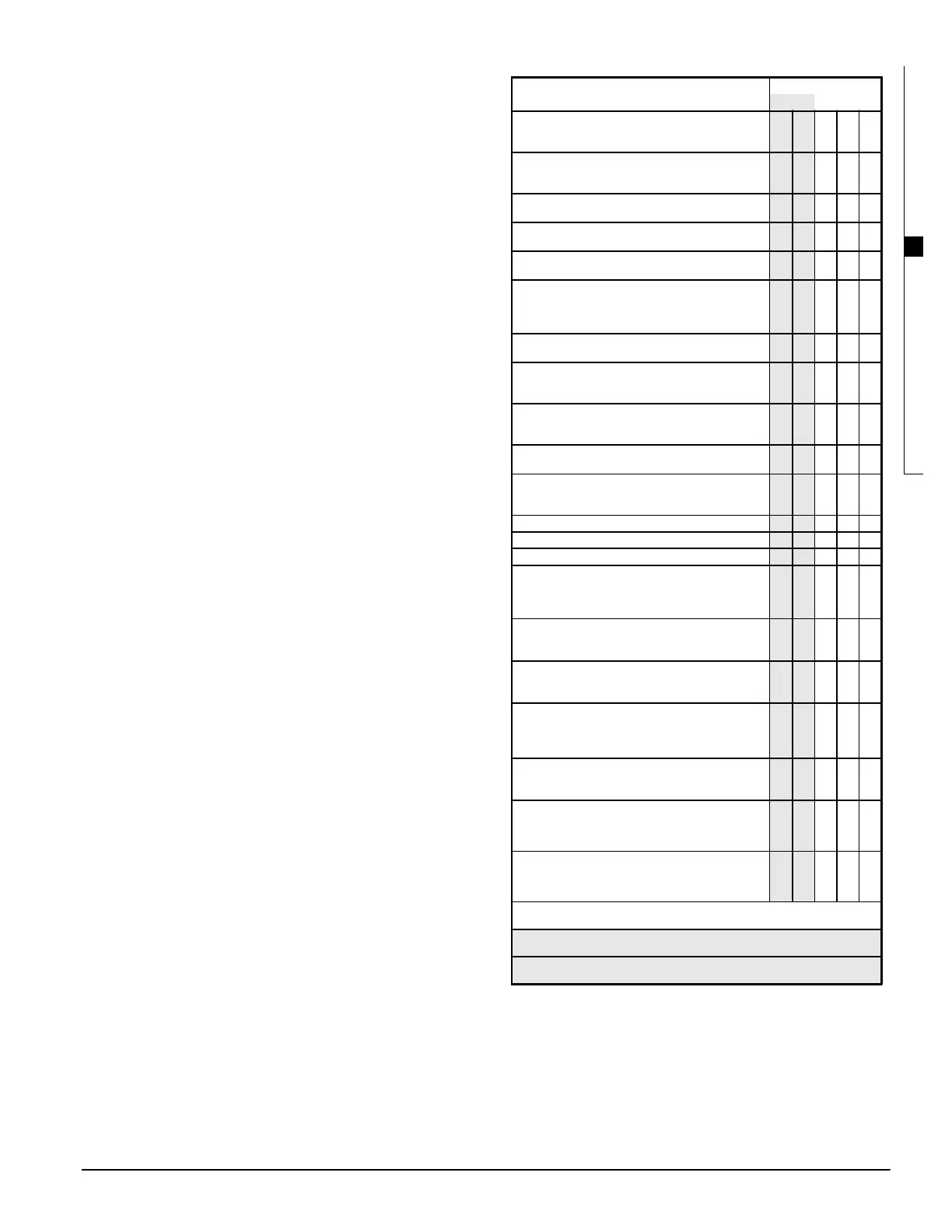
Access Code User Options
Default Settings*
GM 2M SM S AC
System Master
Select this option to program a Grand System Master
Code
Ye s
Supervisor
Select this option to program a Supervisor code. You
must also
program the partition mask for this code.
Yes
**
Ye s
Arm
Allows arming of the
assigned partition(s).
Ye s Ye s Ye s Ye s Ye s
Disarm
Allows disarming of the
assigned partition(s).
Ye s Ye s Ye s Ye s Ye s
Bypass
Allows bypassing of zones on the
assigned partition(s).
Ye s Ye s Ye s Ye s Ye s
Command Output
Allows activation of a [*][7][X] command output when an
access code is required. For more information, ask your
installer.
Ye s Ye s Ye s Ye s Ye s
Duress Pulse
Select option for Duress codes only.
One-Time Use
Select option for One-Time Use codes only (see
"Special Codes")
Escort4580 Access
Allows access to the Escort4580 audio assistant, if
installed.
Ye s Ye s Ye s Ye s Ye s
Global Access
Allows use of a Global keypad.
Ye s Ye s Ye s Ye s Ye s
Partition Select Menu
Allows all accessible partitions to be viewed when the
code is entered.
Ye s Ye s Ye s Ye s Ye s
Card Valid For Access Control Systems only.
Ye s Ye s Ye s Ye s Ye s
Privilege Card (same as previous)
Ye s Ye s
Wait for Prvl (same as previous)
Silence Fire
Allows the user to silence and reset any Fire Alarms on
the selected partitions by entering their access code on
the partition keypad.
Ye s Ye s Ye s Ye s Ye s
T-Code
T-codes can be turned on or off by partition using
the “Special - T-code” function key.
Telephone Number
If a PC4850 Telephone Entry module is connected,
enter a 12-digit telephone number for each user.
Tenant Code
If a PC4850 Telephone Entry module is connected,
enter a 4-digit tenant code (tenant codes cannot
start with 0).
Change Code
When this option is enabled, the user will only be
allowed to change their access code.
No No No No No
Disarm Delay
When this option is enabled, the user will not be able to
disarm the partition immediately. A delay will occur before
disarming (see Section 8.4).
No No No No No
Group Bypass
When this option is enabled, the user will be able to bypass
a group of zones that are set up for Group Bypassing (see
Section 5.5).
Ye s Ye s Ye s No N o
* Code abbreviations: GM = Grand System Master; 2M = Second Master;
SM = System Master; S = Supervisor; AC = Access Code (default).
The options for the Grand System Master and Second Master codes cannot be
changed from their default settings.
**For the System Master code, the supervisor option changes to Yes after you exit
access code programming.


 To Next Page