FCC COMPLIANCE STATEMENT
CAUTION: Changes or modifications not expressly approved by Digital Security Controls Ltd. could
void your authority to use this equipment.
This equipment has been tested and found to comply with the limits for a Class B digital device, pursuant to
Part 15 of the FCC Rules. These limits are designed to provide reasonable protection against harmful inter-
fer-ence in a residential installation. This equipment generates, uses and can radiate radio frequency energy
and, if not installed and used in accordance with the instructions, may cause harmful interference to radio
communications. However, there is no guarantee that interference will not occur in a particular installation.
If this equipment does cause harmful interference to radio or television reception, which can be deter-mined
by turning the equipment off and on, the user is encouraged to try to correct the interference by one or more
of the following measures:
• Re-orient the receiving antenna.
• Increase the separation between the equipment and receiver.
• Connect the equipment into an outlet on a circuit different from that to which the receiver is con-
nected.
• Consult the dealer or an experienced radio/television technician for help.
The user may find the following booklet prepared by the FCC useful: "How to Identify and Resolve Ra-
dio/Television Interference Problems". This booklet is available from the U.S. Government Printing Of-
fice, Wash-ington D.C. 20402, Stock # 004-000-00345-4.
IMPORTANT INFORMATION
This equipment complies with Part 68 of the FCC Rules. On the side of this equipment is a label that con-
tains, among other information, the FCC registration number and ringer equivalence number (REN) for
this equipment. If requested, this number must be provided to the Telephone Company.
FCC Registration Number: F53CAN-20836-AL-E
REN: 0.1B
USOC Jack: RJ-31X
Telephone Connection Requirements
A plug and jack used to connect this equipment to the premises wiring and telephone network must com-
ply with the applicable FCC Part 68 rules and requirements adopted by the ACTA. A compliant telephone
cord and modular plug is provided with this product. It is designed to be connected to a compatible mod-
ular jack that is also compliant. See installation instructions for details.
Ringer Equivalence Number (REN)
The REN is used to determine the number of devices that may be connected to a telephone line. Excessive
RENs on a telephone line may result in the devices not ringing in response to an incoming call. In most but
not all areas, the sum of RENs should not exceed five (5.0). To be certain of the number of devices that may
be connected to a line, as determined by the total RENs, contact the local Telephone Company. For products
approved after July 23, 2001, the REN for this product is part of the product identifier that has the format.
US: AAAEQ##TXXXX. The digits represented by ## are the REN without a decimal point (e.g., 03 is a
REN of 0.3). For earlier products, the REN is separately shown on the label.
Incidence of Harm
If this equipment PC4020 causes harm to the telephone network, the telephone company will notify you
in advance that temporary discontinuance of service may be required. But if advance notice is not practi-
cal, the Telephone Company will notify the customer as soon as possible. Also, you will be advised of
your right to file a complaint with the FCC if you believe it is necessary.
Changes in Telephone Company Equipment or Facilities
The Telephone Company may make changes in its facilities, equipment, operations or procedures that
could affect the operation of the equipment. If this happens the Telephone Company will provide advance
notice in order for you to make necessary modifications to maintain uninterrupted service.
Equipment Maintenance Facility
If trouble is experienced with this equipment PC4020, for repair or warranty information, please contact
the facility indicated below. If the equipment is causing harm to the telephone network, the Telephone
Company may request that you disconnect the equipment until the problem is solved. This equipment is
of a type that is not intended to be repaired by the end user.
Tyco Atlanta Distribution Center, 2600 West Pointe Drive, Lithia Springs, GA 30122. U.S
Additional Information
Connection to party line service is subject to state tariffs. Contact the state public utility commission, pub-
lic service commission or corporation commission for information.
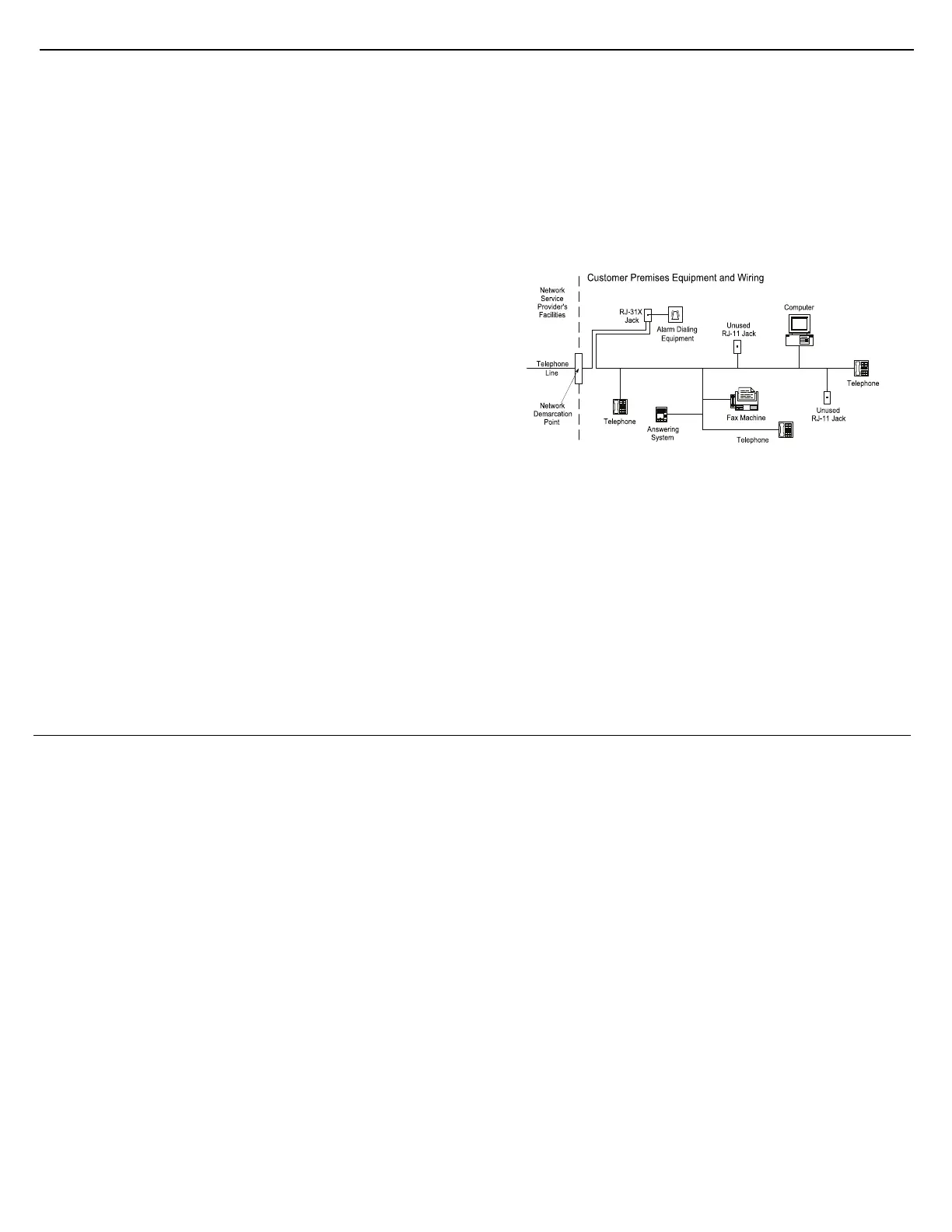
Alarm dialing equipment must be able to seize the telephone line and place a call in an emergency situa-
tion. It must be able to do this even if other equipment (telephone, answering system, computer modem,
etc.) already has the telephone line in use. To do so, alarm dialing equipment must be connected to a prop-
erly installed RJ-31X jack that is electrically in series with and ahead of all other equipment attached to
the same telephone line. Proper installation is depicted in the figure below. If you have any questions con-
cerning these instructions, you should consult your telephone company or a qualified installer about in-
stalling the RJ-31X jack and alarm dialing equipment for you.
Innovation, Scientific, and Economic Development Canada (ISED)
Statement
NOTICE: This Equipment, PC4020/PC4020CF, meets the applicable ISED Canada Terminal Equipment
Technical Specifications. This is confirmed by the registration number. The abbreviation, IC, before the
registration number signifies that registration was performed based on a Declaration of Conformity indicat-
ing that ISED Canada techni-cal specifications were met. It does not imply that Industry ISED approved the
equip-ment.
NOTICE: The Ringer Equivalence Number (REN) for this terminal equipment is 0.1. The REN assigned to
each terminal equipment provides an indication of the maxi-mum number of terminals allowed to be con-
nected to a telephone interface. The ter-mination on an interface may consist of any combination of devices
subject only to the requirement that the sum of the Ringer Equivalence Numbers of all devices does not
exceed five.
L’indice d’équivalence de la sonnerie (IES) sert à indiquer le nombre maximal de ter-minaux qui peuvent
être raccordés à une interface télépho-nique. La terminaison d’une interface peut consister en une combinai-
son quelconque de dispositifs, à la seule condition que la somme d’indices d’équivalence de la sonnerie de
tous les dis-positifs n’excède pas 5.


 To Next Page